
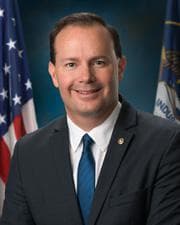
U.S. Senator
Mike Lee
Utah
RepublicanVery Conservative
Organization Ties
Votes on Record
703
across 19 categories
Contact
U.S. Senator
Utah
Organization Ties
Votes on Record
703
across 19 categories
Contact
Voting Profile
Most Active Policy Areas
703
Votes Analyzed
Data sources: voteview, congress.gov
Political Position
Measured by his votes, he is one of the more conservative members of his party, not a moderate within it.
More conservative than the average Republican (0.52)
Data source: VoteView NOMINATE scores (UCLA/UC San Diego)
Policy Positions
703
total votes analyzed
At a Glance
Mike Lee is a Republican U.S. Senator from Utah with 703 recorded votes in this dataset. His ideology score of 0.891 puts him well to the right of the Republican Party average of 0.520. One thing to know about this data: a 'Yea' share does not show whether he supports a policy area. Many Senate votes are on procedure, amendments, nominations, or efforts to cancel agency rules, so a 'Yea' can mean very different things depending on what was being voted on. The individual votes below say more about his positions than the percentages do.
A large part of his record consists of votes on nominees for executive branch posts and federal judgeships. He voted Yea on every sample nomination provided. These included federal judge Matthew R. Byrne, Erica Schwartz as CDC Director, Walter Clayton as Director of National Intelligence, and a group of Treasury Department nominees. He also voted Yea on a bill setting rules for college athletes' name, image, and likeness rights.
On health care, environment, and regulation, his recent votes kept several agency rules in place rather than cancelling them. Congress can use a 'joint resolution of disapproval' to cancel a rule a federal agency has issued. He voted Nay on resolutions to cancel a Medicare prior-authorization rule, an EPA rule changing the timeline for PFAS chemical reporting, and an HHS child care funding rule. He also voted Nay on a Democratic-style proposal to block budget legislation that did not lower out-of-pocket health care costs.
On defense and foreign policy, he voted Yea on the annual defense authorization bill for fiscal year 2027. He voted Nay twice on resolutions directing the removal of U.S. forces from hostilities against Iran that Congress had not authorized. In a trade-related vote, he opposed removing a provision that placed tariffs on countries buying Russian oil or gas. His Nay votes outnumber his Yea votes in trade (4 of 6), defense (38 of 67), and health care (44 of 82). His Yea rates are high in agriculture, foreign policy, and immigration.
He voted Nay twice in July 2026 on joint resolutions that would have directed the removal of U.S. Armed Forces from hostilities with Iran that Congress had not authorized.
He voted Yea on the fiscal year 2027 National Defense Authorization Act, the yearly bill that sets defense policy and spending levels.
He voted Yea on the sample executive and judicial nominees provided, including CDC Director Erica Schwartz, Director of National Intelligence Walter Clayton, and federal judge Matthew R. Byrne.
He voted Nay on resolutions that would have cancelled three agency rules: a Medicare prior-authorization rule (the WISeR Model), an EPA rule on PFAS reporting deadlines, and an HHS child care funding rule. Each of those rules stayed in effect.
He voted Nay on a proposed rule of procedure (a 'point of order') that would have blocked budget reconciliation legislation unless it lowered out-of-pocket health care costs.
He voted Nay on an amendment to strike a provision placing duties on countries that buy Russian crude oil or natural gas, which means he voted to keep that provision.
He voted Yea on a bill to protect college athletes' name, image, and likeness rights and to set rules for competition in college sports.
Yes/no split for each topic is on the Congressional Votes cards below.
Analysis updated: October 6, 2026
Campaign Finance
Includes all authorized campaign committees (principal committee, joint fundraising, and other authorized committees). Outside spending by Super PACs and independent groups is shown separately below.
Verify on FEC.gov →Career: $28.1M
Fundraising Over Time
Contribution Sources
96%
4%
Individual Breakdown
Itemized (>$200)
$3.0M
Small Dollar (≤$200)
$3.9M
Donation Sizes
Share of individual contribution dollars by donation size, current election cycle.
Where the Money Comes From
Itemized individual contributions only (donations over $200 report the donor's state). Small-dollar donations are not included because the FEC does not itemize them.
Top Contributors
Top Contributing Industries
Top Donor Employers
Employer as self-reported by itemized donors. “Not Employed” and “Self-Employed” typically rank highest for small-dollar campaigns and include retirees.
Where the Money Goes
Spending by Purpose
Purpose categories are self-reported on FEC filings; large “Other” totals are common.
Top Payees
TAG LLC
WINRED TECHNICAL SERVICES LLC
AMERICAN EXPRESS
PARIA POINT MEDIA & CONSULTING
L4 CONSULTING LLC
ROOST COMPANY
AXCAPITAL, LLC
THE ULLR GROUP
Detailed Breakdown
Expenditures
Operating Costs
$7.2M
Operating Offsets
$70K
Net Operating
$7.2M
Refunds
Individual Refunds
$348K
Committee Refunds
$3K
Outside Spending (Super PACs)
Supporting
$6.6M
Opposing
$4.6M
Total Outside Spending
$11.2M
Top Outside Spenders
PUT UTAH FIRST PAC
LIBERTY CHAMPIONS
CLUB FOR GROWTH ACTION
AMERICANS FOR PROSPERITY ACTION, INC. (AFP ACTION) DBA CVA ACTION AND DBA LIBRE ACTION
PROTECT FREEDOM POLITICAL ACTION COMMITTEE
SENATE CONSERVATIVES FUND
CRYPTO FREEDOM PAC
Independent expenditures are made without coordination with the candidate. Source: FEC Schedule E filings.
Voting Record
703 votes across 19 categories
Bars show how they voted on the key bills we analyzed in each topic. Tap a card to see every vote.