
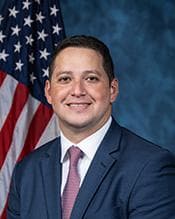
U.S. Representative
Tony Gonzales
Texas District 23
RepublicanConservative
Votes on Record
351
across 19 categories
Contact
Contact information not yet available
U.S. Representative
Texas District 23
Votes on Record
351
across 19 categories
Contact
Contact information not yet available
Voting Profile
Most Active Policy Areas
351
Votes Analyzed
Data sources: voteview, congress.gov
Political Position
The average House Republican scores about 0.520, so he is more moderate than a typical member of his party, though he still sits clearly within the Republican range.
More liberal than the average Republican (0.52)
Data source: VoteView NOMINATE scores (UCLA/UC San Diego)
Policy Positions
351
total votes analyzed
At a Glance
Tony Gonzales is a Republican who represents Texas in the U.S. House. This profile covers 351 recorded votes. He voted Yea on 245 and Nay on 72. The remaining roughly 34 votes, about 10% of the total, were recorded as Not Voting or did not fall into either column. His ideology score shows a conservative voting record that is less conservative than his party's average. Members with scores like his are often described as more center-leaning Republicans.
He votes Yea on most of the measures in this data. That includes about 73% of votes in the broad 'other' category, 73% on environment and energy, 73% on budget, and 67% on defense. He voted Yea on every recorded criminal justice vote (8 of 8) and every recorded technology vote (5 of 5). Healthcare is the main exception, with more Nay votes (14) than Yea votes (9). The healthcare votes shown include procedural motions. For example, he voted Nay on 'motions to recommit' for the Do No Harm in Medicaid Act and the Lower Health Care Premiums for All Americans Act. A motion to recommit is a last-minute attempt, usually by the minority party, to send a bill back for changes. Members of the majority party usually vote against these motions.
Many of the most recent votes shown, from March and April 2026, are recorded as Not Voting. They include the Department of Homeland Security Appropriations Act, 2026 (March 5 and March 27), a proposed balanced budget constitutional amendment (March 18), the Pay Our Homeland Defenders Act (March 26), and the ALERT Act and Emergency Conservation Program Improvement Act (April 14). The data does not explain why these votes were missed. Voters who want to know may wish to look at public records or statements from that period.
Some votes in this record are procedural, such as votes on 'rules' that set how a bill will be debated. Because of this, a Yea or Nay in a category does not always mean he supported or opposed the main policy itself. Committee assignment information was not available for this profile.
He voted Yea on all 8 recorded criminal justice votes, making it one of his most consistent categories.
On healthcare he voted Nay more often than Yea (14 to 9). In December 2025 this included Nay votes on minority-party motions to recommit the Do No Harm in Medicaid Act and the Lower Health Care Premiums for All Americans Act. He voted Yea on the procedural vote to move forward with debate on those bills.
He voted Nay on the Veterans Accessibility Advisory Committee Act (S. 1383) on February 11, 2026. The same day, he voted Yea on the rule that brought that bill and several others to the floor.
He voted Yea on the Veterans Readiness and Employment Improvement Act on February 2, 2026.
He did not vote on several spring 2026 measures: both recorded votes on the Department of Homeland Security Appropriations Act, 2026, the balanced budget constitutional amendment, and the Pay Our Homeland Defenders Act.
He voted Yea on all 5 recorded technology votes and on 4 of 5 taxation votes.
On immigration he voted Yea on 5 of 7 recorded votes and Nay on 2.
Yes/no split for each topic is on the Congressional Votes cards below.
Analysis updated: October 6, 2026
Campaign Finance
Includes all authorized campaign committees (principal committee, joint fundraising, and other authorized committees). Outside spending by Super PACs and independent groups is shown separately below.
Verify on FEC.gov →Career: $15.4M
Fundraising Over Time
Contribution Sources
64%
36%
Individual Breakdown
Itemized (>$200)
$830K
Small Dollar (≤$200)
$29K
Donation Sizes
Share of individual contribution dollars by donation size, current election cycle.
Where the Money Comes From
Itemized individual contributions only (donations over $200 report the donor's state). Small-dollar donations are not included because the FEC does not itemize them.
Top Contributors
Top Contributing Industries
Top Donor Employers
Employer as self-reported by itemized donors. “Not Employed” and “Self-Employed” typically rank highest for small-dollar campaigns and include retirees.
Where the Money Goes
Spending by Purpose
Purpose categories are self-reported on FEC filings; large “Other” totals are common.
Top Payees
SRCP MEDIA
LILLY & COMPANY
THE SYNAPSE GROUP
THOMAS GRAPHICS
TARGETED VICTORY
PUBLIC OPINION STRATEGIES
HEARST NEWSPAPERS
AMERICAN EXPRESS
Detailed Breakdown
Expenditures
Operating Costs
$3.0M
Operating Offsets
$39.55
Net Operating
$3.0M
Refunds
Individual Refunds
$432K
Committee Refunds
$70K
Outside Spending (Super PACs)
Supporting
$2.8M
Opposing
$5.8M
Total Outside Spending
$8.6M
Top Outside Spenders
HOUSE MAJORITY PAC
DCCC
VOTEVETS
ELECT PRINCIPLED VETERANS FUND (EPV FUND)
HISPANIC LEADERSHIP ALLIANCE
NATIONAL ASSOCIATION OF REALTORS POLITICAL ACTION COMMITTEE
EVERYTOWN FOR GUN SAFETY VICTORY FUND (EVERYTOWN VICTORY FUND)
WITH HONOR FUND, INC.
Independent expenditures are made without coordination with the candidate. Source: FEC Schedule E filings.
Voting Record
351 votes across 19 categories
Bars show how they voted on the key bills we analyzed in each topic. Tap a card to see every vote.