
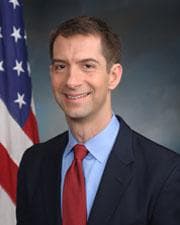
U.S. Senator
Tom Cotton
Arkansas
RepublicanConservative
Votes on Record
694
across 19 categories
Contact
U.S. Senator
Arkansas
Votes on Record
694
across 19 categories
Contact
Voting Profile
Most Active Policy Areas
694
Votes Analyzed
Data sources: voteview, congress.gov
Political Position
He sits within the mainstream of his party, not at its edge.
Near the average for Republicans (0.52)
Data source: VoteView NOMINATE scores (UCLA/UC San Diego)
Policy Positions
694
total votes analyzed
At a Glance
Tom Cotton is a Republican U.S. Senator from Arkansas with 694 recorded votes in this dataset. Committee assignments were not included in the data. His votes are spread across many policy areas. The largest groups are procedural and miscellaneous votes (228), environment and energy (81), healthcare (72), defense (67), and foreign policy (54). Overall he votes 'yea' more often than 'nay'. His yea rates are highest on foreign policy (98.1%), miscellaneous votes (91.2%), and immigration (85.2%). They are lowest on trade (33.3%), defense (56.7%), and healthcare (58.3%).
A 'yea' does not always mean support for a policy, and a 'nay' does not always mean opposition. Many Senate votes ask whether to overturn, block, or change something. For example, the Senate held several votes under the Congressional Review Act (CRA). A CRA resolution lets Congress cancel a rule written by a federal agency. Cotton voted 'nay' on CRA resolutions to cancel an EPA rule on reporting deadlines for PFAS (often called 'forever chemicals'). He also voted 'nay' on resolutions to cancel an HHS rule on child care funding and a Medicare rule on prior authorization, which is a requirement to get approval before certain services are covered. In each case his vote kept the agency rule in place. On defense, he twice voted 'nay' on resolutions that would have required U.S. forces to be removed from hostilities with Iran that Congress had not authorized. He voted 'yea' on the Fiscal Year 2027 National Defense Authorization Act (NDAA), the yearly bill that sets defense policy and spending.
A large share of his 'yea' votes are on presidential nominations. Recent examples include a federal district judge in Ohio, the Director of the Centers for Disease Control and Prevention, the Director of National Intelligence, and a group of Treasury Department officials. His most recent recorded vote, on September 15, 2026, was 'yea' on a bill to protect college athletes' name, image, and likeness rights. These are the rights of student athletes to earn money from their personal brand.
The data has some limits. Votes were sorted into categories automatically, and some placements look imperfect. For instance, a child care rule appears under environment and energy, and Treasury nominations appear under foreign policy. In a few categories the yea and nay counts add up to slightly less than the total, which usually means he did not vote or voted 'present' on those items. Several categories have only a few votes, so patterns there should be read with caution.
Opposed limiting U.S. military action against Iran: he voted 'nay' twice (July 23 and July 30, 2026) on joint resolutions to remove U.S. Armed Forces from hostilities with Iran that Congress had not authorized.
Supported the yearly defense policy bill: he voted 'yea' on the Fiscal Year 2027 National Defense Authorization Act on July 14, 2026.
Kept Russia-related trade penalties in a bill: on August 7, 2026, he voted 'nay' on an amendment to strike a provision placing duties (import taxes) on countries that buy Russian oil or natural gas or help evade sanctions.
Voted to keep several recent agency rules in place: he voted 'nay' on CRA resolutions to overturn an EPA rule on PFAS reporting deadlines, an HHS child care funding rule, and a Medicare prior authorization rule (the WISeR Model).
Opposed a healthcare-related procedural challenge to budget legislation: on April 22, 2026, he voted 'nay' on a point of order (a formal objection that can block a bill) against reconciliation legislation that did not address insurance companies delaying or denying patient care. Reconciliation is a fast-track budget process.
Voted 'yea' on nearly all foreign policy votes in this dataset (53 of 54, or 98.1%). Most of these were nominations, including Walter Clayton as Director of National Intelligence.
Regularly voted to confirm nominees: recent examples include Erica Schwartz as CDC Director and Matthew R. Byrne as a U.S. District Judge for the Southern District of Ohio.
Supported a bill on college athletes' name, image, and likeness (NIL) rights and competition among college athletic programs (September 15, 2026).
Yes/no split for each topic is on the Congressional Votes cards below.
Analysis updated: October 6, 2026
Voting Record
694 votes across 19 categories
Bars show how they voted on the key bills we analyzed in each topic. Tap a card to see every vote.