
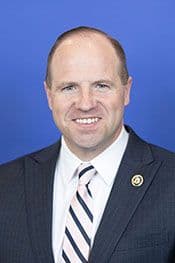
U.S. Representative
Timothy M. Kennedy
New York District 26
DemocratProgressive
Votes on Record
454
across 19 categories
Contact
U.S. Representative
New York District 26
Votes on Record
454
across 19 categories
Contact
Voting Profile
Most Active Policy Areas
454
Votes Analyzed
Data sources: voteview, congress.gov
Political Position
The 0.004 gap is technically on the conservative side, but it is too small to matter, so his voting pattern closely matches that of a typical Democrat in the House.
Near the average for Democrats (-0.38)
Data source: VoteView NOMINATE scores (UCLA/UC San Diego)
Policy Positions
454
total votes analyzed
At a Glance
Timothy M. Kennedy represents New York in the U.S. House of Representatives as a Democrat. This profile covers 454 recorded votes. His ideology score is nearly identical to his party's average, which suggests that across hundreds of votes he generally votes the way most House Democrats do. Committee information was not available for this profile.
He voted 'yes' on fewer than half of the measures in several areas: budget (4 of 22, or 18%), environment and energy (12 of 34, or 35%), housing (3 of 8) and banking and finance (1 of 3). He voted 'yes' more often on foreign policy (9 of 11), labor (4 of 5), taxation (8 of 11), technology (7 of 10) and defense (17 of 25). These percentages count 'yes' votes only. They do not show whether he supported or opposed a policy goal. Voting 'no' on a bill can mean opposing the policy, objecting to how the bill is written, or disagreeing with how the majority party brought it to the floor. A low 'yes' rate therefore does not by itself show opposition to the subject area.
His recent votes include a mix of positions. He voted for the Water Resources Development Act, the Ratepayer Protection Act, the Take Care of America's Veterans Act, the Prison Staff Safety Enhancement Act and the National Fraud Enforcement Division Act. He voted against the fiscal year 2027 congressional budget resolution, a fiscal year 2027 continuing appropriations measure (temporary funding that keeps the government running) and the PROOF Act. On war powers, he voted on two resolutions about U.S. forces in Lebanon and voted differently on each: 'no' in June 2026 and 'yes' in July 2026.
One limitation applies to the whole profile. More than half of his votes (276 of 454) fall into an 'other' category, and sample votes were provided for only five categories. Conclusions about the smaller categories rest on vote counts alone, without information on the specific bills.
He voted against the fiscal year 2027 congressional budget resolution (July 22, 2026) and against a fiscal year 2027 continuing appropriations measure (July 21, 2026). Overall he voted 'yes' on 4 of 22 budget-related measures.
He voted on two War Powers Resolution measures about U.S. forces in Lebanon. He voted 'no' on one directing removal of U.S. forces from Lebanon (June 4, 2026) and 'yes' on another directing removal from hostilities in Lebanon (June 30, 2026). The two resolutions had different wording, which may explain the different votes.
He voted 'no' on a recorded vote tied to a resolution to impeach President Donald Trump (September 15, 2026). House votes on impeachment resolutions are often procedural, such as a motion to set the resolution aside. The data provided does not say whether this was a vote on the resolution itself or on a procedural motion.
On energy and environment, he voted for the Ratepayer Protection Act and the Water Resources Development Act. He voted against a resolution that would have overturned an EPA decision on California's pollution standards for commercial harbor craft (September 16, 2026).
He voted for the Take Care of America's Veterans Act (July 16, 2026) and voted 'yes' on 17 of 25 defense-related measures overall.
On criminal justice, he voted for the Prison Staff Safety Enhancement Act and for a resolution honoring law enforcement officers killed in the line of duty.
He voted for a measure extending the time that certain North Atlantic right whale regulations remain in effect under the Consolidated Appropriations Act, 2023 (September 1, 2026). This was one of only four budget-category measures he supported.
Yes/no split for each topic is on the Congressional Votes cards below.
Analysis updated: October 6, 2026
Voting Record
454 votes across 19 categories
Bars show how they voted on the key bills we analyzed in each topic. Tap a card to see every vote.