
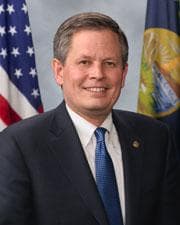
U.S. Senator
Steve Daines
Montana
RepublicanConservative
Votes on Record
694
across 19 categories
Contact
U.S. Senator
Montana
Votes on Record
694
across 19 categories
Contact
Voting Profile
Most Active Policy Areas
694
Votes Analyzed
Data sources: voteview, congress.gov
Political Position
The Republican average is 0.520, which makes him somewhat more conservative than the typical Republican, though not by a wide margin.
Near the average for Republicans (0.52)
Data source: VoteView NOMINATE scores (UCLA/UC San Diego)
Policy Positions
694
total votes analyzed
At a Glance
This profile is based on 694 recorded Senate votes, with the most recent examples from mid-2025 through September 2026. The largest group of votes (228) falls under 'other,' which is mostly nominations and general legislation. Senator Daines voted Yea on 90.8% of those. His recent votes include confirming a federal district judge for Ohio and supporting a bill on name, image, and likeness (NIL) rights for college athletes, meaning athletes' right to be paid when their name or image is used. He also voted Yea on 98.1% of the 54 votes labeled 'foreign policy.' The sample votes in that group are mostly executive-branch confirmations, such as the Director of National Intelligence and a group of Treasury Department nominees. Together these patterns show consistent support for the current administration's nominees.
On defense, he voted for the Fiscal Year 2027 National Defense Authorization Act, the yearly bill that sets military funding and policy. He also voted twice (July 23 and July 30, 2026) against joint resolutions that would have ordered U.S. forces out of hostilities with Iran that Congress had not authorized. Supporters of those resolutions argued that Congress should approve military action. Opponents argued that the President needs flexibility as commander in chief. In healthcare, he voted to confirm Erica Schwartz as CDC Director. He voted against a resolution that would have overturned a Medicare rule on prior authorization, the requirement that some services be approved before Medicare pays for them. He also voted against a procedural challenge (a 'point of order,' a formal objection that a bill breaks Senate rules) that would have targeted a budget reconciliation bill for not addressing insurers delaying or denying care.
On environmental and regulatory matters, he voted against resolutions that would have overturned an EPA rule changing when PFAS reporting begins (PFAS are long-lasting industrial chemicals sometimes called 'forever chemicals') and an HHS rule on child care funding flexibility. A vote against these resolutions is a vote to keep the existing rules in place. He also voted against an amendment that would have removed tariffs (import taxes) on countries that buy Russian oil or gas. In other words, he voted to keep those tariffs. His Yea rates are high on budget (83.0%), immigration (85.2%), housing (92.3%), infrastructure (84.6%), and agriculture (90.0%). They are lower on healthcare (57.5%), defense (56.7%), and trade (33.3%).
Voters should know three limits of this data. First, a 'Yea' is not always a vote for a policy. Voting Yea on a motion to block or overturn something is a vote against that thing, so Yea percentages alone don't show his views. Second, votes were sorted into categories automatically, and some placements are imperfect. For example, the child care rule appears under 'environment energy' and Treasury nominations appear under 'foreign policy.' Third, committee assignments were not available, and several topics have very few votes, including reproductive rights (1), firearms (2), and technology (3).
Voted twice in July 2026 (July 23 and July 30) against joint resolutions that would have required U.S. forces to be withdrawn from hostilities with Iran that Congress had not authorized.
Voted for the Fiscal Year 2027 National Defense Authorization Act, the yearly bill that authorizes military spending and sets defense policy (July 14, 2026).
Consistently voted to confirm administration nominees, including Walter Clayton as Director of National Intelligence, Erica Schwartz as CDC Director, a group of Treasury Department officials, and federal district judge Matthew Byrne.
Voted against congressional resolutions to overturn several agency rules, which kept those rules in place. These included an EPA rule changing the PFAS reporting timeline, a Medicare prior-authorization model, and an HHS child care funding rule.
Voted against an amendment to remove tariffs on countries that buy Russian-origin oil or natural gas, so he supported keeping that provision in the bill (August 7, 2026).
Voted against a point of order (a procedural objection) that would have challenged a budget reconciliation bill for not addressing insurance companies delaying or denying patient care (April 22, 2026).
Voted for legislation to protect name, image, and likeness (NIL) rights for student athletes and set rules for competition in college sports (September 15, 2026).
Yes/no split for each topic is on the Congressional Votes cards below.
Analysis updated: October 6, 2026
Campaign Finance
Includes all authorized campaign committees (principal committee, joint fundraising, and other authorized committees). Outside spending by Super PACs and independent groups is shown separately below.
Verify on FEC.gov →Career: $49.4M
Fundraising Over Time
Contribution Sources
54%
45%
1%
Individual Breakdown
Itemized (>$200)
$2.3M
Small Dollar (≤$200)
$646K
Donation Sizes
Share of individual contribution dollars by donation size, current election cycle.
Where the Money Comes From
Itemized individual contributions only (donations over $200 report the donor's state). Small-dollar donations are not included because the FEC does not itemize them.
Top Contributors
Top Contributing Industries
Top Donor Employers
Employer as self-reported by itemized donors. “Not Employed” and “Self-Employed” typically rank highest for small-dollar campaigns and include retirees.
Where the Money Goes
Spending by Purpose
Purpose categories are self-reported on FEC filings; large “Other” totals are common.
Top Payees
AMERICAN EXPRESS
ALME VICTORY
ELEVATED GROUP LLC
ENVISION MARKETING
S2R PUBLIC AFFAIRS
MAYBELL GROUP LLC
HIGHWOOD CAPITAL LLC
ALLEGIANCE DIRECT LLC
Detailed Breakdown
Expenditures
Operating Costs
$3.6M
Operating Offsets
$505K
Net Operating
$3.1M
Transfers
Transfers Out
$3K
Refunds
Individual Refunds
$1.0M
Committee Refunds
$643K
Outside Spending (Super PACs)
Supporting
$6.7M
Opposing
$47.1M
Total Outside Spending
$53.8M
Top Outside Spenders
DSCC
SMP
LCV VICTORY FUND
AMERICANS FOR PROSPERITY ACTION, INC.(AFP ACTION)
MONTANA HUNTERS AND ANGLERS LEADERSHIP FUND
EDF ACTION VOTES
NATIONAL ASSOCIATION OF REALTORS CONGRESSIONAL FUND
END CITIZENS UNITED
Independent expenditures are made without coordination with the candidate. Source: FEC Schedule E filings.
Voting Record
694 votes across 19 categories
Bars show how they voted on the key bills we analyzed in each topic. Tap a card to see every vote.