
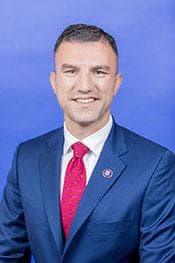
U.S. Representative
Rudy Yakym
Indiana District 2
RepublicanConservative
Votes on Record
464
across 19 categories
Contact
U.S. Representative
Indiana District 2
Votes on Record
464
across 19 categories
Contact
Voting Profile
Most Active Policy Areas
464
Votes Analyzed
Data sources: voteview, congress.gov
Political Position
He is technically 0.006 points more liberal than the average, but that gap is too small to separate him from typical House Republicans in any meaningful way.
Near the average for Republicans (0.52)
Data source: VoteView NOMINATE scores (UCLA/UC San Diego)
Policy Positions
464
total votes analyzed
At a Glance
Rudy Yakym is a Republican member of the U.S. House of Representatives from Indiana. This profile draws on 464 recorded votes. More than half of them (275) are in a general 'other' category, so the topic-by-topic picture is based on smaller numbers of votes. His ideology score is almost identical to the Republican average, which suggests that on the votes this measure captures, he usually votes the way most of his party does.
He voted 'Yea' (yes) on most bills in several economic and domestic areas: energy and environment (31 of 34), budget (21 of 24), taxation (10 of 11), housing (7 of 8), technology (10 of 10), and infrastructure (5 of 5). In September 2026 he voted for the Ratepayer Protection Act and the Water Resources Development Act. He also voted for a resolution using the Congressional Review Act to overturn an Environmental Protection Agency (EPA) decision on California's pollution standards for commercial harbor boats. The Congressional Review Act lets Congress cancel a rule issued by a federal agency. On the budget, he voted for the fiscal year 2027 budget resolution and for a continuing resolution, which is a temporary bill that keeps the government funded while Congress works on full-year spending.
He voted 'Nay' (no) more often than 'Yea' in a few areas: labor (4 of 5 votes were Nay), foreign policy (7 of 11), and healthcare (5 of 9). On defense, he voted Nay on two War Powers Resolution measures in June 2026 that would have directed the President to remove U.S. armed forces from hostilities in, or from, Lebanon. The War Powers Resolution is a 1973 law that lets Congress direct the President to withdraw troops from conflicts Congress has not authorized. He also voted Nay on the Take Care of America's Veterans Act in July 2026.
One entry needs explaining. The data lists a 'Yea' vote on 2026-09-15 on a resolution to impeach President Donald Trump. The data does not say which question was being voted on. Impeachment resolutions brought by individual members are often decided by a 'motion to table', which is a vote to set the resolution aside. On that kind of vote, 'Yea' means voting to stop the resolution, not to support impeachment. Readers should check the official House roll call before drawing a conclusion from this entry. On other criminal justice votes, he voted Yea on all 13, including the Prison Staff Safety Enhancement Act and a resolution honoring law enforcement officers killed in the line of duty.
Voted against two War Powers Resolution measures (June 4 and June 30, 2026) that would have directed the President to remove U.S. armed forces from Lebanon or from hostilities there.
Voted to overturn an EPA decision approving California's pollution standards for commercial harbor boats (September 2026), and voted for the Ratepayer Protection Act. He voted Yea on 31 of 34 energy and environment votes.
Voted for the fiscal year 2027 congressional budget resolution (July 22, 2026) and for a continuing resolution to keep the government funded (July 21, 2026).
Voted Yea on all 13 criminal justice votes on record, including the Prison Staff Safety Enhancement Act. A listed 'Yea' on a September 15, 2026 impeachment resolution does not say which question was voted on, and may have been a procedural vote such as a motion to table.
Voted against the Take Care of America's Veterans Act (July 16, 2026).
Voted Nay on 4 of 5 labor votes and 7 of 11 foreign policy votes, his two highest 'no' rates of any category.
Voted for the National Fraud Enforcement Division Act, the PROOF Act, and the Retire through Ownership Act (all September 16, 2026).
Yes/no split for each topic is on the Congressional Votes cards below.
Analysis updated: October 6, 2026
Campaign Finance
Includes all authorized campaign committees (principal committee, joint fundraising, and other authorized committees). Outside spending by Super PACs and independent groups is shown separately below.
Verify on FEC.gov →Career: $10.1M
Fundraising Over Time
Contribution Sources
69%
31%
Individual Breakdown
Itemized (>$200)
$1.7M
Small Dollar (≤$200)
$1.2M
Donation Sizes
Share of individual contribution dollars by donation size, current election cycle.
Where the Money Comes From
Itemized individual contributions only (donations over $200 report the donor's state). Small-dollar donations are not included because the FEC does not itemize them.
Top Contributors
Top Contributing Industries
Top Donor Employers
Employer as self-reported by itemized donors. “Not Employed” and “Self-Employed” typically rank highest for small-dollar campaigns and include retirees.
Where the Money Goes
Spending by Purpose
Purpose categories are self-reported on FEC filings; large “Other” totals are common.
Top Payees
TARGETED VICTORY LLC
AMERICAN EXPRESS
HIGH POINT GROUP
814 CONSULTING LLC
NRCC
NATE, GRIFFIN
DANIELS SPAULDING CONSULTING LLC
WINRED TECHNICAL SERVICES
Detailed Breakdown
Expenditures
Operating Costs
$3.7M
Operating Offsets
$2K
Net Operating
$3.7M
Refunds
Individual Refunds
$176K
Committee Refunds
$1K
Outside Spending (Super PACs)
Supporting
$60K
Opposing
$0
Total Outside Spending
$60K
Top Outside Spenders
AMERICAN LEADERSHIP PAC
Independent expenditures are made without coordination with the candidate. Source: FEC Schedule E filings.
Voting Record
464 votes across 19 categories
Bars show how they voted on the key bills we analyzed in each topic. Tap a card to see every vote.