
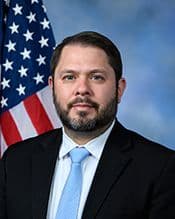
U.S. Senator
Ruben Gallego
Arizona
DemocratProgressive
Votes on Record
647
across 19 categories
Contact
U.S. Senator
Arizona
Votes on Record
647
across 19 categories
Contact
Voting Profile
Most Active Policy Areas
647
Votes Analyzed
Data sources: voteview, congress.gov
Political Position
The gap is only 0.022 points, though, so overall he votes very close to the center of his party.
Near the average for Democrats (-0.38)
Data source: VoteView NOMINATE scores (UCLA/UC San Diego)
Policy Positions
647
total votes analyzed
At a Glance
Ruben Gallego is a Democratic U.S. Senator from Arizona with 647 recorded votes. On most of them (570) he voted Yea or Nay. On 77 others (about 12%), he did not cast either vote; the sample votes mark some of these as 'not voting.' Across his Yea and Nay votes, he voted Yea about 33% of the time and Nay about 67% of the time. These percentages should be read with care. A Yea or Nay is a response to the specific bill, amendment, nomination, or resolution being voted on. A low Yea rate in a category does not mean he opposes that whole policy area. Votes are also sorted into categories automatically by keywords, so some land in categories where they don't obviously belong. For example, a resolution about a child care funding rule appears under Environment & Energy, and a group of Treasury Department nominees appears under Foreign Policy.
The largest group of his votes (221) falls under 'Other,' and he voted Nay on most of them (156 Nay, 36 Yea). The sample votes in this group include judicial nominations, such as two Nay votes on Matthew R. Byrne's nomination as a federal district judge in Ohio. They also include a Yea vote on a bill protecting college athletes' rights to earn money from their name, image, and likeness. Executive branch nominations show a similar pattern. He voted Nay on Walter Clayton for Director of National Intelligence and on a group of Treasury Department nominees.
On health care, he voted Yea a little more often than Nay (37 Yea, 28 Nay). His recent votes focus on how insurers and Medicare handle 'prior authorization,' which is when approval is required before a patient can receive a service. He voted to overturn a Medicare rule that tested prior authorization for selected services. He also supported a procedural challenge against a budget bill on the grounds that it did not address insurers delaying or denying care. On defense, his votes were roughly split (31 Yea, 21 Nay). He voted twice for resolutions directing the removal of U.S. forces from hostilities against Iran that Congress had not authorized. He also voted Nay on the Senate's version of the yearly defense policy bill for fiscal year 2027.
In several other areas he voted Nay more often than Yea. These include budget (12 Yea, 35 Nay), environment and energy (15 Yea, 43 Nay), banking and finance (3 Yea, 14 Nay), and immigration (8 Yea, 12 Nay). He voted Yea more often on housing (7 Yea, 2 Nay) and taxation (13 Yea, 7 Nay). The data provided does not show which party sponsored each measure or how other senators voted. Because of that, it can't say whether a given vote went with or against his party.
Iran war powers: He voted Yea twice (July 23 and July 30, 2026) on resolutions directing the removal of U.S. armed forces from hostilities against Iran that Congress had not authorized. These votes reflect a position that Congress, not only the President, should approve military action.
Defense policy bill: On July 14, 2026, he voted Nay on the Senate's original fiscal year 2027 National Defense Authorization Act. This is the yearly bill that sets defense programs and military pay levels. He voted Yea on 31 of 57 defense-related votes overall.
Prior authorization in health care: On July 16, 2026, he voted to overturn a Medicare rule that tested prior authorization (advance approval) for selected services. On April 22, 2026, he supported a procedural objection to a budget bill for not addressing insurers who delay or deny care.
Judicial and executive nominations: In the sample votes, he voted Nay on Matthew R. Byrne for federal district judge (twice), on Walter Clayton for Director of National Intelligence, and on a group of Treasury Department nominees. He did not vote on Erica Schwartz's nomination as CDC Director.
Overturning federal agency rules: He voted Yea on resolutions to overturn an EPA rule that changed when PFAS ('forever chemicals') reports are due (August 5, 2026) and a Health and Human Services rule on the Child Care and Development Fund (July 30, 2026).
Russian energy sanctions: On August 7, 2026, he voted Yea on an amendment to remove a provision that would have placed duties (import taxes) on countries that buy Russian oil or natural gas or help others avoid sanctions.
College athletes: On September 15, 2026, he voted Yea on a bill to protect college athletes' rights to earn money from their name, image, and likeness and to promote fair competition in college sports.
Missed votes: He did not cast a Yea or Nay on 77 of his 647 recorded votes (about 12%), including the CDC Director nomination and one vote on the Treasury nominee group.
Yes/no split for each topic is on the Congressional Votes cards below.
Analysis updated: October 6, 2026
Campaign Finance
Includes all authorized campaign committees (principal committee, joint fundraising, and other authorized committees). Outside spending by Super PACs and independent groups is shown separately below.
Verify on FEC.gov →Career: $69.0M
Fundraising Over Time
Contribution Sources
89%
11%
Individual Breakdown
Itemized (>$200)
$1.7M
Small Dollar (≤$200)
$1.8M
Donation Sizes
Share of individual contribution dollars by donation size, current election cycle.
Where the Money Comes From
Itemized individual contributions only (donations over $200 report the donor's state). Small-dollar donations are not included because the FEC does not itemize them.
Top Contributors
Top Contributing Industries
Top Donor Employers
Employer as self-reported by itemized donors. “Not Employed” and “Self-Employed” typically rank highest for small-dollar campaigns and include retirees.
Where the Money Goes
Spending by Purpose
Purpose categories are self-reported on FEC filings; large “Other” totals are common.
Top Payees
NGP VAN, INC.
RWT PRODUCTION, LLC
AISLE 518 STRATEGIES
AMERICAN EXPRESS
DIVVY
PAYCHEX, INC
ACTBLUE TECHNICAL SERVICES
BF DIRECT LLC
Detailed Breakdown
Expenditures
Operating Costs
$2.4M
Operating Offsets
$32K
Net Operating
$2.3M
Refunds
Individual Refunds
$55K
Committee Refunds
$2K
Outside Spending (Super PACs)
Supporting
$24.3M
Opposing
$21.0M
Total Outside Spending
$45.3M
Top Outside Spenders
WIN IT BACK PAC
PROTECT PROGRESS
VOTEVETS
LCV VICTORY FUND
ESAFUND
SOMOS PAC
WINSENATE
CHC BOLD PAC
Independent expenditures are made without coordination with the candidate. Source: FEC Schedule E filings.
Voting Record
647 votes across 19 categories
Bars show how they voted on the key bills we analyzed in each topic. Tap a card to see every vote.