
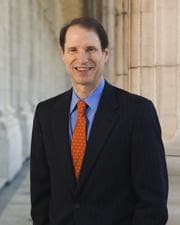
U.S. Senator
Ron Wyden
Oregon
DemocratProgressive
Votes on Record
3,581
across 21 categories
Contact
U.S. Senator
Oregon
Votes on Record
3,581
across 21 categories
Contact
Voting Profile
Most Active Policy Areas
3581
Votes Analyzed
Data sources: voteview, congress.gov
Political Position
The gap is small, though, and overall his record falls well within the mainstream of his party.
Near the average for Democrats (-0.38)
Data source: VoteView NOMINATE scores (UCLA/UC San Diego)
Policy Positions
3581
total votes analyzed
At a Glance
Ron Wyden is a Democratic U.S. Senator from Oregon with 3,581 recorded votes in this dataset, which makes it a large sample for analysis. His ideology score of -0.334 is close to the Democratic average of -0.380. This means his votes generally line up with his party's positions, and he lands slightly toward the center compared with the average Democratic senator. One caution applies to the yea/nay percentages below: a 'yea' vote is not always a vote 'for' a policy. Many Senate votes are on amendments, procedural motions, nominations, or resolutions to overturn rules, so a yea can mean either supporting or blocking a change depending on how the question was worded.
Most of his votes fall into general business (1,250 votes), budget (598), defense (336), and healthcare (259). His yea rates are highest on civil rights (88.9%), Social Security (79.8%), criminal justice (79.2%), and general business (76.2%). They are lowest on reproductive rights (33.3%, only 3 votes), guns and firearms (40.0%, only 5 votes), and immigration (44.9%). In most categories he votes yea somewhat more often than nay, but foreign policy (54.4%), banking and finance (54.5%), and taxation (56.7%) are close to evenly split.
His recent votes from 2026 show a few patterns. He voted to overturn several executive-branch rules: a Medicare prior-authorization rule, an EPA rule changing the PFAS chemical reporting period, and an HHS child care funding rule. He also voted against some of the current administration's nominees, including a nominee for CDC Director and a federal district judge in Ohio. On defense, he twice voted for resolutions directing the removal of U.S. forces from hostilities against Iran that Congress had not authorized, and he voted against the Fiscal Year 2027 defense authorization bill. He also supported a resolution to withhold senators' pay during a government shutdown, and he voted for a bill on name, image, and likeness rights for student athletes.
Voted twice in July 2026 (July 23 and July 30) for a joint resolution directing the removal of U.S. Armed Forces from hostilities against Iran that had not been authorized by Congress.
Voted against the original Fiscal Year 2027 bill authorizing Department of Defense military activities, military construction, and personnel levels (July 14, 2026).
Voted to overturn a Medicare rule that set up prior authorization for select services under the WISeR model (July 16, 2026), and voted for a point of order against reconciliation legislation that did not address insurers delaying or denying care (April 22, 2026).
Voted against confirming Erica Schwartz as Director of the Centers for Disease Control and Prevention (August 5, 2026), and voted against Matthew R. Byrne for U.S. District Judge for the Southern District of Ohio on two votes (September 14 and 15, 2026).
Voted against reconciliation instructions tied to voter registration identification, photo ID for federal elections, and rules on election day and ballot counting (April 23, 2026).
Voted to overturn an EPA rule that changed when PFAS ('forever chemical') reporting would begin under the Toxic Substances Control Act (August 5, 2026).
Voted for a resolution to withhold senators' pay if a government shutdown occurs (May 13, 2026), and for funding inspections of the Delaney Hall Detention Facility (June 4, 2026).
Voted for a bill to protect the name, image, and likeness rights of student athletes (September 15, 2026).
Yes/no split for each topic is on the Congressional Votes cards below.
Analysis updated: October 6, 2026
Campaign Finance
Includes all authorized campaign committees (principal committee, joint fundraising, and other authorized committees). Outside spending by Super PACs and independent groups is shown separately below.
Verify on FEC.gov →Career: $49.5M
Fundraising Over Time
Contribution Sources
72%
28%
Individual Breakdown
Itemized (>$200)
$970K
Small Dollar (≤$200)
$608K
Donation Sizes
Share of individual contribution dollars by donation size, current election cycle.
Where the Money Comes From
Itemized individual contributions only (donations over $200 report the donor's state). Small-dollar donations are not included because the FEC does not itemize them.
Top Contributors
Top Contributing Industries
Top Donor Employers
Employer as self-reported by itemized donors. “Not Employed” and “Self-Employed” typically rank highest for small-dollar campaigns and include retirees.
Where the Money Goes
Spending by Purpose
Purpose categories are self-reported on FEC filings; large “Other” totals are common.
Top Payees
ADP
MANDATE MEDIA
COLUMBIA BANK COMMERCIAL CARDS
BLUE HERON CONSULTING LLC
BURDICK CONSULTING GROUP , LLC
THE ASHMEAD GROUP
HEATH, JOSH
LEAHY, TIM
Detailed Breakdown
Expenditures
Operating Costs
$4.2M
Operating Offsets
$6K
Net Operating
$4.2M
Refunds
Individual Refunds
$8K
Committee Refunds
$8K
Outside Spending (Super PACs)
Supporting
$108K
Opposing
$152K
Total Outside Spending
$260K
Top Outside Spenders
WEB3 FORWARD
SIERRA CLUB POLITICAL COMMITTEE
DEMOCRATIC REPUBLICAN INDEPENDENT VOTER EDUCATION COMMITTEE
NATIONAL COUNCIL OF SENIOR CITIZENS POLITICAL ACTION COMMITTEE
OREGON NATURAL RESOURCES COUNCIL ACTION FEDERAL PAC (ONRC ACTION FEDERAL PAC)
SIERRA CLUB INDEPENDENT ACTION
LINN COUNTY DEMOCRATIC CENTRAL COMMITTEE
Independent expenditures are made without coordination with the candidate. Source: FEC Schedule E filings.
Voting Record
3,581 votes across 21 categories
Bars show how they voted on the key bills we analyzed in each topic. Tap a card to see every vote.