
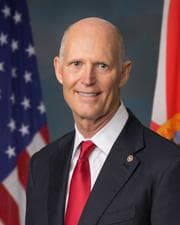
U.S. Senator
Rick Scott
Florida
RepublicanVery Conservative
Votes on Record
628
across 20 categories
Contact
U.S. Senator
Florida
Votes on Record
628
across 20 categories
Contact
Voting Profile
Most Active Policy Areas
628
Votes Analyzed
Data sources: voteview, congress.gov
Political Position
The average Republican scores about 0.52, which means Scott's voting record is more conservative than that of most members of his own party.
More conservative than the average Republican (0.52)
Data source: VoteView NOMINATE scores (UCLA/UC San Diego)
Policy Positions
628
total votes analyzed
At a Glance
Rick Scott is a Republican U.S. Senator from Florida with 628 recorded votes in this dataset. His ideology score puts him toward the conservative end of the Senate Republican conference. Many of his votes fall under nominations and general Senate business. He voted Yea on 92.8% of the 223 votes grouped as 'Other,' which included confirming federal judicial nominees such as Matthew R. Byrne for the Southern District of Ohio. He also usually voted to confirm executive-branch nominees, including Walter Clayton as Director of National Intelligence and a group of Treasury Department nominees.
On national security, Scott voted for the Fiscal Year 2027 National Defense Authorization Act, the yearly bill that sets defense policy and spending levels. Twice in July 2026 he voted against joint resolutions that would have required the removal of U.S. Armed Forces from hostilities with Iran that Congress had not authorized. In August 2026 he voted against an amendment to remove a provision placing duties (import taxes) on countries that buy Russian oil or natural gas or help others get around sanctions. A Nay on that amendment means he voted to keep the provision in the bill. His defense votes were split more evenly than most categories, with 31 Yea and 26 Nay.
On spending, Scott voted against several Democratic-sponsored budget amendments in April 2026. These would have set up 'deficit-neutral reserve funds' related to grocery costs and to hedge fund ownership of single-family homes. A deficit-neutral reserve fund is a placeholder in a budget plan that allows future legislation on a topic as long as it doesn't add to the deficit. In May 2026 he voted for a resolution to withhold Senators' pay during a government shutdown. In environment and energy, health care, and housing his record is mixed: he voted Yea on roughly half to three-quarters of these votes. In August 2026 he voted against a resolution to overturn an EPA rule about the reporting period for PFAS chemicals (long-lasting chemicals sometimes called 'forever chemicals').
A note on the data: votes are sorted into categories automatically, and some labels may not match the subject. For example, Treasury nominations appear under Foreign Policy and a child care rule appears under Environment/Energy. Yea percentages also include procedural votes, amendments, and votes on whether to move ahead with a bill. A Yea or Nay does not always mean support for or opposition to the underlying policy.
Consistently votes to confirm presidential nominees, including federal judges like Matthew R. Byrne (Sept. 2026) and Walter Clayton as Director of National Intelligence (July 2026).
Voted against two joint resolutions (July 23 and July 30, 2026) that would have required the removal of U.S. forces from hostilities with Iran not authorized by Congress.
Voted for the Fiscal Year 2027 National Defense Authorization Act (July 14, 2026), the yearly bill setting defense policy and funding.
Voted to keep a provision placing duties on countries that buy Russian oil or gas or help with sanctions evasion, by voting Nay on an amendment to strike it (Aug. 7, 2026).
Voted against budget amendments to create reserve funds on grocery costs (April 22, 2026) and on hedge fund ownership of single-family homes and rent prices (April 23, 2026).
Voted for a resolution to withhold Senators' pay if a government shutdown occurs (May 13, 2026).
Voted against a resolution to overturn an EPA rule about the PFAS reporting submission period (Aug. 5, 2026), and against a resolution to overturn an HHS rule on Child Care and Development Fund flexibility (July 30, 2026).
Voted against a bill on name, image, and likeness (NIL) rights and protections for student athletes (Sept. 15, 2026).
Yes/no split for each topic is on the Congressional Votes cards below.
Analysis updated: October 6, 2026
Campaign Finance
Includes all authorized campaign committees (principal committee, joint fundraising, and other authorized committees). Outside spending by Super PACs and independent groups is shown separately below.
Verify on FEC.gov →Career: $133.4M
Fundraising Over Time
Contribution Sources
37%
7%
56%
Individual Breakdown
Itemized (>$200)
$224K
Small Dollar (≤$200)
$178K
Donation Sizes
Share of individual contribution dollars by donation size, current election cycle.
Where the Money Comes From
Itemized individual contributions only (donations over $200 report the donor's state). Small-dollar donations are not included because the FEC does not itemize them.
Top Contributors
Top Contributing Industries
Top Donor Employers
Employer as self-reported by itemized donors. “Not Employed” and “Self-Employed” typically rank highest for small-dollar campaigns and include retirees.
Where the Money Goes
Spending by Purpose
Purpose categories are self-reported on FEC filings; large “Other” totals are common.
Top Payees
SCOTT, RICK SENA
ONMESSAGE DIGITAL FUNDRAISING LLC
LEX POLITICA PLLC
ADET LLC
FIRST BANKCARD
THREE ARBOR INSURANCE
CH STRATEGIES LLC
BETTER MOUSETRAP DIGITAL
Detailed Breakdown
Expenditures
Operating Costs
$1.7M
Operating Offsets
$31K
Net Operating
$1.6M
Refunds
Individual Refunds
$11K
Committee Refunds
$3K
Outside Spending (Super PACs)
Supporting
$2.1M
Opposing
$36.0M
Total Outside Spending
$38.1M
Top Outside Spenders
SMP
PRIORITIES USA ACTION
MAJORITY FORWARD
VOTEVETS
LCV VICTORY FUND
SENATE CONSERVATIVES FUND
FOR OUR FUTURE
ENVIRONMENTAL DEFENSE ACTION FUND
Independent expenditures are made without coordination with the candidate. Source: FEC Schedule E filings.
Voting Record
628 votes across 20 categories
Bars show how they voted on the key bills we analyzed in each topic. Tap a card to see every vote.