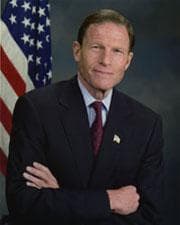
U.S. Senator
Richard Blumenthal
Connecticut
DemocratProgressive
Votes on Record
703
across 19 categories
Contact
U.S. Senator
Connecticut
Votes on Record
703
across 19 categories
Contact
Voting Profile
Most Active Policy Areas
703
Votes Analyzed
Data sources: voteview, congress.gov
Political Position
Senator Richard Blumenthal is a progressive Democrat who votes to the left of the average member of his party. His NOMINATE ideology score of -0.435 places him noticeably more liberal than the Democratic Party average of -0.380, meaning he consistently favors expanding government programs, strengthening regulations, and supporting social safety net policies more often than a typical Democrat.
Near the average for Democrats (-0.38)
Data source: VoteView NOMINATE scores (UCLA/UC San Diego)
Policy Positions
703
total votes analyzed
Overview
Senator Richard Blumenthal of Connecticut has compiled a substantial voting record of 703 votes in the U.S. Senate. His record reflects consistent alignment with progressive policy priorities across healthcare, environmental protection, and social spending, while frequently opposing measures backed by the Republican majority. On healthcare, Blumenthal has supported efforts to lower out-of-pocket costs and maintain federal oversight of Medicare programs, while opposing nominees he viewed as insufficiently committed to public health mandates. On defense and foreign policy, he has backed congressional authority over military engagements — notably voting to require congressional authorization for military action involving Iran — while opposing certain defense authorization bills and executive branch nominees. Blumenthal's voting pattern on environment and energy issues shows strong support for maintaining environmental regulations, including rules governing chemical reporting requirements like PFAS standards. On fiscal matters including budgets and taxation, his votes reflect support for progressive tax policies and opposition to spending packages that he viewed as insufficiently protective of social programs. Across nearly all categories, Blumenthal's high rate of 'Nay' votes reflects his position as a member of the minority party during a period when the Senate majority advanced legislation and nominations he frequently opposed. This is a common pattern for senators in the minority and should be understood in that context rather than as an indication of obstructionism.
Key Positions
By Policy Area
Analysis updated: September 18, 2026
Campaign Finance
Includes all authorized campaign committees (principal committee, joint fundraising, and other authorized committees). Outside spending by Super PACs and independent groups is shown separately below.
Verify on FEC.gov →Career: $28.1M
Fundraising Over Time
Contribution Sources
70%
30%
Individual Breakdown
Itemized (>$200)
$273K
Small Dollar (<$200)
$142K
Donation Sizes
Share of individual contribution dollars by donation size, current election cycle.
Where the Money Comes From
Itemized individual contributions only (donations over $200 report the donor's state). Small-dollar donations are not included because the FEC does not itemize them.
Top Contributors
Top Contributing Industries
Top Donor Employers
Employer as self-reported by itemized donors. “Not Employed” and “Self-Employed” typically rank highest for small-dollar campaigns and include retirees.
Where the Money Goes
Spending by Purpose
Purpose categories are self-reported on FEC filings; large “Other” totals are common.
Top Payees
NGP VAN, INC.
ANNE LEWIS STRATEGIES DBA MISSION WIRED
MLT STRATEGIC FUNDRAISING, LLC
REINOSO-CASTELLANO, JENNY
ADP, LLC
WEBSTER BANK
UNITED STATES TREASURY
CAPITOL COMPLIANCE ASSOCIATES, INC.
Detailed Breakdown
Expenditures
Operating Costs
$758K
Operating Offsets
$26K
Net Operating
$732K
Refunds
Individual Refunds
$6K
Committee Refunds
$6K
Outside Spending (Super PACs)
Supporting
$127K
Opposing
$6.8M
Total Outside Spending
$6.9M
Top Outside Spenders
CONNECTICUT PATRIOTS PAC
RESTORATION PAC
LEADERSHIP NOW
NATIONAL RIFLE ASSOCIATION OF AMERICA POLITICAL VICTORY FUND
NATIONAL COMMITTEE TO PRESERVE SOCIAL SECURITY & MEDICARE PAC
NATIONAL RIGHT TO LIFE POLITICAL ACTION COMMITTEE
FRONTIERS OF FREEDOM ACTION, INC.
PLANNED PARENTHOOD ACTION FUND INC
Independent expenditures are made without coordination with the candidate. Source: FEC Schedule E filings.
Voting Record
703 votes across 19 categories