
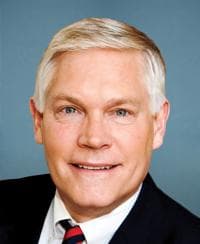
U.S. Representative
Pete Sessions
Texas District 17
RepublicanConservative
Votes on Record
713
across 19 categories
Contact
U.S. Representative
Texas District 17
Votes on Record
713
across 19 categories
Contact
Voting Profile
Most Active Policy Areas
713
Votes Analyzed
Data sources: voteview, congress.gov
Political Position
The Republican average in this data is 0.520, which puts him a little more conservative than the typical Republican in Congress, but well within his party's main group.
Near the average for Republicans (0.52)
Data source: VoteView NOMINATE scores (UCLA/UC San Diego)
Policy Positions
713
total votes analyzed
At a Glance
Pete Sessions is a Republican member of the U.S. House of Representatives from Texas. This profile covers 713 recorded votes. Most of them are from 2025 and 2026, when Republicans held the House majority. His ideology score of 0.584 is a little more conservative than the Republican average of 0.520. That suggests he usually votes with his party, sometimes from a slightly more conservative position. Committee assignments were not available in this data.
Many of the votes in this record are procedural, meaning they are about how the House runs its business rather than final decisions on bills. Two common types appear in his sample votes. A 'motion to recommit' gives the minority party (currently Democrats) a last chance to change or delay a bill before the final vote. An 'ordering the previous question' vote ends debate on the rules that set how bills will be considered. On health care, he voted NAY on motions to recommit the Do No Harm in Medicaid Act and the Lower Health Care Premiums for All Americans Act. He voted YEA to move forward the rule covering those bills. Those votes match the usual pattern for majority-party members. Because procedural votes are mixed in, his 54.8% YEA rate on health care does not, by itself, tell you whether he supported or opposed particular health policies.
On budget and spending, he voted YEA on the fiscal year 2027 congressional budget resolution and on a continuing resolution (a temporary bill that keeps the government funded). On defense and foreign policy, he voted NAY on two War Powers Resolution measures that would have directed the President to remove U.S. armed forces from Lebanon. He also voted NAY on the Take Care of America's Veterans Act. On agriculture, he voted YEA on the rule to bring the Fiscal Year 2027 Agriculture appropriations bill to the floor, then voted NAY on the bill itself. He voted NAY on the Pet and Livestock Protection Act. The data does not include his stated reasons for any of these votes.
His YEA rates are highest in criminal justice (13 of 13), technology (10 of 10), environment and energy (33 of 35), and taxation (12 of 13). They are lowest in labor (2 of 6), foreign policy (4 of 11), and Social Security (4 of 8, an even split). A high YEA rate means he usually voted for whatever measure came up in that category. It does not show which policy direction those measures took. Voters who want the details can look up the specific bills in each category.
Ideology: his NOMINATE score of 0.584 is somewhat more conservative than the Republican average of 0.520.
Military action: he voted NAY on two 2026 War Powers Resolution measures (June 4 and June 30) that would have directed the President to remove U.S. armed forces from Lebanon. A NAY vote leaves the decision about those troops with the President.
Health care: in December 2025, he voted NAY on Democratic motions to recommit the Do No Harm in Medicaid Act and the Lower Health Care Premiums for All Americans Act. He voted YEA to move forward the rule that brought those bills to the floor.
Federal budget: he voted YEA on the fiscal year 2027 congressional budget resolution (July 22, 2026) and on a continuing resolution to keep the government funded for fiscal year 2027 (July 21, 2026).
Agriculture spending: he voted YEA on the rule to consider the Fiscal Year 2027 Agriculture appropriations bill (June 3, 2026), then voted NAY on the bill itself the next day (June 4, 2026).
Veterans: he voted NAY on the Take Care of America's Veterans Act (July 16, 2026).
Fraud and financial issues: in September 2026, he voted YEA on the National Fraud Enforcement Division Act, the PROOF Act, and the Retire through Ownership Act.
Criminal justice and technology: he voted YEA on every recorded vote in criminal justice (13 votes) and technology (10 votes).
Yes/no split for each topic is on the Congressional Votes cards below.
Analysis updated: October 6, 2026
Campaign Finance
Includes all authorized campaign committees (principal committee, joint fundraising, and other authorized committees). Outside spending by Super PACs and independent groups is shown separately below.
Verify on FEC.gov →Career: $32.3M
Fundraising Over Time
Contribution Sources
49%
51%
0%
Individual Breakdown
Itemized (>$200)
$495K
Small Dollar (≤$200)
$4K
Donation Sizes
Share of individual contribution dollars by donation size, current election cycle.
Where the Money Comes From
Itemized individual contributions only (donations over $200 report the donor's state). Small-dollar donations are not included because the FEC does not itemize them.
Top Contributors
Top Contributing Industries
Top Donor Employers
Employer as self-reported by itemized donors. “Not Employed” and “Self-Employed” typically rank highest for small-dollar campaigns and include retirees.
Where the Money Goes
Spending by Purpose
Purpose categories are self-reported on FEC filings; large “Other” totals are common.
Top Payees
AVIATOR BARCLAY MASTERCARD
THE STANTON GROUP
AMERICAN EXPRESS
AD SPECTATIONS
CHERIAN, JEZIAH
LINK LETTER
U.S. TREASURY
ANEDOT
Detailed Breakdown
Expenditures
Operating Costs
$481K
Net Operating
$481K
Outside Spending (Super PACs)
Supporting
$1.8M
Opposing
$8.2M
Total Outside Spending
$9.9M
Top Outside Spenders
HOUSE MAJORITY PAC
DCCC
INDEPENDENCE USA PAC
NATIONAL ASSOCIATION OF REALTORS CONGRESSIONAL FUND
PATIENTS FOR AFFORDABLE DRUGS ACTION
HUMANE SOCIETY LEGISLATIVE FUND
END CITIZENS UNITED
CULAC THE PAC OF CREDIT UNION NATIONAL ASSOCIATION
Independent expenditures are made without coordination with the candidate. Source: FEC Schedule E filings.
Voting Record
713 votes across 19 categories
Bars show how they voted on the key bills we analyzed in each topic. Tap a card to see every vote.