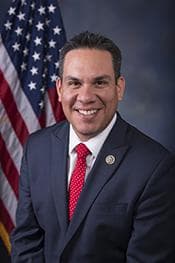
U.S. Representative
Pete Aguilar
California District 33
DemocratProgressive
Votes on Record
525
across 19 categories
Contact
U.S. Representative
California District 33
Votes on Record
525
across 19 categories
Contact
Voting Profile
Most Active Policy Areas
525
Votes Analyzed
Data sources: voteview, congress.gov
Political Position
Pete Aguilar's NOMINATE score of -0.325 places him in the progressive range of the political spectrum, though he sits slightly closer to the center than the average House Democrat (whose score is approximately -0.380). In practical terms, he generally votes with his party on most issues but has occasionally broken from the Democratic mainstream, making him one of the more moderate members of the Democratic caucus. This positioning is consistent with his role in House Democratic leadership, where building broad coalitions within the party is part of the job.
Near the average for Democrats (-0.38)
Data source: VoteView NOMINATE scores (UCLA/UC San Diego)
Policy Positions
525
total votes analyzed
Overview
Pete Aguilar is a Democratic member of the U.S. House of Representatives from California with a substantial voting record of 525 recorded votes. His voting patterns show consistent alignment with Democratic priorities on healthcare, labor, education, and foreign policy, while his overall ideology score suggests he occupies a position slightly more centrist than the typical House Democrat. Across policy areas, Aguilar has voted in favor of healthcare-related legislation about two-thirds of the time, supported labor measures at a high rate, and backed foreign policy bills in nearly all instances. He has voted against most budget resolutions brought to the floor, which is common for minority-party members opposing the majority's spending framework. On immigration and housing, his lower yes-vote percentages reflect opposition to bills brought forward by the Republican majority rather than opposition to action in those areas generally. His record on environment and energy legislation shows a mix of positions — he supported some measures like the Water Resources Development Act and the Ratepayer Protection Act while opposing others, including a resolution to disapprove California-specific environmental regulations. On defense, he supported veterans' legislation and a War Powers Resolution measure while voting against the fiscal year 2027 National Defense Authorization Act. Aguilar's voting patterns are broadly representative of a mainstream Democrat who occasionally departs from the party's most progressive wing, particularly on issues where pragmatic or coalition-building considerations come into play.
Key Positions
By Policy Area
Analysis updated: September 18, 2026
Campaign Finance
Includes all authorized campaign committees (principal committee, joint fundraising, and other authorized committees). Outside spending by Super PACs and independent groups is shown separately below.
Verify on FEC.gov →Career: $24.8M
Fundraising Over Time
Contribution Sources
48%
52%
Individual Breakdown
Itemized (>$200)
$1.6M
Small Dollar (<$200)
$260K
Donation Sizes
Share of individual contribution dollars by donation size, current election cycle.
Where the Money Comes From
Itemized individual contributions only (donations over $200 report the donor's state). Small-dollar donations are not included because the FEC does not itemize them.
Top Contributors
Top Contributing Industries
Top Donor Employers
Employer as self-reported by itemized donors. “Not Employed” and “Self-Employed” typically rank highest for small-dollar campaigns and include retirees.
Where the Money Goes
Spending by Purpose
Purpose categories are self-reported on FEC filings; large “Other” totals are common.
Top Payees
DCCC
AMERICAN EXPRESS
ANGERHOLZER BROZ CONSULTING LLC
RYAN MULCAHY
MOMENTUM CAMPAIGNS
YES ON 50, ELECTION RIGGING RESPONSE ACT
MSL STRATEGIES
GOLF, REDD
Detailed Breakdown
Expenditures
Operating Costs
$2.0M
Operating Offsets
$22K
Net Operating
$2.0M
Refunds
Individual Refunds
$18K
Committee Refunds
$18K
Outside Spending (Super PACs)
Supporting
$1.1M
Opposing
$88K
Total Outside Spending
$1.1M
Top Outside Spenders
CULAC THE PAC OF CREDIT UNION NATIONAL ASSOCIATION
LEAGUE OF CONSERVATION VOTERS VICTORY FUND
RESTORING OUR COMMUNITY
COOPERATIVE OF AMERICAN PHYSICIANS INDEPENDENT EXPENDITURE COMMITTEE
WOMEN VOTE!
SAN BERNARDINO COUNTY SAFETY EMPLOYEES' BENEFIT ASSOCIATION LOCAL PAC
DEMOCRATIC CONGRESSIONAL CAMPAIGN COMMITTEE
HUMANE SOCIETY LEGISLATIVE FUND
Independent expenditures are made without coordination with the candidate. Source: FEC Schedule E filings.
Voting Record
525 votes across 19 categories