
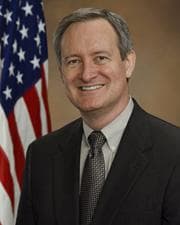
U.S. Senator
Mike Crapo
Idaho
RepublicanConservative
Votes on Record
900
across 20 categories
Contact
U.S. Senator
Idaho
Votes on Record
900
across 20 categories
Contact
Voting Profile
Most Active Policy Areas
900
Votes Analyzed
Data sources: voteview, congress.gov
Political Position
In practice, he votes very close to the typical Republican senator.
Near the average for Republicans (0.52)
Data source: VoteView NOMINATE scores (UCLA/UC San Diego)
Policy Positions
900
total votes analyzed
At a Glance
Mike Crapo is a Republican U.S. Senator from Idaho. This profile covers 900 recorded votes. His ideology score of 0.505 is close to the Republican average of 0.520, which means his overall voting pattern closely matches his party's mainstream. His most recent sample votes include support for a Republican budget resolution for fiscal year 2026, support for the yearly defense spending and policy bill for fiscal year 2027, and votes to confirm the administration's nominees, including a federal district judge and a Director of the Centers for Disease Control and Prevention.
Healthcare is his largest single policy area, with 185 votes, and his Yea and Nay votes are split almost evenly (90 Yea, 91 Nay). An even split like this usually reflects which side wrote the measure, not a mixed view of healthcare. In the sample votes, he voted against a resolution that would have overturned a Medicare rule adding prior-authorization requirements for certain services. He also voted against a procedural challenge that would have required budget legislation to address insurance companies delaying or denying care. Votes like these are often proposed by the minority party during budget debates.
On defense and foreign affairs, he twice voted against resolutions directing the removal of U.S. forces from hostilities involving Iran that Congress had not authorized. He voted Yea on 53 of 54 foreign policy votes. On energy and trade policy toward Russia, he voted against an amendment that would have removed a provision placing duties on countries that buy Russian oil or gas. On regulatory issues, he voted against resolutions that would have overturned an EPA rule on the timing of PFAS ('forever chemical') reporting and a federal rule on child care funding flexibility. Both rules came from the current administration, so his votes kept them in place.
These numbers come with limits. Yea and Nay percentages show how often he voted for or against whatever question was on the floor. They do not show whether he supported or opposed a policy, because many votes are on amendments, procedural motions, or nominations. The automatic sorting into categories is also imperfect: for example, the child care rule vote was filed under environment and energy. Committee assignments were not available for this profile.
Voted against two joint resolutions (July 23 and July 30, 2026) that would have directed the removal of U.S. armed forces from hostilities with Iran that Congress had not authorized.
Voted for the Senate's fiscal year 2027 defense authorization bill (July 14, 2026), the yearly bill that sets military spending levels and policy.
Voted for the fiscal year 2026 congressional budget resolution (April 21, 2026). He also voted for an amendment adding budget instructions on voter ID requirements and photo identification for federal elections (April 23, 2026).
Voted against a resolution to overturn a Medicare rule that adds prior-authorization requirements for certain services, so the rule stayed in place (July 16, 2026).
Voted against an amendment that would have removed a provision placing duties on countries that buy Russian-origin oil or natural gas or help others evade sanctions (August 7, 2026).
Voted to confirm the administration's nominees, including Erica Schwartz as CDC Director (August 5, 2026) and Matthew R. Byrne as a federal district judge in Ohio (September 2026).
Voted for a resolution to withhold senators' pay during a government shutdown (May 13, 2026), and for a bill on name, image, and likeness rights for college athletes (September 15, 2026).
Yes/no split for each topic is on the Congressional Votes cards below.
Analysis updated: October 6, 2026
Campaign Finance
Includes all authorized campaign committees (principal committee, joint fundraising, and other authorized committees). Outside spending by Super PACs and independent groups is shown separately below.
Verify on FEC.gov →Career: $25.1M
Fundraising Over Time
Contribution Sources
39%
61%
Individual Breakdown
Itemized (>$200)
$563K
Small Dollar (≤$200)
$38K
Donation Sizes
Share of individual contribution dollars by donation size, current election cycle.
Where the Money Comes From
Itemized individual contributions only (donations over $200 report the donor's state). Small-dollar donations are not included because the FEC does not itemize them.
Top Contributors
Top Contributing Industries
Top Donor Employers
Employer as self-reported by itemized donors. “Not Employed” and “Self-Employed” typically rank highest for small-dollar campaigns and include retirees.
Where the Money Goes
Spending by Purpose
Purpose categories are self-reported on FEC filings; large “Other” totals are common.
Top Payees
DELTA AIRLINES
BARRACKS ROW STRATEGIES
INTERNAL REVENUE SERVICE - OGDEN
BALLARD, MARGARET
CITICARDS - THE LAKES
ELLIOTT GROUP CONSULTING LLC
HOEHNE, JOHN MR.
PROFESSIONAL DATA SERVICES
Detailed Breakdown
Expenditures
Operating Costs
$1.6M
Operating Offsets
$111K
Net Operating
$1.5M
Refunds
Individual Refunds
$14K
Committee Refunds
$5K
Outside Spending (Super PACs)
Supporting
$109K
Opposing
$861.86
Total Outside Spending
$110K
Top Outside Spenders
AMERICAN ENERGY ACTION FUND
CLEARPATH ACTION FUND, INC.
IDAHO REPUBLICAN PARTY
EVERYTOWN FOR GUN SAFETY ACTION FUND
NATIONAL RIGHT TO LIFE POLITICAL ACTION COMMITTEE
TEA PARTY ARMY
NATIONAL RIGHT TO LIFE VICTORY FUND
Independent expenditures are made without coordination with the candidate. Source: FEC Schedule E filings.
Voting Record
900 votes across 20 categories
Bars show how they voted on the key bills we analyzed in each topic. Tap a card to see every vote.