
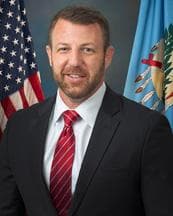
U.S. Senator
Markwayne Mullin
Oklahoma
RepublicanConservative
Votes on Record
544
across 17 categories
Contact
Contact information not yet available
U.S. Senator
Oklahoma
Votes on Record
544
across 17 categories
Contact
Contact information not yet available
Voting Profile
Most Active Policy Areas
544
Votes Analyzed
Data sources: voteview, congress.gov
Political Position
In practice, he sits close to the middle of Senate Republicans rather than at either edge of the party.
Near the average for Republicans (0.52)
Data source: VoteView NOMINATE scores (UCLA/UC San Diego)
Policy Positions
544
total votes analyzed
At a Glance
Markwayne Mullin is a Republican who represented Oklahoma in the U.S. Senate. This profile covers 544 recorded votes. In most policy areas he voted Yea more often than Nay. The largest group of votes (172) is labeled 'other,' and most of them are confirmation votes on presidential nominees. He voted Yea on 158 of those 172. The records also include two votes, on March 22 and 23, 2026, on his own nomination to be Secretary of Homeland Security. He voted Yea on both. If that nomination took effect, his Senate voting record would end around that date.
On spending and the economy, he voted Yea on several versions of the bill to fund the federal government for fiscal year 2026 in March 2026. Overall he voted Yea on 32 of 43 budget votes, 17 of 22 tax votes and 11 of 11 infrastructure votes. Trade is the one area where he mostly voted No: 4 Nay and 1 Yea out of 5 votes. On foreign policy he voted Yea 35 times and never voted Nay, including votes to confirm Michael Waltz as U.S. Representative to the United Nations and Joshua Simmons as General Counsel of the CIA. Defense was more mixed, with 23 Yea and 13 Nay votes out of 41.
Several recent votes were on 'joint resolutions of disapproval.' Under the Congressional Review Act, Congress can use these to cancel a rule written by a federal agency. When a senator votes Nay on one, he is voting to keep the rule in place. Mullin voted Nay on resolutions to cancel a federal health insurance marketplace rule under the Affordable Care Act, an EPA approval of South Dakota's regional haze (air visibility) plan, and a Department of Health and Human Services rule-making policy. In each case his vote supported keeping the rule.
Some limits of this data: votes are sorted into categories automatically, and some are filed in unexpected places. For example, a health department rule is listed under environment and energy, and a drug-policy nominee is listed under healthcare. The Yea and Nay counts in some categories also add up to less than the total, which most likely means he did not vote or the vote was recorded another way. The data does not show what each bill contained or how other senators voted, so these numbers describe his voting habits, not the reasons behind them.
He voted Yea on 158 of 172 votes in the 'other' category, which is mostly confirmations of presidential nominees. That includes two Yea votes, on March 22 and 23, 2026, on his own nomination as Secretary of Homeland Security.
He voted Yea on several versions of the fiscal year 2026 government funding bill (March 5, 12 and 20, 2026). Across all budget votes he voted Yea 32 times and Nay 9 times.
On January 13, 2026, he voted Nay on a resolution to cancel a Centers for Medicare & Medicaid Services rule called 'Patient Protection and Affordable Care Act; Market Integrity and Affordability.' That vote supported keeping the rule.
On January 7, 2026, he voted Nay on a resolution to cancel the EPA's approval of South Dakota's regional haze plan, which supported leaving the approval in place. Overall he voted Yea on 44 of 56 environment and energy votes.
He never voted Nay in the foreign policy category: 35 Yea out of 43 votes. That includes Yea votes to confirm Michael Waltz as U.N. ambassador and Joshua Simmons as CIA General Counsel.
Trade is the only category where he mostly voted No, with 4 Nay votes and 1 Yea vote out of 5.
On immigration he voted Yea on 21 of 25 votes and Nay on 2.
Yes/no split for each topic is on the Congressional Votes cards below.
Analysis updated: October 6, 2026
Campaign Finance
Includes all authorized campaign committees (principal committee, joint fundraising, and other authorized committees). Outside spending by Super PACs and independent groups is shown separately below.
Verify on FEC.gov →Career: $10.4M
Fundraising Over Time
Contribution Sources
44%
54%
2%
Individual Breakdown
Itemized (>$200)
$1.3M
Small Dollar (≤$200)
$79K
Donation Sizes
Share of individual contribution dollars by donation size, current election cycle.
Where the Money Comes From
Itemized individual contributions only (donations over $200 report the donor's state). Small-dollar donations are not included because the FEC does not itemize them.
Top Contributors
Top Contributing Industries
Top Donor Employers
Employer as self-reported by itemized donors. “Not Employed” and “Self-Employed” typically rank highest for small-dollar campaigns and include retirees.
Where the Money Goes
Spending by Purpose
Purpose categories are self-reported on FEC filings; large “Other” totals are common.
Top Payees
MULLIN, MARKWAYNE MR.
GRAND VALLEY CONSULTING, LLC
BB&T/TRUIST CREDIT CARD
SOUTHERN PLAINS ADVOCACY
HUCKABY DAVIS LISKER
WICHITA FALLS ASAP LLC
CAMP POLITICAL LLC
LAUNCHPAD STRATEGIES LLC
Detailed Breakdown
Expenditures
Operating Costs
$1.6M
Operating Offsets
$67K
Net Operating
$1.5M
Transfers
Transfers Out
$3K
Refunds
Individual Refunds
$514K
Committee Refunds
$368K
Outside Spending (Super PACs)
Supporting
$2.7M
Opposing
$0
Total Outside Spending
$2.7M
Top Outside Spenders
DEFEND US PAC
CRYPTO INNOVATION
NATIONAL RIFLE ASSOCIATION OF AMERICA POLITICAL VICTORY FUND
PERFORMANCE RACING INC.
Independent expenditures are made without coordination with the candidate. Source: FEC Schedule E filings.
Voting Record
544 votes across 17 categories
Bars show how they voted on the key bills we analyzed in each topic. Tap a card to see every vote.