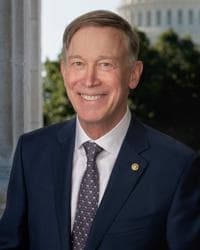
U.S. Senator
John W. Hickenlooper
Colorado
DemocratModerate Liberal
Votes on Record
615
across 20 categories
Contact
U.S. Senator
Colorado
Votes on Record
615
across 20 categories
Contact
Voting Profile
Most Active Policy Areas
615
Votes Analyzed
Data sources: voteview, congress.gov
Political Position
Senator Hickenlooper's NOMINATE score of -0.288 places him in the moderate-liberal range of American politics. Compared to the average Senate Democrat score of approximately -0.380, he sits noticeably closer to the political center, making him one of the more conservative-leaning members of his party. In practical terms, this means he generally aligns with Democratic priorities but is more likely than many of his colleagues to break with the party on certain votes or to support bipartisan compromises.
Near the average for Democrats (-0.38)
Data source: VoteView NOMINATE scores (UCLA/UC San Diego)
Policy Positions
615
total votes analyzed
Overview
John Hickenlooper, a Democrat representing Colorado in the U.S. Senate, has built a voting record across 615 recorded votes that reflects a center-left approach to governance. Before entering the Senate, Hickenlooper served as Governor of Colorado and Mayor of Denver, bringing an executive-branch perspective that often shows in his pragmatic approach to legislation. His most active voting areas include defense, environment and energy, healthcare, and budget matters. On defense, he has supported military authorization bills while also voting to require congressional approval for military action against Iran, reflecting a stance that balances national security with legislative oversight. On environment and energy, he has engaged with regulatory issues including PFAS chemical reporting rules and energy-related trade provisions, consistent with Colorado's mix of energy production and environmental priorities. In budget and taxation matters, Hickenlooper has voted for measures addressing housing costs, grocery prices, and government shutdown accountability, while opposing many broader budget proposals from the opposing party. His healthcare votes are relatively balanced between yea and nay, suggesting engagement with specific policy details rather than blanket support or opposition. His voting pattern on nominations and procedural matters — reflected in the large 'Other' category — shows frequent opposition to the current administration's nominees, which is typical for a senator in the minority party. On trade, he has supported most measures that came to a vote, and on criminal justice, his limited votes have all been in favor of the measures considered.
Key Positions
By Policy Area
Analysis updated: September 18, 2026
Campaign Finance
Includes all authorized campaign committees (principal committee, joint fundraising, and other authorized committees). Outside spending by Super PACs and independent groups is shown separately below.
Verify on FEC.gov →Career: $54.5M
Fundraising Over Time
Contribution Sources
87%
12%
1%
Individual Breakdown
Itemized (>$200)
$5.6M
Small Dollar (<$200)
$1.9M
Donation Sizes
Share of individual contribution dollars by donation size, current election cycle.
Where the Money Comes From
Itemized individual contributions only (donations over $200 report the donor's state). Small-dollar donations are not included because the FEC does not itemize them.
Top Contributors
Top Contributing Industries
Top Donor Employers
Employer as self-reported by itemized donors. “Not Employed” and “Self-Employed” typically rank highest for small-dollar campaigns and include retirees.
Where the Money Goes
Spending by Purpose
Purpose categories are self-reported on FEC filings; large “Other” totals are common.
Top Payees
ASCEND DIGITAL STRATEGIES, LLC
GAMBIT STRATEGIES LLC
CANAL PARTNERS MEDIA
PAYROLL DATA PROCESSING
QCT PRODUCTION
GUSTO
SALK STRATEGIES
AMERICAN EXPRESS
Detailed Breakdown
Expenditures
Operating Costs
$9.7M
Operating Offsets
$115K
Net Operating
$9.6M
Refunds
Individual Refunds
$59K
Committee Refunds
$31K
Outside Spending (Super PACs)
Supporting
$7.7M
Opposing
$33.5M
Total Outside Spending
$41.3M
Top Outside Spenders
SENATE LEADERSHIP FUND
NRSC
SMP
FAIR SHARE ACTION
ESAFUND
NRA VICTORY FUND, INC.
NRDC ACTION VOTES
AMERICANS FOR PROSPERITY ACTION, INC.(AFP ACTION)
Independent expenditures are made without coordination with the candidate. Source: FEC Schedule E filings.
Voting Record
615 votes across 20 categories