
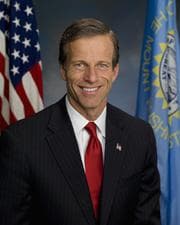
U.S. Senator
John Thune
South Dakota
RepublicanConservative
Votes on Record
819
across 20 categories
Contact
U.S. Senator
South Dakota
Votes on Record
819
across 20 categories
Contact
Voting Profile
Most Active Policy Areas
819
Votes Analyzed
Data sources: voteview, congress.gov
Political Position
He stands well apart from the Democratic average of about -0.38.
Near the average for Republicans (0.52)
Data source: VoteView NOMINATE scores (UCLA/UC San Diego)
Policy Positions
819
total votes analyzed
At a Glance
Senator John Thune, a Republican from South Dakota, has 819 recorded votes in this dataset. His NOMINATE ideology score of 0.432 puts him firmly on the conservative side of the Senate. He is somewhat less conservative than the average Republican (0.520). How often he votes 'yes' varies a lot by topic. He voted yes on nearly all foreign policy votes (98.1%), all housing votes (100%), and most votes in the 'other' category (93.1%), which includes nominations such as federal district judges. In healthcare, defense, budget, and banking, he voted yes on about 60% of the time. He voted yes less often on Social Security (46.2%) and trade (33.3%).
A 'yes' or 'no' vote alone does not show a senator's position, because the question being voted on may be to pass a bill, amend it, block it, or overturn an agency rule. Many of Thune's recent recorded votes are on Congressional Review Act resolutions, which let Congress cancel rules issued by federal agencies. On several of these he voted no, which left the agency rules in place. Examples include rules on Medicare prior authorization, reporting of PFAS chemicals (long-lasting industrial compounds), and child care fund flexibility.
On national security, Thune twice voted against resolutions that would have directed U.S. forces to withdraw from hostilities involving Iran that Congress had not authorized. He also voted to keep a provision placing duties (import taxes) on countries that buy Russian oil or gas. He voted no on one recorded vote on the fiscal year 2027 defense authorization bill. The data does not say whether that was a final passage vote or a procedural step. On budget matters, he voted for the fiscal year 2026 budget resolution and for reconciliation instructions related to voter identification requirements in federal elections. He also voted for a resolution to withhold senators' pay during a government shutdown.
The data has limits. Committee assignments are not available. Some categories have very few votes, such as reproductive rights (1 vote), civil rights (1), guns (2), and technology (3), so they say little about his overall views. Some votes also appear to be filed under the wrong category. For example, a child care funding rule is listed under environment and energy.
Voted against two joint resolutions (July 23 and July 30, 2026) that would have directed the removal of U.S. Armed Forces from hostilities with Iran that Congress had not authorized.
Voted for the fiscal year 2026 congressional budget resolution (April 21, 2026) and for reconciliation instructions on voter identification requirements and ballot counting in federal elections (April 23, 2026).
Voted against a Congressional Review Act resolution that would have overturned a Medicare rule adding prior authorization requirements for selected services under the WISeR model (July 16, 2026), which left the rule in place.
Voted to confirm Erica Schwartz as Director of the Centers for Disease Control and Prevention (August 5, 2026).
Voted against an amendment to remove a provision placing duties on countries that buy Russian crude oil or natural gas (August 7, 2026), which kept the provision in the bill.
Voted for a resolution to withhold senators' pay if a government shutdown occurs (May 13, 2026).
Voted for a bill on name, image, and likeness rights for college athletes (September 15, 2026) and to confirm Matthew R. Byrne as a federal district judge in Ohio.
Voted yes on 53 of 54 foreign policy votes and all 12 housing votes in this dataset.
Yes/no split for each topic is on the Congressional Votes cards below.
Analysis updated: October 6, 2026
Campaign Finance
Includes all authorized campaign committees (principal committee, joint fundraising, and other authorized committees). Outside spending by Super PACs and independent groups is shown separately below.
Verify on FEC.gov →Career: $66.4M
Fundraising Over Time
Contribution Sources
67%
33%
Individual Breakdown
Itemized (>$200)
$2.2M
Small Dollar (≤$200)
$454K
Donation Sizes
Share of individual contribution dollars by donation size, current election cycle.
Where the Money Comes From
Itemized individual contributions only (donations over $200 report the donor's state). Small-dollar donations are not included because the FEC does not itemize them.
Top Contributors
Top Contributing Industries
Top Donor Employers
Employer as self-reported by itemized donors. “Not Employed” and “Self-Employed” typically rank highest for small-dollar campaigns and include retirees.
Where the Money Goes
Spending by Purpose
Purpose categories are self-reported on FEC filings; large “Other” totals are common.
Top Payees
AMERICAN EXPRESS
UNITED STATES TREASURY
RIZZO DUKES GROUP LLC
CROSBY OTTENHOFF GOUP
SDLS, LLC
THE LUKENS COMPANY
CHARLES SCHWAB & CO INC
MDG STRATEGIES INC
Detailed Breakdown
Expenditures
Operating Costs
$3.4M
Operating Offsets
$1K
Net Operating
$3.4M
Transfers
Transfers Out
$7K
Refunds
Individual Refunds
$68K
Committee Refunds
$7K
Outside Spending (Super PACs)
Supporting
$824K
Opposing
$496K
Total Outside Spending
$1.3M
Top Outside Spenders
NRA POLITICAL VICTORY FUND
NATIONAL RIGHT TO LIFE POLITICAL ACTION COMMITTEE
LEAGUE OF CONSERVATION VOTERS
AVE MARIA LIST PAC, THE
AMERICAN ENERGY ACTION FUND
ASSOCIATED BUILDERS AND CONTRACTORS POLITICAL ACTION COMMITTEE (ABC/PAC)
NATIONAL RIGHT TO WORK COMMITTEE PAC, THE
SUSAN B ANTHONY LIST CANDIDATE FUND
Independent expenditures are made without coordination with the candidate. Source: FEC Schedule E filings.
Voting Record
819 votes across 20 categories
Bars show how they voted on the key bills we analyzed in each topic. Tap a card to see every vote.