
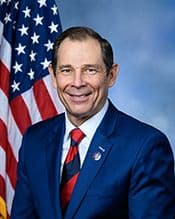
U.S. Senator
John R. Curtis
Utah
RepublicanConservative
Votes on Record
623
across 19 categories
Contact
U.S. Senator
Utah
Votes on Record
623
across 19 categories
Contact
Voting Profile
Most Active Policy Areas
623
Votes Analyzed
Data sources: voteview, congress.gov
Political Position
The Republican average is about 0.520, so he votes somewhat less conservatively than the typical Republican senator, though his record still clearly falls within his party's mainstream.
Near the average for Republicans (0.52)
Data source: VoteView NOMINATE scores (UCLA/UC San Diego)
Policy Positions
623
total votes analyzed
At a Glance
John Curtis is a Republican U.S. Senator from Utah with 623 recorded votes in this dataset. Overall, he votes 'Yea' far more often than 'Nay.' That pattern is especially strong on procedural and general business (93.6% Yea across 220 votes), foreign policy (96.3%), housing (91.7%) and infrastructure (90.9%). A large share of Senate votes are confirmations of presidential nominees, and the samples show him voting to confirm a federal district judge, a Director of National Intelligence, a CDC Director and a group of Treasury Department officials.
He votes 'Nay' most often in healthcare (41.7% Yea), trade (33.3% Yea) and defense (55.6% Yea). On healthcare, he voted against a proposed point of order on reconciliation legislation that dealt with insurance companies delaying or denying care. He also voted against a resolution that would have overturned a Medicare rule on prior authorization (the requirement that some services get approved before they are covered). On defense, he voted for the Fiscal Year 2027 National Defense Authorization Act, the yearly bill that sets defense policy and spending levels. He voted against two July 2026 resolutions that would have directed the removal of U.S. forces from hostilities with Iran that Congress had not authorized.
On regulatory issues, his recent votes show that he does not automatically support overturning agency rules. He voted against using the Congressional Review Act (a law that lets Congress cancel recent agency rules) to overturn an EPA rule on the timing of PFAS reporting. PFAS are long-lasting industrial chemicals. He also voted against overturning an HHS child care funding rule and the Medicare prior-authorization rule mentioned above. On energy and sanctions, he voted against an amendment to remove a provision that would place duties (import taxes) on countries that buy Russian oil or gas or help evade sanctions.
Voters should keep a few limits of this data in mind. The issue categories are assigned automatically, so some votes appear in unexpected places: Treasury nominations are listed under foreign policy, and a child care rule is listed under environment and energy. A 'Yea' or 'Nay' alone does not show whether a vote supported or opposed a policy, because the meaning depends on how each motion is worded. Several categories, including guns, labor, technology, Social Security and reproductive rights, have very few votes, so they say little about his broader views.
Voted against two joint resolutions (July 23 and July 30, 2026) that would have directed the removal of U.S. Armed Forces from hostilities with Iran not authorized by Congress.
Voted for the Fiscal Year 2027 National Defense Authorization Act on July 14, 2026.
Voted against an amendment to strike a provision imposing duties on countries that buy Russian-origin oil or gas or help evade sanctions (August 7, 2026), which kept that provision in the bill.
Voted against Congressional Review Act resolutions to overturn three agency rules: an EPA rule on the PFAS reporting timeline, an HHS child care funding rule and a Medicare prior-authorization rule.
Voted against a proposed point of order on reconciliation legislation about insurance companies delaying or denying patient care (April 22, 2026).
Regularly votes to confirm presidential nominees, including a federal district judge, a Director of National Intelligence, a CDC Director and several Treasury officials.
Voted for a bill creating name, image and likeness (NIL) protections for college athletes and setting rules for competition in intercollegiate sports (September 15, 2026).
Yes/no split for each topic is on the Congressional Votes cards below.
Analysis updated: October 6, 2026
Campaign Finance
Includes all authorized campaign committees (principal committee, joint fundraising, and other authorized committees). Outside spending by Super PACs and independent groups is shown separately below.
Verify on FEC.gov →Career: $6.5M
Fundraising Over Time
Contribution Sources
47%
53%
Individual Breakdown
Itemized (>$200)
$343K
Small Dollar (≤$200)
$3K
Donation Sizes
Share of individual contribution dollars by donation size, current election cycle.
Where the Money Comes From
Itemized individual contributions only (donations over $200 report the donor's state). Small-dollar donations are not included because the FEC does not itemize them.
Top Contributors
Top Contributing Industries
Top Donor Employers
Employer as self-reported by itemized donors. “Not Employed” and “Self-Employed” typically rank highest for small-dollar campaigns and include retirees.
Where the Money Goes
Spending by Purpose
Purpose categories are self-reported on FEC filings; large “Other” totals are common.
Top Payees
GRAND VALLEY CONSULTING LLC
PAYCHEX
CFS COMPLIANCE
CAPLIN & DRYSDALE
JEDX LLC
HERRING, ADRIELLE
FORD CREDIT
A&A ART & FRAME
Detailed Breakdown
Expenditures
Operating Costs
$833K
Operating Offsets
$42.13
Net Operating
$833K
Refunds
Committee Refunds
$3K
Outside Spending (Super PACs)
Supporting
$7.8M
Opposing
$79K
Total Outside Spending
$7.9M
Top Outside Spenders
CONSERVATIVE VALUES FOR UTAH
DEFEND AMERICAN JOBS
CLEARPATH ACTION FUND, INC.
AMERICAN CONSERVATION COALITION PAC (ACC PAC)
EDF ACTION VOTES
UTAHNS FOR LIBERTY
ALL IN FOR UTAH
GUN RIGHTS AMERICA
Independent expenditures are made without coordination with the candidate. Source: FEC Schedule E filings.
Voting Record
623 votes across 19 categories
Bars show how they voted on the key bills we analyzed in each topic. Tap a card to see every vote.