
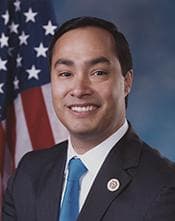
U.S. Representative
Joaquin Castro
Texas District 20
DemocratProgressive
Votes on Record
544
across 19 categories
Contact
U.S. Representative
Texas District 20
Votes on Record
544
across 19 categories
Contact
Voting Profile
Most Active Policy Areas
544
Votes Analyzed
Data sources: voteview, congress.gov
Political Position
Voters can expect his overall record to line up closely with mainstream Democratic positions.
Near the average for Democrats (-0.38)
Data source: VoteView NOMINATE scores (UCLA/UC San Diego)
Policy Positions
544
total votes analyzed
At a Glance
Joaquin Castro is a Democratic member of the U.S. House of Representatives from Texas. This profile is based on 544 recorded votes. More than half of them (280) are filed under a general 'Other' category, so the topic breakdowns below cover only part of his record. The recent votes in this data come from a period when Republicans controlled the House. That context matters because many of the bills, budgets and procedural motions he voted on were written and scheduled by the majority party.
On budget and spending, he voted 'no' on most measures (24 of 29). These include the fiscal year 2027 congressional budget resolution and a July 2026 stopgap spending bill (a 'continuing resolution', which keeps the government funded at current levels for a short time). On healthcare, he voted 'yes' on about 61% of measures. His recent healthcare votes were mostly procedural, as is typical for members of the minority party: he backed Democratic motions to change Republican-led health bills and opposed the rules that set up debate on those bills. On environment and energy he voted 'yes' only about 35% of the time. That includes a 'no' vote on a resolution to overturn an EPA decision on California's pollution standards for harbor boats, but he also voted 'yes' on the Ratepayer Protection Act and the Water Resources Development Act.
He voted 'yes' on most defense measures (23 of 31) and nearly all foreign policy measures (10 of 11). His recent defense votes include support for the Take Care of America's Veterans Act and for two War Powers Resolution measures that would direct the President to remove U.S. forces from hostilities in Lebanon. The War Powers Resolution is a 1973 law that lets Congress limit military action the President starts without a declaration of war. He voted 'yes' on all 5 labor votes and on most taxation (8 of 12) and education (7 of 11) votes. He voted 'no' on most banking and finance (4 of 5) and criminal justice (9 of 13) measures.
Overall, the record shows a legislator who mostly votes with his party's majority. He also supports some measures in areas like water infrastructure, veterans' services and retirement savings. Without the full text and party breakdown of each vote, it is not possible to say from this data exactly which votes crossed party lines.
Voted against most budget and spending measures (24 of 29), including the FY2027 congressional budget resolution and a July 2026 stopgap spending bill (continuing resolution).
Voted for two War Powers Resolution measures (June 4 and June 30, 2026) directing the President to remove U.S. Armed Forces from hostilities in Lebanon, which shows support for Congress having a say in military action abroad.
On healthcare, voted for Democratic 'motions to recommit' on the Lower Health Care Premiums for All Americans Act and the Do No Harm in Medicaid Act. A motion to recommit is the minority party's formal attempt to send a bill back for changes before the final vote.
Voted against a resolution to overturn an EPA decision approving California's pollution standards for commercial harbor boats, so the state's rules would stay in effect.
Voted for the Take Care of America's Veterans Act (July 2026) and for most defense-related measures (23 of 31).
Voted for all 5 labor-related measures in the data, the most consistent 'yes' record of any category with five or more votes.
Voted for the Retire through Ownership Act and against the PROOF Act and the National Fraud Enforcement Division Act (all September 16, 2026).
Yes/no split for each topic is on the Congressional Votes cards below.
Analysis updated: October 6, 2026
Campaign Finance
Includes all authorized campaign committees (principal committee, joint fundraising, and other authorized committees). Outside spending by Super PACs and independent groups is shown separately below.
Verify on FEC.gov →Career: $7.5M
Fundraising Over Time
Contribution Sources
73%
27%
Individual Breakdown
Itemized (>$200)
$333K
Small Dollar (≤$200)
$40K
Donation Sizes
Share of individual contribution dollars by donation size, current election cycle.
Where the Money Comes From
Itemized individual contributions only (donations over $200 report the donor's state). Small-dollar donations are not included because the FEC does not itemize them.
Top Contributors
Top Contributing Industries
Top Donor Employers
Employer as self-reported by itemized donors. “Not Employed” and “Self-Employed” typically rank highest for small-dollar campaigns and include retirees.
Where the Money Goes
Spending by Purpose
Purpose categories are self-reported on FEC filings; large “Other” totals are common.
Top Payees
HM CONSULTING, LTD.
HACKETT, SAWYER
GLIDER GROUP
AMERICAN EXPRESS
BEE COMPLIANCE LLC
NGP VAN, INC.
DCCC
ACTBLUE TECHNICAL SERVICES
Detailed Breakdown
Expenditures
Operating Costs
$440K
Operating Offsets
$3
Net Operating
$440K
Refunds
Individual Refunds
$3K
Outside Spending (Super PACs)
Supporting
$9K
Opposing
$0
Total Outside Spending
$9K
Top Outside Spenders
LATINO VICTORY FUND
UNITED WE DREAM ACTION PAC
PLANNED PARENTHOOD VOTES
UNITED WE DREAM ACTION
SIERRA CLUB POLITICAL COMMITTEE
SIERRA CLUB INDEPENDENT ACTION
HUMAN RIGHTS CAMPAIGN PAC
HUMAN RIGHTS CAMPAIGN EQUALITY VOTES
Independent expenditures are made without coordination with the candidate. Source: FEC Schedule E filings.
Voting Record
544 votes across 19 categories
Bars show how they voted on the key bills we analyzed in each topic. Tap a card to see every vote.