
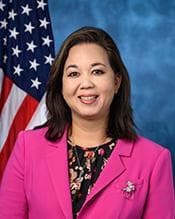
U.S. Representative
Jill N. Tokuda
Hawaii District 2
DemocratProgressive
Votes on Record
463
across 19 categories
Contact
U.S. Representative
Hawaii District 2
Votes on Record
463
across 19 categories
Contact
Voting Profile
Most Active Policy Areas
463
Votes Analyzed
Data sources: voteview, congress.gov
Political Position
She is not at the far end of the scale.
Near the average for Democrats (-0.38)
Data source: VoteView NOMINATE scores (UCLA/UC San Diego)
Policy Positions
463
total votes analyzed
At a Glance
Jill N. Tokuda is a Democratic member of the U.S. House of Representatives from Hawaii. This profile draws on 463 recorded votes. Her committee assignments were not included in the data. Her NOMINATE score of -0.475 puts her to the left of the average House Democrat (-0.380). In practice, that means she usually votes with the liberal wing of her party on contested questions.
Her yes-vote rates differ a lot from one policy area to another. She voted yes on most foreign policy measures (10 of 11) and on most defense measures (18 of 25). Her defense votes included support for veterans' legislation and for two War Powers Resolution measures directing the President to remove U.S. armed forces from Lebanon. Her yes-vote rate was lower on environment and energy votes (11 of 34), on immigration votes (2 of 8), and especially on budget votes (4 of 23). On the budget, she voted against both the fiscal year 2027 congressional budget resolution and a fiscal year 2027 continuing resolution, a temporary measure that keeps the government funded while Congress works on full-year spending bills.
A low yes-vote rate in a category does not by itself mean she opposes that policy area. The majority party controls which bills reach the House floor and how they are written. In this Congress the House majority is Republican, so many of her no votes may be votes against specific majority-party proposals rather than against the subject itself. For example, in environment and energy she voted no on a resolution to overturn an Environmental Protection Agency (EPA) decision on California's pollution standards for harbor boats. She voted yes on the Water Resources Development Act and the Ratepayer Protection Act.
The largest group of her votes (276) falls into an 'Other' category of mixed subjects, where she voted yes 61% of the time. Recent examples include a yes vote on the Retire through Ownership Act and no votes on the National Fraud Enforcement Division Act and the PROOF Act. Several categories, including healthcare, education, housing, and labor, have fewer than 10 recorded votes each, so conclusions about those areas are limited.
She voted for War Powers Resolution measures directing the President to remove U.S. armed forces from Lebanon, on June 4 and June 30, 2026. Both votes concerned Congress's role in authorizing military action.
She voted against the congressional budget resolution for fiscal year 2027 (July 22, 2026) and against a fiscal year 2027 continuing resolution (July 21, 2026). Overall she voted no on 19 of 23 budget-related measures.
She voted against a resolution to overturn an EPA decision approving California's pollution standards for commercial harbor boats (September 16, 2026). That vote supported leaving the California standards in place.
She voted for the Water Resources Development Act and the Ratepayer Protection Act (September 16, 2026), even though she voted no on most environment and energy measures overall (23 of 34).
She voted for the Take Care of America's Veterans Act (July 16, 2026) and for 72% of defense-related measures.
She voted for the Prison Staff Safety Enhancement Act and for a resolution honoring law enforcement officers killed in the line of duty. She voted no on 8 of 13 criminal justice measures overall.
The record shows a 'Nay' vote on a resolution to impeach President Donald Trump (September 15, 2026). Votes like this are often taken on procedural motions, such as a motion to table (set aside) the resolution, so this record alone does not show her view on the impeachment itself.
Yes/no split for each topic is on the Congressional Votes cards below.
Analysis updated: October 6, 2026
Campaign Finance
Includes all authorized campaign committees (principal committee, joint fundraising, and other authorized committees). Outside spending by Super PACs and independent groups is shown separately below.
Verify on FEC.gov →Career: $2.9M
Fundraising Over Time
Contribution Sources
78%
22%
Individual Breakdown
Itemized (>$200)
$553K
Small Dollar (≤$200)
$82K
Donation Sizes
Share of individual contribution dollars by donation size, current election cycle.
Where the Money Comes From
Itemized individual contributions only (donations over $200 report the donor's state). Small-dollar donations are not included because the FEC does not itemize them.
Top Contributors
Top Contributing Industries
Top Donor Employers
Employer as self-reported by itemized donors. “Not Employed” and “Self-Employed” typically rank highest for small-dollar campaigns and include retirees.
Where the Money Goes
Spending by Purpose
Purpose categories are self-reported on FEC filings; large “Other” totals are common.
Top Payees
DCCC
GUSTO
ROSS, BRITTANY
BLUE WAVE POLITICAL PARTNERS
PACIFIC CAMPAIGN HOUSE
KAIWI'ULA STRATEGIES
NGP VAN
ACTBLUE TECHNICAL SERVICES
Detailed Breakdown
Expenditures
Operating Costs
$486K
Operating Offsets
$2K
Net Operating
$485K
Refunds
Individual Refunds
$7K
Committee Refunds
$9K
Outside Spending (Super PACs)
Supporting
$239K
Opposing
$603K
Total Outside Spending
$843K
Top Outside Spenders
VOTEVETS
CONGRESSIONAL PROGRESSIVE CAUCUS PAC
MAINSTREAM DEMOCRATS PAC
MEDICARE FOR ALL
DEMOCRATIC PARTY OF HAWAII
SIERRA CLUB INDEPENDENT ACTION
Independent expenditures are made without coordination with the candidate. Source: FEC Schedule E filings.
Voting Record
463 votes across 19 categories
Bars show how they voted on the key bills we analyzed in each topic. Tap a card to see every vote.