
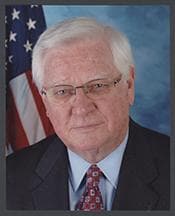
U.S. Representative
Harold Rogers
Kentucky District 5
RepublicanConservative
Votes on Record
3,405
across 21 categories
Contact
U.S. Representative
Kentucky District 5
Votes on Record
3,405
across 21 categories
Contact
Voting Profile
Most Active Policy Areas
3405
Votes Analyzed
Data sources: voteview, congress.gov
Political Position
In practice, he votes with conservatives on most issues but is less consistently conservative than many of his Republican colleagues.
More liberal than the average Republican (0.52)
Data source: VoteView NOMINATE scores (UCLA/UC San Diego)
Policy Positions
3405
total votes analyzed
At a Glance
Harold Rogers is a Republican member of the U.S. House of Representatives from Kentucky. This profile is based on 3,405 recorded votes. Committee assignments were not available in the data. His ideology score marks him as a conservative who sits closer to the political center than the average Republican. NOMINATE scores mainly reflect positions on economic issues and the size and role of government.
The largest share of his recorded votes deals with the federal budget and spending (602 votes), defense (287), healthcare (223), and environment and energy (162). He votes Yea more often than Nay in nearly every category, usually 60% to 75% of the time. A high Yea rate does not by itself show whether he supports or opposes a policy, because many House votes are procedural, and a Yea can mean approving a bill or approving a measure that blocks or reverses a policy. In recent budget votes, he supported the Republican-led fiscal year 2027 budget resolution and a continuing resolution, a temporary spending bill that keeps the government funded while Congress finishes its annual budget.
On defense and foreign policy, he has voted against resolutions that would have required the President to withdraw U.S. forces from Lebanon. On healthcare, his recent votes follow the usual pattern for a member of the majority party: he supported the procedural rule bringing several health bills to the floor and voted against minority-party attempts to send those bills back to committee. On environment and energy, he voted for the Water Resources Development Act, the Ratepayer Protection Act, and a resolution overturning an EPA approval of California pollution standards for harbor boats.
A few areas have very few recorded votes, including reproductive rights (3), guns and firearms (3), and civil rights (8). Conclusions about his positions in those areas rest on very limited data.
His ideology score of 0.333 places him to the left of the average House Republican (0.520), so he is a more moderate member of his party's conference.
He voted for the fiscal year 2027 congressional budget resolution (July 22, 2026) and for a continuing resolution to keep the government funded (July 21, 2026).
He twice voted against War Powers Resolution measures directing the President to remove U.S. forces from Lebanon (June 4 and June 30, 2026), which supports leaving those decisions with the executive branch.
On healthcare bills in December 2025, including the Lower Health Care Premiums for All Americans Act and the Do No Harm in Medicaid Act, he voted against motions to recommit. A motion to recommit is a minority-party attempt to send a bill back to committee or change it before the final vote.
He voted to overturn an EPA decision approving California's pollution standards for commercial harbor boats, and he voted for the Ratepayer Protection Act (September 16, 2026).
He voted against the Take Care of America’s Veterans Act (July 16, 2026) and against extending certain North Atlantic right whale protection regulations (September 1, 2026).
He votes Yea most often on technology (85.7%), trade (76.3%), criminal justice (75.7%), education (74.2%), and agriculture (73.3%). He votes Yea least often on civil rights (25.0% of 8 votes) and immigration (51.7%).
Yes/no split for each topic is on the Congressional Votes cards below.
Analysis updated: October 6, 2026
Campaign Finance
Includes all authorized campaign committees (principal committee, joint fundraising, and other authorized committees). Outside spending by Super PACs and independent groups is shown separately below.
Verify on FEC.gov →Career: $15.7M
Fundraising Over Time
Contribution Sources
56%
44%
Individual Breakdown
Itemized (>$200)
$402K
Small Dollar (≤$200)
$1K
Donation Sizes
Share of individual contribution dollars by donation size, current election cycle.
Where the Money Comes From
Itemized individual contributions only (donations over $200 report the donor's state). Small-dollar donations are not included because the FEC does not itemize them.
Top Contributors
Top Contributing Industries
Top Donor Employers
Employer as self-reported by itemized donors. “Not Employed” and “Self-Employed” typically rank highest for small-dollar campaigns and include retirees.
Where the Money Goes
Spending by Purpose
Purpose categories are self-reported on FEC filings; large “Other” totals are common.
Top Payees
GRIT CREATIVE, LLC
CARDMEMBER SERVICE
CHURCHILL DOWNS INC.
CAPITAL RESEARCH GROUP
CFS COMPLIANCE
MULLENIX DESIGN
AD EAST, INC.
MITCHELL, ROBERT
Detailed Breakdown
Expenditures
Operating Costs
$914K
Operating Offsets
$2K
Net Operating
$912K
Refunds
Individual Refunds
$10K
Committee Refunds
$1K
Outside Spending (Super PACs)
Supporting
$12K
Opposing
$17K
Total Outside Spending
$29K
Top Outside Spenders
NRA POLITICAL VICTORY FUND
NATIONAL RIGHT TO LIFE POLITICAL ACTION COMMITTEE
CARE ACTION
EVERYTOWN FOR GUN SAFETY ACTION FUND
TOGETHER WE THRIVE
COUNCIL FOR NATIONAL DEFENSE INC, THE
KENTUCKY PRO-LIFE POLITICAL ACTION COMMITTEE
NATIONAL CHAMBER ALLIANCE FOR POLITICAL OF THE CHAMBER OF THE COMMERCE OF THE USA
Independent expenditures are made without coordination with the candidate. Source: FEC Schedule E filings.
Voting Record
3,405 votes across 21 categories
Bars show how they voted on the key bills we analyzed in each topic. Tap a card to see every vote.