
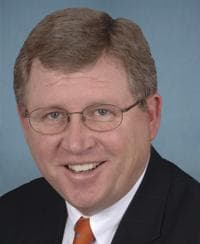
U.S. Representative
Frank D. Lucas
Oklahoma District 3
RepublicanConservative
Votes on Record
747
across 19 categories
Contact
U.S. Representative
Oklahoma District 3
Votes on Record
747
across 19 categories
Contact
Voting Profile
Most Active Policy Areas
747
Votes Analyzed
Data sources: voteview, congress.gov
Political Position
He still votes with the conservative side far more often than with the liberal side.
More liberal than the average Republican (0.52)
Data source: VoteView NOMINATE scores (UCLA/UC San Diego)
Policy Positions
747
total votes analyzed
At a Glance
Frank D. Lucas is a Republican member of the U.S. House of Representatives from Oklahoma, with 747 recorded votes in this dataset. His ideology score of 0.361 is about 0.16 points closer to the center than the Republican average of 0.520. That places him among the more moderate Republicans by this measure, while he remains clearly within the conservative half of Congress. His committee assignments were not available in this data.
His most frequent vote categories are general legislation (284 votes), healthcare (163), budget (73) and agriculture (44). Many of the healthcare and budget votes are procedural. These are votes on the rules for how a bill will be debated ("ordering the previous question") or on a "motion to recommit," which is usually the minority party's last attempt to change or send back a bill before the final vote. In December 2025 he followed the usual majority-party pattern on these: he voted yes on ordering the previous question for a rule covering the Lower Health Care Premiums for All Americans Act and the Do No Harm in Medicaid Act, and no on the motions to recommit both bills.
On spending, he voted for the fiscal year 2027 congressional budget resolution and for a continuing resolution, a short-term bill that keeps the government funded at existing levels (both July 2026). He voted against the fiscal year 2027 Agriculture appropriations bill (June 2026), although the day before he had voted for the rule that brought it to the floor. He supported most environment and energy measures (31 of 35), every recorded criminal justice measure (13 of 13) and every recorded technology measure (10 of 10). In 2026 he voted against a War Powers Resolution measure that would have directed the removal of U.S. forces from Lebanon.
Voters should know the limits of this data. The yes and no percentages show how often he voted for whatever was on the floor in each category. They do not show which party wrote each bill or whether he voted with or against his party. A yes vote can mean support for either a conservative or a liberal proposal, depending on the bill. Some categories, such as reproductive rights and civil rights, contain only one vote each and say little about his overall views.
Voted for the Republican-led fiscal year 2027 congressional budget resolution (July 22, 2026) and for a continuing resolution to keep the government funded (July 21, 2026).
Voted against the fiscal year 2027 Agriculture, Rural Development, and FDA appropriations bill (June 4, 2026), one day after voting for the rule that set the terms for debating it.
In December 2025 he voted against the motions to recommit on the Lower Health Care Premiums for All Americans Act and the Do No Harm in Medicaid Act. These were the minority party's last attempts to change those bills before the final vote.
Voted against a War Powers Resolution measure directing the removal of U.S. armed forces from Lebanon (June 4, 2026). He did not vote on a related Lebanon measure on June 30, 2026.
Voted for all 13 recorded criminal justice measures and all 10 recorded technology measures, and for 31 of 35 environment and energy measures.
Voted against the Take Care of America's Veterans Act (July 16, 2026) and against 4 of 6 recorded labor measures.
On September 16, 2026, voted for the National Fraud Enforcement Division Act, the PROOF Act and the Retire through Ownership Act.
Yes/no split for each topic is on the Congressional Votes cards below.
Analysis updated: October 6, 2026
Campaign Finance
Includes all authorized campaign committees (principal committee, joint fundraising, and other authorized committees). Outside spending by Super PACs and independent groups is shown separately below.
Verify on FEC.gov →Career: $15.8M
Fundraising Over Time
Contribution Sources
25%
75%
Individual Breakdown
Itemized (>$200)
$216K
Small Dollar (≤$200)
$4K
Donation Sizes
Share of individual contribution dollars by donation size, current election cycle.
Where the Money Comes From
Itemized individual contributions only (donations over $200 report the donor's state). Small-dollar donations are not included because the FEC does not itemize them.
Top Contributors
Top Contributing Industries
Top Donor Employers
Employer as self-reported by itemized donors. “Not Employed” and “Self-Employed” typically rank highest for small-dollar campaigns and include retirees.
Where the Money Goes
Spending by Purpose
Purpose categories are self-reported on FEC filings; large “Other” totals are common.
Top Payees
MEDIUM BUYING
ETHOS ADVISORS, LLC
BALKENBUSH, SUSAN
SOUTH CREEK GROUP
ACME STRATEGIES LLC
COLE HARGRAVE & SNODGRASS
U.S. TREASURY/IRS
ARISTOTLE PUBLISHING
Detailed Breakdown
Expenditures
Operating Costs
$941K
Operating Offsets
$13K
Net Operating
$928K
Refunds
Individual Refunds
$30
Outside Spending (Super PACs)
Supporting
$68K
Opposing
$7K
Total Outside Spending
$74K
Top Outside Spenders
CLEARPATH ACTION FUND, INC.
CITIZENS FOR RESPONSIBLE ENERGY SOLUTIONS INC.
NATIONAL RIGHT TO LIFE POLITICAL ACTION COMMITTEE
CLUB FOR GROWTH ACTION
EVERYTOWN FOR GUN SAFETY ACTION FUND
UNITED SENIORS PAC INC
NATIONAL RIGHT TO LIFE VICTORY FUND
PLANNED PARENTHOOD ACTION FUND INC
Independent expenditures are made without coordination with the candidate. Source: FEC Schedule E filings.
Voting Record
747 votes across 19 categories
Bars show how they voted on the key bills we analyzed in each topic. Tap a card to see every vote.