
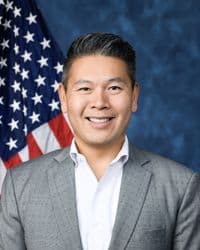
U.S. Representative
Derek Tran
California District 45
DemocratModerate Liberal
Votes on Record
452
across 19 categories
Contact
U.S. Representative
California District 45
Votes on Record
452
across 19 categories
Contact
Voting Profile
Most Active Policy Areas
452
Votes Analyzed
Data sources: voteview, congress.gov
Political Position
The average House Democrat scores about -0.380, which makes him one of the more moderate Democrats in the chamber by this measure.
More conservative than the average Democrat (-0.38)
Data source: VoteView NOMINATE scores (UCLA/UC San Diego)
Policy Positions
452
total votes analyzed
At a Glance
Derek Tran represents California in the U.S. House of Representatives. This profile is based on 452 recorded votes. The largest group, 274 votes, falls under a general 'Other' category that covers a wide range of bills and procedural questions. His ideology score of -0.245 is more conservative than the Democratic average of -0.380. That suggests he usually votes with his party but sides with the other party more often than a typical Democrat does.
His voting patterns differ a good deal from one policy area to another. He voted Yea on every recorded foreign policy vote (11 of 11) and every labor vote (5 of 5). He also supported most defense measures (16 of 23 Yea). On budget legislation he voted Nay far more often than Yea (19 Nay, 5 Yea). That included Nay votes on the fiscal year 2027 congressional budget resolution and on a fiscal year 2027 continuing appropriations bill, which is a temporary measure to keep the government funded. On environment and energy he voted Nay on 21 of 34 votes. One of those was a Nay vote on a resolution to overturn an EPA decision about California's pollution standards for harbor boats. In that case a Nay vote meant keeping the California standards in place.
In other areas his record is more mixed. He voted Yea on most taxation (8 of 11), technology (7 of 10), and criminal justice (8 of 13) measures. Examples include the Prison Staff Safety Enhancement Act and a resolution honoring law enforcement officers killed in the line of duty. On education, immigration, and housing he voted Nay more often than Yea. Some topics have only a few recorded votes, including healthcare, Social Security, banking, reproductive rights, and civil rights, so the record says little about his positions there.
Yea and Nay percentages alone can be misleading. Whether a Yea vote 'supports' a policy depends on how the bill or resolution was written. For example, voting Nay on a resolution that would cancel a regulation is effectively a vote to keep that regulation.
He voted Nay on a resolution to overturn the EPA's approval of California's pollution standards for commercial harbor boats. That vote supported keeping the state standards in place.
He voted Nay on the fiscal year 2027 congressional budget resolution (July 22, 2026) and on a fiscal year 2027 continuing appropriations bill (July 21, 2026). Overall he voted Nay on 19 of 24 budget measures.
He voted Yea on a War Powers Resolution measure directing the President to remove U.S. armed forces from hostilities in Lebanon (June 30, 2026). He did not vote on an earlier, related Lebanon measure (June 4, 2026).
He voted Yea on all 11 recorded foreign policy votes and all 5 recorded labor votes.
He voted Yea on the Take Care of America's Veterans Act and supported 16 of 23 defense-related measures.
On September 16, 2026, he voted Yea on the National Fraud Enforcement Division Act, the Retire through Ownership Act, the Ratepayer Protection Act, and the Water Resources Development Act. He voted Nay on the PROOF Act the same day.
He did not cast a vote on the September 15, 2026 resolution to impeach President Donald Trump.
Yes/no split for each topic is on the Congressional Votes cards below.
Analysis updated: October 6, 2026
Voting Record
452 votes across 19 categories
Bars show how they voted on the key bills we analyzed in each topic. Tap a card to see every vote.