
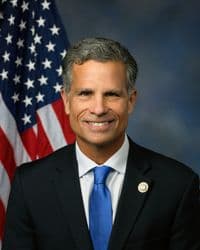
U.S. Representative
Daniel Meuser
Pennsylvania District 9
RepublicanConservative
Votes on Record
495
across 19 categories
Contact
U.S. Representative
Pennsylvania District 9
Votes on Record
495
across 19 categories
Contact
Voting Profile
Most Active Policy Areas
495
Votes Analyzed
Data sources: voteview, congress.gov
Political Position
The gap is small, though, and he sits well inside the mainstream of his party rather than toward either edge of it.
Near the average for Republicans (0.52)
Data source: VoteView NOMINATE scores (UCLA/UC San Diego)
Policy Positions
495
total votes analyzed
At a Glance
Daniel Meuser is a Republican member of the U.S. House of Representatives from Pennsylvania. This profile draws on 495 recorded votes. More than half of them (276) fall into a general 'other' category covering a wide range of bills. He voted Yea on about 72% of those, including three bills on September 16, 2026: the National Fraud Enforcement Division Act, the PROOF Act, and the Retire through Ownership Act. Committee assignments were not available for this profile.
On environment and energy, he voted Yea on 30 of 34 votes (88%). His recent Yea votes include the Ratepayer Protection Act, the Water Resources Development Act, and a resolution under the Congressional Review Act to overturn an Environmental Protection Agency (EPA) decision about California's pollution standards for harbor boats and nonroad engines. The Congressional Review Act lets Congress cancel a federal agency rule if both chambers pass a resolution and the President signs it. On budget matters, he voted Yea on 22 of 29 votes (76%). These include the fiscal year 2027 budget resolution and a continuing resolution, which is a temporary funding measure that keeps the government running while Congress works on full-year spending bills.
Healthcare is one of the few areas where he voted Nay more often than Yea (10 Yea, 18 Nay). His recent healthcare votes in December 2025 were mostly procedural. He voted against motions to recommit on the Lower Health Care Premiums for All Americans Act and the Do No Harm in Medicaid Act. A motion to recommit is usually offered by the minority party to send a bill back with proposed changes, and majority-party members typically vote against it. He also voted Yea on 'ordering the previous question' on the rule that brought those bills to the floor. That procedural vote ends debate on a rule and is usually decided along party lines.
On defense, he voted Yea on 15 of 26 votes (58%). He voted against a War Powers Resolution that would have directed the President to remove U.S. forces from hostilities in Lebanon, and he did not vote on an earlier, similar measure. He also voted against the Take Care of America's Veterans Act. His records show high Yea rates on technology (10 of 10), taxation (9 of 11), and criminal justice (9 Yea, 0 Nay). He voted Nay more often than Yea on foreign policy (4 Yea, 7 Nay) and labor (1 Yea, 3 Nay). Several categories have fewer than 15 votes, so patterns in those areas rest on limited data.
Voted Yea on 88% of environment and energy votes (30 of 34). These include the Ratepayer Protection Act and a resolution to overturn an EPA decision on California's harbor craft and nonroad engine pollution standards (September 2026).
Voted Yea on the fiscal year 2027 congressional budget resolution (July 22, 2026) and on a continuing resolution to temporarily fund the government (July 21, 2026).
Voted Nay on a War Powers Resolution directing the President to remove U.S. armed forces from hostilities in Lebanon (June 30, 2026).
Voted Nay on the Take Care of America's Veterans Act (July 16, 2026).
Voted Nay on minority-party motions to recommit (send back for changes) the Lower Health Care Premiums for All Americans Act and the Do No Harm in Medicaid Act (December 2025). He voted Nay on 18 of 29 healthcare votes overall.
Voted Yea on all 10 recorded technology votes and on 9 of 11 taxation votes.
Voted Nay on a bill to extend the time period for certain North Atlantic right whale regulations created under the Consolidated Appropriations Act, 2023 (September 1, 2026).
Yes/no split for each topic is on the Congressional Votes cards below.
Analysis updated: October 6, 2026
Campaign Finance
Includes all authorized campaign committees (principal committee, joint fundraising, and other authorized committees). Outside spending by Super PACs and independent groups is shown separately below.
Verify on FEC.gov →Career: $10.6M
Fundraising Over Time
Contribution Sources
53%
47%
Individual Breakdown
Itemized (>$200)
$884K
Small Dollar (≤$200)
$7K
Donation Sizes
Share of individual contribution dollars by donation size, current election cycle.
Where the Money Comes From
Itemized individual contributions only (donations over $200 report the donor's state). Small-dollar donations are not included because the FEC does not itemize them.
Top Contributors
Top Contributing Industries
Top Donor Employers
Employer as self-reported by itemized donors. “Not Employed” and “Self-Employed” typically rank highest for small-dollar campaigns and include retirees.
Where the Money Goes
Spending by Purpose
Purpose categories are self-reported on FEC filings; large “Other” totals are common.
Top Payees
NRCC
THE THEODORE COMPANY
DIESEL, MARIA I.
FABRIZIO, LEE & ASSOCIATES, LLC
MAR-A-LAGO CLUB LLC
LN CONSULTING, LLC
REPUBLICAN PARTY OF PENNSYLVANIA
VERGNETTI, LEO P. MR.
Detailed Breakdown
Expenditures
Operating Costs
$1.1M
Operating Offsets
$31K
Net Operating
$1.1M
Refunds
Individual Refunds
$5K
Committee Refunds
$300
Outside Spending (Super PACs)
Supporting
$171K
Opposing
$80K
Total Outside Spending
$250K
Top Outside Spenders
CITIZENS FOR A STRONG AMERICA INC
CLUB FOR GROWTH PAC
NATIONAL RIFLE ASSOCIATION OF AMERICA POLITICAL VICTORY FUND
RURAL FREEDOM NETWORK
TOGETHER WE THRIVE
PENNSYLVANIA PRO-LIFE FEDERATION PAC
Independent expenditures are made without coordination with the candidate. Source: FEC Schedule E filings.
Voting Record
495 votes across 19 categories
Bars show how they voted on the key bills we analyzed in each topic. Tap a card to see every vote.