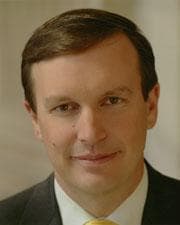
U.S. Senator
Christopher Murphy
Connecticut
DemocratModerate Liberal
Votes on Record
770
across 19 categories
Contact
U.S. Senator
Connecticut
Votes on Record
770
across 19 categories
Contact
Voting Profile
Most Active Policy Areas
770
Votes Analyzed
Data sources: voteview, congress.gov
Political Position
Senator Christopher Murphy holds a moderate liberal position within the Democratic Party. His NOMINATE ideology score of -0.287 places him closer to the political center than the average Senate Democrat (whose score is approximately -0.380). This means that while he generally aligns with his party on most issues, he occasionally breaks from the Democratic mainstream and is considered one of the more centrist members of his caucus.
Near the average for Democrats (-0.38)
Data source: VoteView NOMINATE scores (UCLA/UC San Diego)
Policy Positions
770
total votes analyzed
Overview
Senator Christopher Murphy of Connecticut has cast 770 recorded votes across a wide range of policy areas. His voting record shows strongest engagement in healthcare, environment and energy, and defense policy — the three categories where he has cast the most votes. On healthcare, Murphy has supported the majority of measures that came before him, voting in favor roughly 59% of the time. His votes include support for measures addressing insurance company practices in patient care access. In defense and foreign policy, he has consistently voted to assert congressional authority over military action, including votes to direct the removal of U.S. forces from unauthorized hostilities. His foreign policy voting pattern is notable for an exceptionally low yea rate (under 2%), suggesting he frequently opposed the foreign policy measures that reached the Senate floor during this period. Murphy has shown a pattern of supporting government accountability measures, including voting to withhold senators' pay during government shutdowns and supporting appropriations for oversight of detention facilities. On trade, he supported the large majority of measures (83%), making it one of his highest approval categories. His environmental votes reflect a mixed record — he supported some regulatory measures, such as those related to chemical reporting requirements, while opposing others. Overall, Murphy's record reflects a senator who generally votes with his party but demonstrates some independence, particularly compared to the average Democrat. His most active areas of legislative engagement — healthcare, environment, and defense — align with issues of particular importance to Connecticut voters.
Key Positions
By Policy Area
Analysis updated: September 18, 2026
Campaign Finance
Includes all authorized campaign committees (principal committee, joint fundraising, and other authorized committees). Outside spending by Super PACs and independent groups is shown separately below.
Verify on FEC.gov →Career: $54.3M
Fundraising Over Time
Contribution Sources
100%
Individual Breakdown
Itemized (>$200)
$4.1M
Small Dollar (<$200)
$8.2M
Donation Sizes
Share of individual contribution dollars by donation size, current election cycle.
Where the Money Comes From
Itemized individual contributions only (donations over $200 report the donor's state). Small-dollar donations are not included because the FEC does not itemize them.
Top Contributors
Top Contributing Industries
Top Donor Employers
Employer as self-reported by itemized donors. “Not Employed” and “Self-Employed” typically rank highest for small-dollar campaigns and include retirees.
Where the Money Goes
Spending by Purpose
Purpose categories are self-reported on FEC filings; large “Other” totals are common.
Top Payees
AISLE 518 STRATEGIES LLC
ACTBLUE TECHNICAL SERVICES
AMERICAN EXPRESS
NGP VAN, INC.
STRAUS/BAKER LLC
PAYCHEX
POLITICAL COMPLIANCE MANAGEMENT SERVICES
ELIAS LAW GROUP
Detailed Breakdown
Expenditures
Operating Costs
$7.2M
Operating Offsets
$8K
Net Operating
$7.2M
Refunds
Individual Refunds
$75K
Committee Refunds
$3K
Outside Spending (Super PACs)
Supporting
$2.9M
Opposing
$207K
Total Outside Spending
$3.1M
Top Outside Spenders
CONNECTICUT'S FUTURE PAC INC
WORKING FOR US POLITICAL ACTION COMMITTEE INC
ENVIRONMENT AMERICA ACTION FUND
ARDA-ROC
NATIONAL RIFLE ASSOCIATION INSTITUTE FOR LEGISLATIVE ACTION
NATIONAL EMERGENCY MEDICINE POLITICAL ACTION COMMITTEE
HUMANE SOCIETY LEGISLATIVE FUND
UNITE HERE TIP STATE & LOCAL FUND
Independent expenditures are made without coordination with the candidate. Source: FEC Schedule E filings.
Voting Record
770 votes across 19 categories