
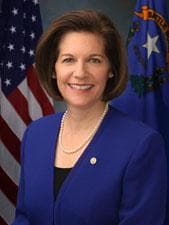
U.S. Senator
Catherine Cortez Masto
Nevada
DemocratProgressive
Votes on Record
654
across 20 categories
Contact
U.S. Senator
Nevada
Votes on Record
654
across 20 categories
Contact
Voting Profile
Most Active Policy Areas
654
Votes Analyzed
Data sources: voteview, congress.gov
Political Position
The gap is small, and her overall record lines up closely with her party.
Near the average for Democrats (-0.38)
Data source: VoteView NOMINATE scores (UCLA/UC San Diego)
Policy Positions
654
total votes analyzed
At a Glance
Catherine Cortez Masto is a Democratic U.S. Senator from Nevada with 654 recorded votes in this dataset. Her ideology score places her within the mainstream of Senate Democrats, slightly toward the moderate side of her party. A 'Yea' vote means yes and a 'Nay' vote means no. A 'no' does not always mean she opposes a policy goal, though. Many Senate votes are on amendments, procedural steps, or nominations, so a single vote can have several possible meanings.
A large share of her recorded votes are 'no' votes, especially in the 'Other' (13.1% yes) and 'Foreign Policy' (7.3% yes) categories. The sample votes show that many of these are on presidential nominations, the Senate's process for confirming people the President appoints. Examples include a federal district judge, the Director of National Intelligence, the Director of the Centers for Disease Control and Prevention, and a group of Treasury Department nominees. She voted 'no' on each of these sampled nominations.
She often used the Congressional Review Act, a law that lets Congress vote to overturn a federal agency rule. She voted 'yes' on resolutions to overturn four agency rules: an EPA rule changing the reporting timeline for PFAS chemicals (sometimes called 'forever chemicals'), a child care funding rule, a Medicare rule on prior authorization (requiring approval before certain services are covered), and an Affordable Care Act marketplace rule. On military matters, she twice voted 'yes' on resolutions directing the removal of U.S. forces from hostilities against Iran that Congress had not authorized. She voted 'no' on a vote related to the fiscal year 2027 defense authorization bill.
Her 'yes' rates are higher in Defense (59.6%), Budget (59.6%), Taxation (62.5%), Trade (66.7%), and Labor (60.0%). These are areas where she more often supported the measures brought to a vote. Some categories have very few votes: Guns and Firearms (2), Reproductive Rights (1), and Criminal Justice (1). Those records are too small to show a clear pattern. The category labels in this dataset are assigned automatically and some appear imprecise. For example, a child care rule appears under Environment/Energy and Treasury nominations appear under Foreign Policy. Category totals should be read as rough groupings.
She consistently voted against presidential nominees in the sampled votes, including federal judge nominee Matthew R. Byrne (September 2026), Director of National Intelligence nominee Walter Clayton (July 2026), and CDC Director nominee Erica Schwartz (August 2026).
She voted 'yes' twice in July 2026 on joint resolutions directing the removal of U.S. Armed Forces from hostilities against Iran that had not been authorized by Congress.
She voted 'no' on a July 2026 vote related to the fiscal year 2027 National Defense Authorization Act, the yearly bill that sets defense policy and spending levels.
She voted to overturn two health-related federal rules: a Medicare prior-authorization rule (the WISeR Model, July 2026) and an Affordable Care Act marketplace rule (January 2026).
She voted to overturn an EPA rule that changed the start of the reporting period for PFAS chemicals (August 2026), and a federal rule on flexibility in the Child Care and Development Fund (July 2026).
She voted 'no' on an August 2026 amendment that would have removed a provision placing duties (import taxes) on countries that buy Russian oil or gas or help evade sanctions.
She voted 'yes' in September 2026 on a bill to protect college athletes' rights over their name, image, and likeness and to set rules for competition in college sports.
Yes/no split for each topic is on the Congressional Votes cards below.
Analysis updated: October 6, 2026
Campaign Finance
Includes all authorized campaign committees (principal committee, joint fundraising, and other authorized committees). Outside spending by Super PACs and independent groups is shown separately below.
Verify on FEC.gov →Career: $92.6M
Fundraising Over Time
Contribution Sources
92%
8%
0%
Individual Breakdown
Itemized (>$200)
$2.3M
Small Dollar (≤$200)
$2.2M
Donation Sizes
Share of individual contribution dollars by donation size, current election cycle.
Where the Money Comes From
Itemized individual contributions only (donations over $200 report the donor's state). Small-dollar donations are not included because the FEC does not itemize them.
Top Contributors
Top Contributing Industries
Top Donor Employers
Employer as self-reported by itemized donors. “Not Employed” and “Self-Employed” typically rank highest for small-dollar campaigns and include retirees.
Where the Money Goes
Spending by Purpose
Purpose categories are self-reported on FEC filings; large “Other” totals are common.
Top Payees
PAYROLL DATA PROCESSING
RWT PRODUCTION
AMERICAN EXPRESS
MISSIONWIRED
ELIAS LAW GROUP
BF DIRECT, LLC
NGP VAN, INC.
CAPITOL COMPLIANCE ASSOCIATES, INC.
Detailed Breakdown
Expenditures
Operating Costs
$5.0M
Operating Offsets
$387K
Net Operating
$4.6M
Transfers
Transfers Out
$3K
Refunds
Individual Refunds
$44K
Committee Refunds
$300
Outside Spending (Super PACs)
Supporting
$25.2M
Opposing
$89.7M
Total Outside Spending
$114.9M
Top Outside Spenders
SENATE LEADERSHIP FUND
CLUB FOR GROWTH ACTION
NRSC
SENATE MAJORITY PAC
FREEDOM PARTNERS ACTION FUND, INC.
LCV VICTORY FUND
SOMOS PAC
MAKE AMERICA GREAT AGAIN INC.
Independent expenditures are made without coordination with the candidate. Source: FEC Schedule E filings.
Voting Record
654 votes across 20 categories
Bars show how they voted on the key bills we analyzed in each topic. Tap a card to see every vote.