
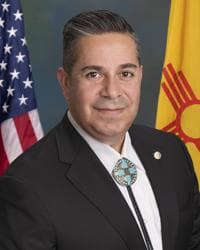
U.S. Senator
Ben Ray Luján
New Mexico
DemocratProgressive
Votes on Record
724
across 19 categories
Contact
U.S. Senator
New Mexico
Votes on Record
724
across 19 categories
Contact
Voting Profile
Most Active Policy Areas
724
Votes Analyzed
Data sources: voteview, congress.gov
Political Position
His score matches the Democratic Party average of -0.380 exactly, so he sits in the middle of his party: neither among its most liberal members nor among its more moderate ones.
Near the average for Democrats (-0.38)
Data source: VoteView NOMINATE scores (UCLA/UC San Diego)
Policy Positions
724
total votes analyzed
At a Glance
Ben Ray Luján is a Democratic U.S. Senator from New Mexico with 724 recorded votes in this dataset. His ideology score equals his party's average, which suggests his overall voting pattern closely follows the typical Senate Democrat. Many of the most recent votes in his record involve nominees put forward by the current Republican administration, including federal judges, a Director of National Intelligence, a CDC Director, and senior Treasury officials. He voted against each of the nominees shown in the sample. This helps explain the high share of 'Nay' votes in several categories, especially 'Other' (185 of 226 votes were Nay) and 'Foreign Policy' (52 of 54 were Nay).
On healthcare, his votes are split almost evenly (54 Yea, 49 Nay). Recent examples show him voting for a resolution to overturn a Medicare rule that introduced prior authorization for certain services, and for a procedural objection aimed at insurance companies delaying or denying patient care. On defense and national security, he voted Yea on 59% of defense votes. That includes two votes for resolutions directing the removal of U.S. forces from hostilities against Iran that Congress had not authorized. He voted against the fiscal year 2027 defense authorization bill in a July 2026 vote.
On environmental and energy matters, he voted Yea on about 24% of the 72 votes. Recent examples include support for overturning an EPA rule that changed the start of the reporting period for PFAS chemicals (long-lasting industrial chemicals sometimes called 'forever chemicals') and support for striking a provision that would have placed duties on countries buying Russian-origin oil or gas. Some votes appear to have been grouped into categories automatically. For example, a child care funding rule is listed under environment and energy, so category totals are best read as rough guides rather than exact measures.
He voted Yea more often than Nay in a few areas: trade (5 of 6), taxation (15 of 26), and housing (7 of 13). He voted Nay on all 5 labor votes and both firearms votes in the record. The descriptions of those votes are not included in this data, so the specific measures he opposed cannot be identified here. In other areas, such as immigration, budget, banking, and agriculture, most of his recorded votes were Nay.
He voted against several nominees put forward by the current administration, including CDC Director nominee Erica Schwartz (August 2026), Director of National Intelligence nominee Walter Clayton (July 2026), and district judge nominee Matthew R. Byrne (September 2026).
He voted twice in July 2026 for joint resolutions directing the removal of U.S. Armed Forces from hostilities against Iran that had not been authorized by Congress.
He voted for a July 2026 resolution to overturn a Medicare rule that introduced prior authorization requirements for select services under the WISeR pilot model.
He voted for an April 2026 point of order objecting to budget reconciliation legislation that did not address insurance companies delaying or denying patient care. A point of order is a formal procedural objection that a bill breaks Senate rules.
He voted for an August 2026 resolution to overturn an EPA rule that changed when reporting on PFAS chemicals would begin.
He voted against the fiscal year 2027 National Defense Authorization Act, the annual bill setting military policy and spending levels, in a July 2026 Senate vote.
He voted for a September 2026 bill to protect the name, image, and likeness rights of college athletes and set rules for competition in intercollegiate sports.
Yes/no split for each topic is on the Congressional Votes cards below.
Analysis updated: October 6, 2026
Voting Record
724 votes across 19 categories
Bars show how they voted on the key bills we analyzed in each topic. Tap a card to see every vote.