
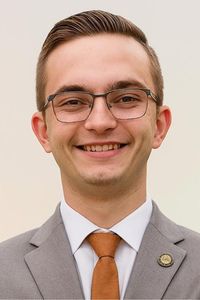
Background
Zach Hall was born in Toledo, Ohio. His career experience includes working in retail management.[1]
In their own words
Who are you? Tell us about yourself.
Zach Hall is a lifelong Ohioan, community advocate, and proud Libertarian running to bring principled leadership to the Ohio Statehouse. A dedicated husband to Santiago and a long-time employee at Kroger, Zach understands the challenges working families face every day. He has served his community in grassroots roles, including as Deputy Campaign Manager for the Roberto Torres for Mayor campaign, and is active in local neighborhood initiatives like the Barrows Street Block Watch Association.
Growing up in Ohio, Zach saw firsthand how government overreach, burdensome taxes, and poor spending decisions hurt everyday people. That’s why he’s committed to fighting for lower taxes, protecting individual freedoms, and ensuring government stays accountable to the people—not special interests. His platform focuses on eliminating property taxes so families can truly own their homes, ending qualified immunity to ensure accountability in law enforcement, and restoring fiscal responsibility in Columbus.
Please list below 3 key messages of your campaign. What are the main points you want voters to remember about your goals for your time in office?
End Property Taxes – Let Ohioans Truly Own Their Homes
No one should have to pay rent to the government forever. Eliminating property taxes will protect homeowners, strengthen communities, and give families true ownership.Accountability for All – End Qualified Immunity
Public officials and law enforcement should be held to the same standards as the people they serve. I’ll work to ensure accountability, transparency, and trust in our institutions.Defend Individual Freedoms – Put People Over Politics
Government should protect your rights, not control your life. I’ll fight to restore liberty, personal responsibility, and freedom of choice for every Ohioan
What areas of public policy are you personally passionate about?
Tax Reform & Property Rights
•
Eliminating property taxes so Ohioans can truly own their homes.
•
Reducing the overall tax burden on individuals and businesses.
•
Prioritizing fiscal responsibility and cutting wasteful government spending.
2.
Individual Liberties & Government Accountability
•
Defending constitutional rights, including free speech, self-defense, and privacy.
•
Ending qualified immunity to ensure public officials and law enforcement are held accountable.
•
Limiting government overreach and protecting personal freedom of choice.
3.
Community Safety & Local Empowerment
•
Supporting community-driven safety initiatives rather than top-down mandates.
•
Strengthening neighborhood involvement through local organizations an
Is there a book, essay, film, or something else you would recommend to someone who wants to understand your political philosophy?
If someone wants to understand my political philosophy, I’d recommend For a New Liberty by Murray Rothbard.
What characteristics or principles are most important for an elected official?
The most important qualities in an elected official are integrity, consistency, and courage.
What do you believe are the core responsibilities for someone elected to this office?
The core responsibilities of a State Representative are to protect the rights of their constituents, ensure government remains accountable, and be a true voice for the people they represent.
What was your very first job? How long did you have it?
My very first job was as a busboy at Inky’s, a local family-owned restaurant in Toledo.
What do you believe is the ideal relationship between the governor and state legislature?
The ideal relationship between the governor and the state legislature is one of respectful cooperation, healthy checks and balances, and a shared commitment to serving the people—not partisan agendas.
What do you perceive to be your state's greatest challenges over the next decade?
Ohio’s greatest challenges over the next decade will be economic freedom, government overreach, and infrastructure decay.
Do you believe that it’s beneficial for state legislators to have previous experience in government or politics?
Previous political experience can be helpful, but it’s not the most important qualification.
Do you believe it’s beneficial to build relationships with other legislators? Please explain your answer.
Yes—building relationships with other legislators is essential to getting things done, but those relationships should never come at the cost of your principles. In the legislature, no one passes meaningful reform alone. Working with colleagues across party lines can help find common ground, move good ideas forward, and stop bad policies before they become law.
That said, too many politicians confuse “getting along” with “going along.” I believe you can work respectfully and cooperatively without compromising your core values. My approach will be to build trust through honesty, listen to different perspectives, and find shared goals—while still standing firm when it comes to protecting the rights and freedoms of Ohioans.
Is there a particular legislator, past or present, whom you want to model yourself after?
If I had to choose one, I’d say Ron Paul.
Are you interested in running for a different political office (for example, the U.S. Congress or governor) in the future?
Right now, my focus is 100% on serving the people of my district in the Ohio House. This race isn’t about building a political résumé—it’s about delivering real results for Ohioans today.
Both sitting legislators and candidates for office hear many personal stories from the residents of their district. Is there a story that you’ve heard that you found particularly touching, memorable, or impactful?
One story that’s stayed with me came from a retired couple in my district who told me they were in danger of losing their home—not because they couldn’t pay their mortgage, but because rising property taxes had made it unaffordable to stay. They’d worked their whole lives, paid off their house, and wanted to spend their retirement in the community they’d built memories in. But the government was effectively telling them, “Pay us every year, or we’ll take it away.”
That conversation hit me hard. It put a human face on why eliminating property taxes isn’t just a policy position for me—it’s about protecting people’s homes, their security, and their dignity. It’s a reminder that every number in a budget represents a real person’s life, and that the decisions we make in Columbus have consequences that go far beyond spreadsheets.
Should the legislature oversee or grant the use of emergency powers?
Yes—the legislature should both oversee and strictly limit the use of emergency powers.
What is the first bill you would introduce if elected?
The first bill I would introduce would be to phase out and ultimately eliminate Ohio’s property tax. No one should have to pay the government every year just to keep living in a home they already own. My bill would protect homeowners—especially seniors and working families—by replacing property taxes with a fairer, more transparent funding system that doesn’t put people at risk of losing their homes.
What organizations or individuals have endorsed your campaign?
Chase Oliver: 2024 Libertarian Party Presidential Nominee
What committees interest you?
Ways & Means Committee – To address tax reform, work toward eliminating property taxes, and ensure Ohio’s fiscal policy respects taxpayers.
What are your views on financial transparency and government accountability?
Financial transparency and government accountability aren’t optional—they’re the foundation of public trust.
Do you support or oppose changes to the current state ballot initiative process? If so, what kind of changes would you consider?
I believe Ohio’s ballot initiative process is a vital tool of direct democracy, and while it should remain accessible, it also requires safeguards to preserve integrity—especially when it comes to summary language and process fairness.
On the 2026 ballot
Links
Compiled from the candidate’s published profile as of September 30, 2026.
Source(opens in new tab)