
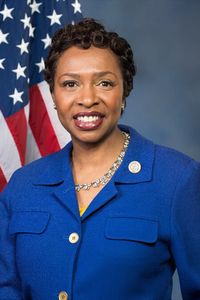
Background
Clarke was born in Brooklyn, N.Y.. She attended Oberlin College from 1982 to 1986.[1]
Prior to her election to the New York City Council, Clarke served as director of business development for the Bronx Empowerment Zone (BOEDC).[2]
- Bachelor's:
- Oberlin College
Campaign money
- Raised
- $1.0M
- From individuals
- $399K
- From PACs & party
- $582K
- Own money
- —
FEC filings through June 30, 2026.
View on FEC.gov(opens in new tab)Campaign themes
Yvette D. Clarke has not yet completed [the profile publisher]'s 2026 Candidate Connection survey.
Send a message to Yvette D. Clarke asking her to fill out the survey.
If you are Yvette D. Clarke, click here to fill out [the profile publisher]'s 2026 Candidate Connection survey.
Who fills out the candidate survey?
Any candidate running for elected office, at any level, can complete [the profile publisher]'s Candidate Survey. Completing the survey will update the candidate's [the profile publisher] profile, letting voters know who they are and what they stand for. More than 32,000 candidates have taken [the profile publisher]'s candidate survey since we launched it in 2015. Learn more about the survey here.
You can ask Yvette D. Clarke to fill out this survey by using the buttons below or emailing clarkeforcongress@gmail.com.
Yvette D. Clarke did not complete [the profile publisher]'s 2024 Candidate Connection survey.
Who are you? Tell us about yourself.
My name is Yvette D. Clarke and I am a proud public servant. Following in the footsteps of my mother before me, I have committed my life to protecting the interests of others and lending my voice to those who have struggled to be heard for so long. If re-elected, I pledge to continue this work by fighting for the progressive future that will give the federal government the means it needs to best protect the people most in need.
Please list below 3 key messages of your campaign. What are the main points you want voters to remember about your goals for your time in office?
The affordable housing crisis has created an unprecedented level of economic anxiety for millions of Americans struggling to find affordable solutions. As the last 40 years have proven, the private market does not have the capacity to provide the solutions that the general public needs to thrive in this increasingly demanding economy. Because only the federal government has both the scale and the lack of a profit motive necessary to provide affordable housing for all of those that need it, we must leverage the development power of the federal government to make sure Americans can afford safe, quality homes. No one in the United States should have to go through life without healthcare insurance or risk financial ruin because of medical debts. Put plainly, denying people the healthcare coverage that acts as a prerequisite to preserving their right to life denies their basic human dignity. We have a responsibility to move towards a Medicare for All system that does not allow anyone to fall through the cracks.No matter how much Trump may try, the United States will not abandon its roots as a nation of immigrants. The American Experiment has always been defined by the constant struggle necessary to help make a nation of immigrants as social cohesive as possible - a struggle that matters now more than ever. As a member of the Homeland Security Committee, I have worked tirelessly to protect the undocumented and their families from undue persecution at the hands of the federal government and will continue to do so if re-elected.
What areas of public policy are you personally passionate about?
In keeping with my legislative priority of protecting constituents against domination and exploitation, I am most concerned with the policy areas that most often undermine the ability for individuals to participate freely in the American system. Specifically, I focus my legislative agenda on issues that have created structural inequities throughout the American public. Housing and healthcare policy in particular sit at the intersection between individual freedoms and collective responsibility. Without access to affordable housing solutions, we doom families to lives defined by economic precarity that incentivizes dangerous decisions that undermine the likelihood of personal success in life. Similarly, healthcare policy impacts every American and has historically had an outsized impact on their ability to participate in the economy free from domination. As the former leading cause of personal bankruptcy, anything less than a Medicare for All system will continue to make households vulnerable to financial ruin due to a single hospitalization. Finding innovative solutions in these two policy areas would largely reorient the American economy providing considerably more opportunity for those that have historically been denied a chance at upward mobility.
Who do you look up to? Whose example would you like to follow, and why?
I proudly look up to the black women who have come before me as public servants in Brooklyn. My mother first sparked my interest in public service acting as a living example of the innumerable benefits to serving others. Watching her serve our community allowed me to grow up in an environment that expected proactive engagement as a minimum requirement in life. Similarly, watching the great Shirley Chisolm provide an example to the limitless potential for black women inspired me to do everything I can to do the same for other little black girls around the world. In a society that all too often looks down upon people that look like you and villianizes the features you see in the mirror every day, it becomes easy to feel inadequate, less than for any number of reasons. Congresswoman Chisolm showed me and so many others that even if they do not invite you to take a seat at the table, you have a responsibility to bring your own folding chair to make your voice heard.
What characteristics or principles are most important for an elected official?
With the primary responsibility of promoting the interests of their constituents, the most important characteristic for an elected official to have is the ability to listen to people. If a representative does not proactively seek out the opinions and concerns of their constituents, they cannot hope to effectively do their job in Washington. Similarly, elected officials must have the ability to speak truth to power without the fear of retribution or political fallout. Failure to speak truth to power almost categorically leads to institutional corruption by making it easier to adopt the conventional wisdom of the moment rather than forge a new path forward. If you cannot stick to your principles in the face of political opposition, you cannot effectively advocate for your constituents interests.
What do you believe are the core responsibilities for someone elected to this office?
By definition, the primary job of any elected official is the advocate for the interests of their constituents. For a congressional representative, they have the dual responsibility of directly servicing constituents by aiding them in their interactions with the federal government as well as promoting a vision for the country that supports their interests. As a member from a more progressive district that will likely safely remain in Democratic hands for the foreseeable future, I also have the added mandate of defining a progressive future that can win over the American public. Taken together, this would allow the nation to move forward in a more progressive direction promoting a more equitable society.
What qualities does the U.S. House of Representatives possess that makes it unique as an institution?
More than any other institution in government, when properly incentivized and insulated from the corrupting influence of monied interests, the House of Representatives does genuinely have the capacity to reflect the will of the American people. In a world of highly scientific data collection, it becomes increasingly difficult to have confidence in a select group of individuals to gauge public opinion. Considering the abysmal approval rating of the legislative boy, it comes as no surprise that many would question Congress' commitment to promoting the interests of the general public. However, when operating as intended no other institution has a similar singular responsibility to act to promote the interests of the American public.
Do you believe that it's beneficial for representatives to have previous experience in government or politics?
Government experience is beneficial for representatives if for no other reason than that legislating is at the end of the day a job. Like any other job, especially one as removed from other industries as public service, working in government requires mastering skills specific to working in government. On the congressional level, this includes not only the parliamentary specifics of a given chamber but also identifying the pressure points necessary to promote actioning your agenda. While the basic interpersonal skills that make a representative give at their job can be developed away from Capitol Hill, it would be difficult to understand how to effectively navigate Congress without having first hand experience doing so.
What do you perceive to be the United States' greatest challenges as a nation over the next decade?
In the aftermath of the Trump Administration, the United States will face the immediate existential challenge of determining our commitment to the rule of law. Trump's tenure in office amounted to an ongoing, relentless assault on the fundamental principle that no one exists above the law in the United States. In the last few months, after he survived the last constitutional check that stood in his way, Trump has made this assault absolute by firing a flurry of inspector generals to insulate his administration from oversight of any kind. We will need to work hard to codify the many protections against corruption that have historically been upheld by tradition alone.
Beyond this immediate crisis, we will also need to begin to take the hard steps necessary to stem the tide of climate change. In order to avoid the worst, irreversible damage that climate change will cause, we must begin now to reorganize our society to meet the scope of this challenge. We will need to allocate trillions of dollars to retrofit buildings, upgrade our power grid to accommodate renewables, and make our nation's infrastructure more climate resilient. If we do not begin to accumulate the public and institutional support necessary to take these seismic steps, we will doom ourselves to a slow moving oblivion that saps the vitality from our society over time.
If you are a current representative, why did you join your current committees?
My current committees allow me to have the most amount of say on issue areas closest to the hearts of my constituents. Energy & Commerce has the most expansive jurisdiction of any House committee overseeing agencies as disparate as the FTC and HHS. Maintaining legislative jurisdiction over such an expansive committee gives me the opportunity to voice the concerns of my constituents on a large swath of issues that might have a direct impact on their lives that might otherwise go undiscussed. Similarly, the Homeland Security Committee has jurisdiction over an issue of outsized importance in my district: immigration. With one of the largest foreign-born populations in the district with many members of the Caribbean Diaspora in particular, my membership on the Homeland committee gives me a voice on the issues that dictates my constituent's ability to live comfortably in their own homes and interact with their loved ones abroad.
Do you believe that two years is the right term length for representatives?
Two years give representatives the ability to work diligently towards legislative goals that they may have while the periodic spectre of elections helps mitigate the possibility of institutional corruption.
What are your thoughts on term limits?
I am not necessarily opposed to the idea of using term limits as a method of ensuring no one can ingratiate themselves so deeply in government that they can begin to change the rules to further entrench their power. However, in a large legislative body such as ours it seems unlikely if not impossible that anyone can secure the undue amount of power necessary to thoroughly entrench themselves in offices. If they continue to serve the interests of their constituents leading to their consistent reelection, I believe that long-tenured members can provide the institutional knowledge necessary to facilitate the legislative process.
Is there a particular representative, past or present, whom you want to model yourself after?
I try to model my work in office after my predecessor representing the 9th District area of Brooklyn - Congresswoman Shirley Chisolm. Unbowed and unbossed, Shirley Chilsom always put the interests of her constituents first and refused to allow anyone to silence her. Whenever necessary, regardless of the potential political costs of her actions, she never failed to stand up for the less fortunate and less powerful leveraging her position to the benefit of so many others. I hope to live by this example of exemplary leadership through public service every day.
.survey-result {padding:10px;}
p.survey-question {font-weight:bold;}
p.survey-response {margin-left:10px;}
p.survey-response {white-space: pre-line;}
div.survey-scrollbox { height:400px; overflow:scroll; margin:20px; padding:10px; border:1px solid gray; }
What would be your top three priorities, if elected?
1) Comprehensive Immigration Reform
2) Affordable Housing
3) Women's Issues
What areas of public policy are you personally passionate about?
1) Immigration reform
2) Cybersecurity
3) Issues concerning women and girls
What characteristics or principles are most important for an elected official?
Honesty, integrity, vision, empathy and love of public service.
What do you believe are the core responsibilities for someone elected to this office?
Representing the interests of the constituents they represent. Putting the needs of the community above that of special interests. Showing up and fighting for the issues that mean the most to constituents and their families.
Clarke listed the following campaign themes on her website:[17]
Increase rent assistance from HUD to low and moderate income households
Expand and preserve public housing programs
Ease the credit crunch affecting current and prospective homeowners
Pass an economic stimulus plan
Provide tax-relief for the middle-class and small businesses
Help promote business opportunities, especially for women and minorities
Reform and fully fund No Child Left Behind
Provide 21st training for teachers and school administrators
Increase funding for college education
Invest more resources in safeguarding America’s infrastructure
Improve the communication system for first responders
Reform the center that oversees the terrorist watch list
Reform immigration policy in the spirit of the American Dream
Uphold the American tradition of an open border
Stop deporting the parents of citizens, leaving them orphaned
Work with the Obama Administration to accomplish the goals of the recent Immigration Policy Change.
Preserve the freedom to organize
Improve workplace safety
Protect workers from the effects of a changing economic climate
On the 2026 ballot
Links
- Campaign X(opens in new tab)
- Official X(opens in new tab)
- Campaign website(opens in new tab)
- Official website(opens in new tab)
- Official youtube(opens in new tab)
- Campaign facebook(opens in new tab)
- Official facebook(opens in new tab)
- Personal facebook(opens in new tab)
- Campaign instagram(opens in new tab)
- Official instagram(opens in new tab)
- Personal instagram(opens in new tab)
Compiled from the candidate’s published profile as of September 30, 2026 and FEC filings.
Source(opens in new tab)