
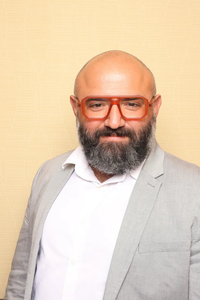
Background
Wissam Charafeddine earned a high school diploma from W.D. Lowe High School, an associate degree from Henry Ford Community College in 1998, and a bachelor's degree from Wayne State University in 2000.
His career experience includes working in education administration.[1]
- Associates:
- Henry Ford Community College, 1998
- Bachelor's:
- Wayne State University, 2000
- High school:
- W.D. Lowe High School
In their own words
Who are you? Tell us about yourself.
I've spent my career at this intersection. I'm an engineer, an educator, an author, and a community builder from Dearborn. I work daily as a Family & Community Engagement Liaison in Michigan schools. I've built student governments, ed-tech tools, and the nonprofit institutions my community was missing for 20 years.
Please list below 3 key messages of your campaign. What are the main points you want voters to remember about your goals for your time in office?
Code the Future
The SBE adopted K–12 Computer Science Standards on May 14, 2019, making Michigan the 31st state to do so — but implementation was left voluntary and uneven. Michigan Governor Whitmer signed Public Act 206 of 2024 on January 17, 2025, requiring every Michigan high school to offer CS by the 2027–28 school year — but offering a course is not the same as requiring students to take it. As of 2022–23, 401 of Michigan's 1,265 high schools reported no students in any CS-related course. My three commitments: 1. District-by-district CS implementation transparency report; 2. A CS teacher pipeline plan to meet the 2027 mandate; and 3. STEAM integration across all subjects, not just math and science.Tech That Works for Teachers
Rigorous, Teacher-Led Standards for Ed-Tech Procurement Anchored in real Michigan history: MI Roadmap: Transforming Education Through Technology was presented to the SBE in March 2017 — a vision document with no procurement standards or teacher input requirements. Michigan's SOPPA (Public Act 368 of 2016) governs student data privacy with ed-tech vendors — but addresses data only, not efficacy or teacher usability. My three commitments: 1. Mandatory Michigan Ed-Tech Quality Standards before purchase; 2. Required teacher review panels in all procurement; 3. An annual public Ed-Tech Transparency Report.Schools That Know Your Family
Fully Funding Culturally Competent Family Engagement Anchored in real Michigan history: The MDE released MiFamily: Michigan's Family Engagement Framework, aligned to the Top 10 in 10 Strategic Plan — a strong document that is completely voluntary and unfunded. Federal law (Lau v. Nichols and ESSA) requires schools to provide interpretation and translation so families can meaningfully participate — requirements Michigan schools routinely fail to meet. My three commitments: 1. A funded Culturally Competent Family Engagement Pilot in high-density immigrant districts; 2. A mandatory Language Access Standard for family communications;
What areas of public policy are you personally passionate about?
I'm passionate about three interconnected areas: environmental literacy — ensuring Michigan students understand the ecological realities shaping their futures; structural equity — treating achievement gaps as policy failures, not personal ones; and CS access as economic justice — because Michigan adopted K–12 computer science standards in 2019, but implementation remains uneven and under-resourced, leaving low-income students behind. These aren't separate issues. They share a common root: a Board that thinks in systems, follows the evidence, and designs policy around the students who need it most — not the ones who are already fine.
What organizations or individuals have endorsed your campaign?
Arab American & Muslim American Green Party Caucus
Livonia Salon
Dr. Jill Stein
Dr. Michael Lance
Dr. Ronald Stockton
Dr. Hani Bawardi
Dr. Wessam Elmeligi
Dr. Ali Ajami
Dr. Nabil Alkhateeb
On the 2026 ballot
Links
Compiled from the candidate’s published profile as of September 30, 2026.
Source(opens in new tab)