
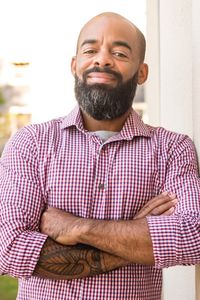
Background
William Brown Jr. was born in Florida. He served in the U.S. Marine Corps from 2000 to 2013. He graduated from W.J. Woodham High School. He earned a bachelor's degree from Arizona State University in 2014, a graduate degree from the University of Southern California in 2016, and a graduate degree from West Texas A&M in 2020. His career experience includes working as a clinical social worker.[1][2]
- Graduate:
- West Texas A&M, 2020
- Bachelor's:
- Arizona State University, 2014
- High school:
- W.J. Woodham High School
In their own words
Who are you? Tell us about yourself.
A little about myself: I'm a husband, father of two fabulous kiddos, and a middle-class neighbor facing the same challenges as most. I entered this race because I am tired of the two-party system that plagues our government and brings forth lackluster results.
I was born and raised in northwest Florida. After high school, I dedicated 13 years to the Marine Corps as an F/A-18 Avionics technician at Marine Corps Air Station Miramar. My role expanded beyond technical work to include Maintenance Control and Quality Assurance positions. Throughout my service, I completed six deployments: two to East/ Southeast Asia as part of the Unit Deployment Program and four to combat zones supporting Operations Enduring Freedom and Iraqi Freedom.
When my military service ended, I channeled my discipline into education. I earned dual bachelor's degrees from Arizona State University—one in Political Science and another in Justice Studies. I completed a Master of Social Work degree at the University of Southern California and an MBA at West Texas A&M University. Today, I work as a contract clinical social worker, providing mental health treatment and assessments for the Department of Corrections and Rehabilitation. I've also established my private practice here in the Central Valley via my professional corporation.
Please list below 3 key messages of your campaign. What are the main points you want voters to remember about your goals for your time in office?
Defending Individual Liberty: California's tax burden has reached an unsustainable level. While state spending continues its upward trajectory, hardworking citizens watch an ever-increasing portion of their earnings diverted to Sacramento's general fund. As a start, I propose a two-part solution to restore some level of fairness to our tax system. First, eliminate state income tax for our essential workforce—teachers, healthcare workers, first responders, and active/ reserve military personnel. Second, exempt all overtime earnings from state income tax for every California worker, regardless of profession. Reducing the tax burden on work enables local investment, encourages productivity, and restores individual liberty.Protecting Economic Freedom: The concept of free markets extends far beyond economic theory—it represents the fundamental balance between necessary oversight and entrepreneurial freedom. This balance has profound implications for both businesses and consumers. California's petroleum industry provides a notable example. Despite substantial domestic resources, the state has predominantly depended on foreign oil imports. This situation stems not from resource scarcity but from a regulatory framework that has effectively curtailed local production. Therefore, the central policy challenge is not to choose between regulation and deregulation but to craft measured oversight that genuinely serves the public interest.Preventing Government Overreach: Freedom flourishes when entrepreneurs and professionals can innovate without burdensome regulatory barriers. California's AB5 legislation exemplifies the fallout from overreach: enforcing strict classifications on independent contractors has significantly curtailed the flexibility of the gig economy. The insurance sector faces similar challenges, with price controls driving carriers out of the market and leaving property owners with few options. The healthcare system shows analogous problems; increased government intervention has resulted in soaring premiums and reduced choices. The state government's role should emphasize the protection of fundamental rights instead of excessive intrusion.
What areas of public policy are you personally passionate about?
I'm committed to reducing taxes and restoring your personal freedom. The government shouldn't interfere with your wallet, life, or business as long as you respect others' rights to live freely and pursue their dreams. Fiscal responsibility is essential. Taxation becomes theft when it's imposed without your consent and the funds are mismanaged or wasted. I'm also dedicated to disrupting the outdated two-party system. The false choices they present don't reflect our true values, and I'm here to change that. It's a tough battle, but I'm ready for it. It is a significant challenge, but I understand the assignment and am here for it!
Who are you? Tell us about yourself.
A little about myself: I'm a husband, father of two fabulous kiddos, and a middle-class neighbor facing the same challenges as most.
I was born and raised in northwest Florida. After high school, I dedicated 13 years to the Marine Corps as an F/A-18 Avionics technician at Marine Corps Air Station Miramar. My role expanded beyond technical work to include Maintenance Control and Quality Assurance positions. Throughout my service, I completed six deployments: two to East/ Southeast Asia as part of the Unit Deployment Program and four to combat zones supporting Operations Enduring Freedom and Iraqi Freedom.
When my military service ended, I channeled my discipline into education. I earned dual bachelor's degrees from Arizona State University—one in Political Science and another in Justice Studies. I completed a Master of Social Work from the University of Southern California and an MBA from West Texas A&M University. Today, I work as a contract clinical social worker, providing mental health treatment and assessments for the Department of Corrections and Rehabilitation. I've also established my private practice here in the Central Valley via my professional corporation certified as a Disabled Veteran Business Enterprise.
Please list below 3 key messages of your campaign. What are the main points you want voters to remember about your goals for your time in office?
Defending Individual Liberty:
California's tax burden has reached an unsustainable level. While state spending continues its upward trajectory, hardworking citizens watch an ever-increasing portion of their earnings diverted to Sacramento's general fund. As a start, I propose a two-part solution to restore some level of fairness to our tax system. First, eliminate state income tax for our essential workforce—teachers, healthcare workers, first responders, and active military personnel. Second, exempt all overtime earnings from state income tax for every California worker, regardless of profession. Reducing the tax burden on work enables local investment, encourages productivity, and restores individual liberty.Protecting Economic Freedom:
The concept of free markets extends far beyond economic theory—it represents the fundamental balance between necessary oversight and entrepreneurial freedom. This balance has profound implications for both businesses and consumers.
California's petroleum industry provides a notable example. Despite substantial domestic resources, the state has predominantly depended on foreign oil imports. This situation stems not from resource scarcity but from a regulatory framework that has effectively curtailed local production. Therefore, the central policy challenge is not to choose between regulation and deregulation but to craft measured oversight that genuinely serves the public interest.Preventing Government Overreach:
Freedom flourishes when entrepreneurs and professionals can innovate without burdensome regulatory barriers. California's AB5 legislation exemplifies the fallout from overreach: enforcing strict classifications on independent contractors has significantly curtailed the flexibility of the gig economy. The insurance sector faces similar challenges, with price controls driving carriers out of the market and leaving property owners with few options. The healthcare system shows analogous problems; increased government intervention has resulted in soaring premiums and reduced choices. The state government's role should emphasize the protection of fundamental rights instead of excessive intrusion.
What areas of public policy are you personally passionate about?
I'm committed to reducing taxes and restoring your personal freedom. The government shouldn't interfere with your wallet, life, or business as long as you respect others' rights to live freely and pursue their dreams. Fiscal responsibility is essential. Taxation becomes theft when it's imposed without your consent and the funds are mismanaged or wasted. I'm also dedicated to disrupting the outdated two-party system. The false choices they present don't reflect our true values, and I'm here to change that. It's a tough battle, but I'm ready for it. It is a significant challenge, but I understand the assignment and am here for it!
Is there a book, essay, film, or something else you would recommend to someone who wants to understand your political philosophy?
"Liberty Defined: 50 Essential Issues That Affect Our Freedom" by Dr. Ron Paul
What characteristics or principles are most important for an elected official?
A sense of realness, integrity, willingness to listen, capacity to learn, and not be financially influenced by special interests.
What do you believe are the core responsibilities for someone elected to this office?
I want to be your voice in the 32nd Assembly District because Sacramento needs to hear directly from our community. While other representatives may be content to sit in their offices, I'll be in our neighborhoods, listening to your concerns and fighting for your fundamental rights.
Our district deserves a representative who understands that the government's primary role is to protect our liberties, not restrict them. That means crafting legislation that defends your right to life, liberty, and the pursuit of happiness — and standing firm against any attempts to infringe upon these essential freedoms.
I won't be another politician who bends to special interests. Instead, I'll be your neighbor who brings your voice to the state capitol. When legislation threatens our individual liberties, you'll hear my voice rise in opposition. You'll find me leading the charge when opportunities arise to expand your freedoms.
The strength of our district lies in its people, not in distant bureaucrats. Let's restore government to its proper role: serving our community.
What was your very first job? How long did you have it?
My first job was at Chuck E. Cheese, where I worked as a game room technician during high school. Those two years taught me more than just how to fix arcade machines - they showed me what it meant to work hard and be part of a team. After graduation, I joined the Marines, but Chuck E. Cheese wasn't quite done with me. Between deployments in San Diego, I picked up weekend shifts as a Birthday Coordinator for another four years. And yes, I even donned the famous mouse costume from time to time. (I still have my "making magic" Chuck E. wizard pin as a reminder of those days.)
What was the last song that got stuck in your head?
Currently: “WHATCHU KNO ABOUT ME” by GloRilla and Sexyy Red; “Loose Control” by Teddy Swims; “TV Off” by Kendrick Lemar
What is something that has been a struggle in your life?
Military training drills one core principle into you: always be ready to take charge. This mindset became part of my DNA, creating a constant drive for self-improvement that followed me into civilian life. Even now, I can't sit still - I need goals to chase and skills to master. While this drive serves me well, helping me stay open to new ideas, education, and perspectives, it's also taught me an unexpected lesson. As a therapeutic provider, I've learned that true growth includes knowing when to slow down. Finding peace in stillness is its own kind of progress - one I'm still working on mastering, day by day.
What do you believe is the ideal relationship between the governor and state legislature?
Governors and state legislators need to work together, but they also need to keep each other in check. Think of it as a professional partnership in which both sides can openly disagree without burning bridges. When the governor proposes something questionable, legislators should speak up. When legislators pass problematic bills, the governor should veto them. This back-and-forth keeps everyone honest while still getting things done.
What do you perceive to be your state's greatest challenges over the next decade?
California faces several challenges that must be addressed to ensure prosperity in the coming decades. First, there's the healthcare crisis. Rising costs, primarily due to overregulation and government interventions, require urgent solutions. Next, we have the issue of debt. California seems to be "doing the most," as Gen Z would say, by accumulating more debt due to various failing programs. This growing debt doesn't bode well for our children, especially since the usual remedy is to increase taxes — a solution that doesn't sit well with Libertarians like me. Working towards reducing taxation and returning money and control to the communities must be at the forefront of decision-making. Lastly, disaster preparedness is crucial. While it's not the right time to assign blame for the ongoing LA fires, we must acknowledge the need for more effective solutions to prevent such disasters, especially given the current changes in climate.
Do you believe that it’s beneficial for state legislators to have previous experience in government or politics?
I don't believe legislators need prior experience in government or politics. In fact, effective legislation requires diverse perspectives to make sound decisions. If our legislative bodies consisted solely of career politicians, who would represent the viewpoints of everyday citizens? I would actually argue for the opposite: we need more individuals without government or political experience in our legislative bodies. Their fresh perspectives and real-world experiences would better reflect the needs of everyday citizens.
Do you believe it’s beneficial to build relationships with other legislators? Please explain your answer.
Working with others matters, regardless of where you are, is critically important to success. This is especially true in legislation, where the divide between parties often seems massive. But here's the thing: lawmakers can still find common ground. When they do, they can build real relationships that help them tackle statewide problems together. Sure, they might disagree on politics, but that's exactly why these connections are so valuable - they bring different perspectives to the table and help get things done.
Is there a particular legislator, past or present, whom you want to model yourself after?
Two statesmen come to mind for their willingness to challenge the system: Dr. Ron Paul and Bernie Sanders. Although their views couldn't be more different, they share something important: They both stick to their beliefs, even when it means standing alone.
Paul, as a Libertarian-minded Republican, has always fought against big government and defended individual freedom, even when it put him at odds with his party. Conversely, Sanders has spent decades as an Independent, refusing to fully join the Democratic Party despite typically voting with them. While I don't agree with all of Sanders' positions, I respect how both men have carved their own paths, bringing fresh ideas to a system that usually rewards conformity.
Are you interested in running for a different political office (for example, the U.S. Congress or governor) in the future?
My focus is clear: I'm a parent and husband first. While serving in Congress might be meaningful someday, I won't consider it until my kids are older. These years with them are too precious to spend shuttling back and forth to Washington.
The real question is what our district needs today: a representative who fights for individual liberty and thinks beyond the tired Democrat-Republican divide. Maybe I'll run for Congress one day, but my mission today is here at home. California needs strong Libertarian voices, and that's where I'm planting my flag.
Both sitting legislators and candidates for office hear many personal stories from the residents of their district. Is there a story that you’ve heard that you found particularly touching, memorable, or impactful?
I want to tell you about a colleague, a nurse trying to save up for a house. She works extra shifts whenever she can, but there's a frustrating catch: the more overtime she works, the higher her tax rate climbs. Sometimes, she'll work an extra 12-hour shift only to see a tiny bump in her take-home pay.
This isn't just her problem. Across our district and state, people are stuck in the same trap. They're willing to work harder and longer to reach their goals - buying a home, starting a business, or saving for their kids' education. But heavy taxation eats away at their extra earnings, making all those additional hours feel almost pointless. If we let people keep more of what they earn, they'd have a better shot at building the life they want. And when individuals thrive financially, that money flows back into local businesses and communities.
Tell us your favorite joke.
Should the legislature oversee or grant the use of emergency powers?
“Absolute Power corrupts absolutely.”
When leaders declare emergencies, they gain extraordinary powers, which should worry us. History shows that temporary authority has a funny way of becoming permanent, and unchecked power tends to corrupt even the most principled people.
Sure, emergencies require quick action. But when we let officials bypass normal checks and balances and allow them to redirect funds without proper oversight, we're playing a dangerous game. They might start with good intentions, using these powers to address genuine crises. But soon enough, "emergency" becomes a magic word that unlocks whatever authority they want.
That's why we need robust oversight whenever we grant emergency powers. Every dollar spent, every right suspended, and every executive action taken needs careful monitoring. Protecting people during a crisis shouldn't mean abandoning the principles that protect us from abuse of power.
What is the first bill you would introduce if elected?
“The Heroes tax relief”- Eliminating the CA personal income tax for teachers, healthcare workers, first responders, and active military personnel. These heroes deserve more than verbal gratitude. That's why I propose eliminating state income tax for these public servants. A police officer shouldn't worry about taxes during a graveyard shift, and a teacher shouldn't lose sleep over their tax bill while preparing tomorrow's lessons.
What committees interest you?
Business and Professions, Health, Military and Veterans, Higher Education, Labor and Employment, Revenue and Taxation, Insurance.
What are your views on financial transparency and government accountability?
100% and complete transparency. As an elected official, constituents have the right to know how our money is spent, where the money is going, and who is funding the campaign.
On the 2026 ballot
Links
Compiled from the candidate’s published profile as of September 30, 2026.
Source(opens in new tab)