
Background
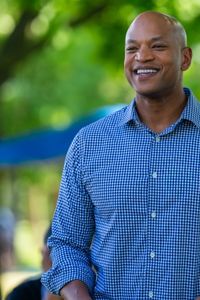
Moore earned an associate degree from Valley Forge Military College in 1998 and was commissioned as a second lieutenant in the U.S. Army. He was deployed to Afghanistan in 2005 a captain with the 82nd Airborne Division. Moore received a bachelor's degree from Johns Hopkins University in 2001, and a degree from the University of Oxford. His career experience includes work in the finance sector at Deutsche Bank and Citigroup, serving as CEO of the Robin Hood Foundation, and as an author.[8][3]
- Associates:
- Valley Forge Military College, 1998
- Bachelor's:
- Johns Hopkins University, 2001
- High school:
- Valley Forge Military College
In their own words
Who are you? Tell us about yourself.
Wes Moore is the 63rd Governor of Maryland and the state’s first Black governor, and only the third African American elected governor in U.S. history. A graduate of Valley Forge Military Academy and College and Johns Hopkins University, he became the first Black Rhodes Scholar in Johns Hopkins history and earned a master’s degree in international relations from Oxford University. Moore served as a lieutenant in the U.S. Army’s 82nd Airborne Division and deployed to Afghanistan, leading soldiers in combat. He is also the bestselling author of The Other Wes Moore and previously served as CEO of the Robin Hood Foundation, where more than $600 million was distributed to fight poverty. Governor Moore lives in Maryland with his wife, First Lady Dawn Flythe Moore, their two children, Mia and James, and their dog, Tucker Balti.
Please list below 3 key messages of your campaign. What are the main points you want voters to remember about your goals for your time in office?
Governor Wes Moore is laser-focused on protecting our people, driving down costs for working families, and strengthening our state’s economic competitiveness. In just three years, Maryland has added nearly 100,000 jobs, with the majority coming from the private sector. The Moore-Miller administration has helped create more than 35,000 new businesses, and the state is now creating about 45% more new establishments each month than in 2019. Major investments are coming to Maryland, including AstraZeneca’s $2 billion expansion, the largest private investment by a single company in state history, and Sphere National Harbor, expected to generate more than $1 billion annually and thousands of jobs.Governor Moore is delivering safer communities across Maryland. His administration has made record investments in public safety, including more than $50 million for Baltimore City law enforcement, $10.8 million for the Baltimore City State’s Attorney’s Office, and $124.1 million through the State Aid for Police Protection Program. These investments are producing real results. Since he took office, homicides have dropped 44% statewide and non-fatal shootings are down 40%. In Baltimore City alone, homicides have fallen 58%, leading to the lowest number of homicides in 50 years, while robberies across the state dropped 25% statewide in the past year.Governor Moore is strengthening Maryland’s public schools and investing in the next generation. For three consecutive years, his administration has delivered record funding for K–12 education, including a historic $10.2 billion proposed investment for the 2027 Fiscal Year. His agenda increases per-pupil funding to $11,811, provides $480.5 million for school construction, and launches new academic support programs. Governor Moore has also signed the Maryland Educator Shortage Reduction Act, helping reduce the state’s teacher vacancy rate by 58%. These investments are delivering results, with reading and math scores improving across nearly every grade level statewide.
What areas of public policy are you personally passionate about?
Governor Moore is deeply passionate about creating new pathways to public service because his life has been defined by service – from deploying to Afghanistan with the 82nd Airborne to running the poverty-fighting nonprofit Robin Hood. In his first year as governor, Moore launched a first-in-the-nation Service Year Option for High School Graduates. He has also advanced policies to uplift service members and veterans. In addition, Governor Moore leads in a way that puts service first–working with elected officials across the political spectrum to deliver real results and build pathways to opportunity. His focus on bipartisanship has helped expand economic opportunity, made communities safer and strengthened public education.
What organizations or individuals have endorsed your campaign?
To date, the Maryland League of Conservation Voters join the Maryland REALTORS®, Maryland International Association of Fire Fighters, Maryland’s largest union, the Maryland State Education Association, Service Employees International Union (SEIU) Local 500, as well as Democrats and Republicans from across the state have endorsed Governor Moore’s reelection campaign.
Wes Moore did not complete [the profile publisher]'s 2022 Candidate Connection survey.
Campaign website
Moore's campaign website stated the following:
ISSUES
Economy: Work, Wages, And Wealth
Building a Growing and Thriving Economy that Lifts up Every Maryland Family
Wes believes that no matter where you start in life, you deserve an equal opportunity to succeed – a job you can raise a family on, wages that reflect the dignity of work, and the chance to create wealth for you and your family. Right now in Maryland, as we continue to grapple with the COVID crisis, that’s simply not the case. Economic opportunity is readily available to some and dangerously absent to others. No one knows this better than Wes, who understands firsthand the struggles many Maryland families face and has made creating economic opportunity the central mission driving his candidacy for Governor.
Wes has led in sectors across the economy – in the private sector in the financial industry and as a small business owner, in the nonprofit industry as CEO of one of the largest nonprofits in the U.S., and in the public sector as an Army combat veteran and White House Fellow. Wes understands how the economy works and knows how to increase economic opportunities through creating economic growth.
Wes’ drive to create inclusive economic growth is both personal and professional. He grew up in communities that were chronically neglected and watched his single mother struggle to pay the family’s bills each month. And as the CEO of one of the nation’s largest non-profit organizations exclusively focused on ending poverty and creating economic advancement, Wes spearheaded the creation of Mobility LABs, a $25 million initiative driving economic mobility in urban, rural, and suburban parts of the country, including millions of dollars here in Maryland. Additionally, he fought for the expansion of the Child Tax Credit by the Biden Administration.
Based on his own family’s story, Wes knows there’s no single switch to simply create economic opportunity – it takes leading a focused effort that uses every economic lever in our state, and his vast leadership experience positions him to take Maryland to the next level.
ISSUES
Transportation
Maryland has a rich history as a transportation innovator. We were home to America’s first railroad, its first national highway, and even its first air flight when 13-year-old Edward Warren ascended in a balloon over Baltimore in 1784. Maryland has historically recognized the value of transportation, not only as a means of mobility, but as an economic engine and as a vehicle for helping people lift themselves from poverty. There is an important link between transportation and economic mobility, and as billions of federal dollars are allocated to improve Maryland’s infrastructure, we must ensure that the economic opportunities that come with this investment are available to everyone.
There is no team better equipped to take on this challenge than Wes Moore and Aruna Miller. Aruna Miller spent 25 years working at the local Department of Transportation in Montgomery County to improve the safety of the public, alleviate traffic, and create equitable transportation access to connect people to opportunities. As a Delegate in Annapolis, she was a respected voice and leader on Transportation issues. Her deep understanding of these issues makes her the perfect complement to Wes. As a former U.S. Army captain, small business owner, and CEO of one of the nation’s largest anti-poverty nonprofits, Wes brings the leadership and unique perspective we need to address these challenges.
Maryland has amazing economic, educational, natural, and cultural assets, but our transportation system needs to better connect our citizens to jobs, schools, parks, and other amenities in their communities. As a result, we have not lived up to our economic potential, and we continue to lag in implementing sound policies to protect our environment and enhance our communities. The Moore-Miller administration will build an efficient and equitable transportation system that unharnesses economic growth in our region, drives billions in new investment, protects our environment and our neighbors, and connects people with employers by:
Providing equity and opportunity in transportation planning by ensuring that our efforts to improve mass transit focus on the people who rely on it the most, addressing the connection between transportation and public health, removing politics from transportation planning and investment to ensure merit-based project funding, and implementing procurement reform.
Driving the economy through leveraging a regional approach that expands transit-oriented development, connects workers with jobs, and drives growth at BWI Marshall Airport and the Port of Baltimore.
Protecting the environment by converting the state’s fleet to EV technology by 2030, improving our EV charging station infrastructure and policies to get more private EVs on the roads, and fighting sprawl.
Better managing congested corridors by using the influx of federal infrastructure funding to build generational infrastructure improvements like establishing usable mass transit and bus lanes, expanding and improving commuter rail around the state, and developing true high-speed rail capacity on the Northeast Corridor.
ISSUES
A Bold Plan To Unlock Economic Opportunity For Maryland’s Black Families
In this moment, Maryland has a unique opportunity to be bold about the systemic and generational challenges that have held families back for decades.
This is a core part of why Wes Moore is running for Governor.
From leading soldiers in combat in Afghanistan, to working in the financial sector, to building and running a small business in Baltimore that helped first-generation students succeed in college, to serving as Chief Executive Officer of one of the largest anti-poverty nonprofits in the United States – Wes has demonstrated a core understanding of the economic barriers facing Black families in Maryland and the tools needed to address them.
In Maryland, the average White family has eight times the wealth of the average Black family. The average Black worker makes 71 cents to the White worker’s dollar.
This bold action plan to unlock economic opportunity for Black families in Maryland seeks to both meet the urgent needs that families across the state are facing, and move Maryland toward the kind of generational change that addresses the generational challenges that got us to a state of fragility and disparity.
Through this plan, we sought to build on the critical work that Speaker Adrienne Jones detailed in her Racial & Economic Justice Agenda, which Wes worked closely to help develop.
We also leveraged the frameworks and policy agendas of bedrock organizations like the Maryland state conference of the NAACP, The President’s Roundtable, and the Maryland Legislative Black Caucus.
Wes believes strongly that effective leadership involves listening and good governance involves uplifting voices closest to the problem as we work toward solutions. To that end, this plan will evolve and update based on additional learnings gained on the road to Annapolis.
Wes knows deeply that increasing opportunity across Maryland is not merely an exercise in economic policy. Increased opportunity will depend on our ability to confront existential threats like climate change, which disproportionately affects Black and Brown families in Maryland. It is reflected and laid bare by how the COVID-19 pandemic affected communities that were struggling before COVID. It is deeply tied to our transportation policies, and how we approach moving people from where they live to where they work. It is rooted in our ability to provide people with the basic right to quality healthcare, amid a reality where getting sick is the number one cause of bankruptcy in Maryland. It is seen in the damaging impacts of historic crime policies and the need to continue to holistically reimagine prison and criminal justice policies. It is driven by our commitment to transform Maryland’s Pre-K to 12 educational system and ensure every child has access to a quality education regardless of zip code.
We know that issues affecting Black families are issues of childcare, Pre-K, healthcare, education, workforce development, college and career prep, public safety, transportation, climate, social justice, nutrition, and more. And we cannot unlock economic opportunities for Black families unless we address the systemic barriers that have locked so many out for so long.
This bold plan focuses on tools to give Black families in Maryland increased access to work that imparts dignity and career options, wages that you can raise a family on, and wealth that imparts stability for families and allows people to pass on something other than debt to their children.
Increasing access to work, wages, and wealth are north stars for Wes Moore’s campaign for Maryland Governor, and they guide this bold agenda for increased economic opportunity for Black families in Maryland.
ISSUES
Building A More Equitable Future Where Every Marylander Can Thrive
In Maryland and across the nation, women face inequities in health, caregiving responsibilities, economic opportunity, safety and more. Overall, women earn 84 cents to every dollar men make, while Black and Latina women make 68 and 46 cents to every dollar that a man makes respectively. Additionally, reproductive rights and a woman’s right to make decisions about her body are under attack now more than ever before, and child care and paid leave policies too often force women to choose between nurturing their career and nurturing their families. When it comes to public safety, women are also more likely to be victims of sex crimes and human trafficking. It is essential that Maryland continue to advance solutions to expand economic opportunities, reproductive rights, and enhance families’ economic and personal security.
Wes Moore and Aruna Miller are ready to address these challenges head-on because our state and economy work better when everyone has equitable access to opportunity. Former Delegate Aruna Miller has spent her career fighting the status quo; from being an immigrant who came to the United States as a little girl, graduating as a Civil Engineer in a male-dominated field, and to being elected as the first Indian American woman to the Maryland General Assembly. In these roles, and in raising three daughters and being a caretaker for her mother, Aruna understands firsthand the challenges women face. Wes credits his mother’s support as the most important factor in his success. After Wes’ father died, he watched his mom work three jobs just to support their family. He knows the challenges a single mom faces raising a family.
With this shared determination to implement equitable policies, the Moore-Miller administration will:
Advance reproductive rights by enshrining the protections of Roe v. Wade into our constitution, expanding access to abortion training for health care providers and ensuring that every Maryland can afford and access reproductive care.
Repeal the Maryland law allowing spouses who engage in sexual abuse against their partner to use their marriage as a legal defense; and pass legislation to ensure that women, particularly minors, aren’t charged as criminals when they are forced into prostitution by human traffickers.
Ensure equal pay for women by exploring policies requiring companies to disclose demographics on gender, race and salary bands; and removing salary history from the interview process.
Establish a Women in STEM focus across all levels of education and invest in job training and credentialing programs to drive women into high-demand, high-paying STEM jobs.
Get women back to work by ensuring every family has access to quality, affordable child care by broadening the expansion of the Child and Dependent Care Tax Credit, developing a system to cap out-of-pocket expenses for families in need and more.
Secure paid sick, family, and medical leave for every Marylander so that no family has to choose between caring for a new child or loved one or their paycheck.
Allow small, woman-owned businesses to compete by modernizing Maryland’s procurement process, requiring small business set-asides, and making it easier for local governments to piggyback on state contracts with small and woman-owned businesses.
ISSUES
LGBTQ+ Inclusion
In Maryland and across the nation, LGBTQ+ individuals face adversity at higher levels than many other communities. This adversity is felt in all intersections of life including education, health care, housing, and criminal justice to name a few. To provide a brief snapshot, more than half of LGBTQ+ youth in Maryland report they have been harassed or assaulted in schools. Further, LGBTQ+ youth are more likely to experience depression and to attempt suicide. Members of this community are also more likely to experience housing instability, food insecurity, and are more likely to be represented in the foster care system. Maryland’s LGBTQ+ seniors also face housing discrimination, harassment, and victimization at higher levels. LGBTQ+ Marylanders deserve a governor who will fight for their rights and create a state where every person can thrive.
With the commitment to better the wellbeing of Maryland’s LGBTQ+ population, the Moore-Miller administration will:
Support students who identify as LGBTQ+ by fully implementing the newly passed Inclusive Schools Act, ensuring Maryland schools adopt LGBTQ+ affirming policies, create partnerships with organizations working with LGBTQ+ youth to provide additional resources needed to support our students, and broaden access to trauma-informed mental health care in schools.
Support the passage of the Trans Health Equity Act to ensure transgender Marylanders can receive the gender-affirming health care they need.
Abolish Maryland’s outdated laws that criminalize HIV, which disproportionately affect and stigmatize the LGBTQ+ community.
Work with the LGBTQ+ Chamber of Commerce and community to build and publish a list of LGBTQ+ businesses so state agencies can more easily identify and contract with them.
Ensure the LGBTQ+ community has a seat at the table and voice in the discussion, and work to implement the recommendations of Maryland’s newly created LGBTQ+ Commission.
Stand as a brick wall against any anti-LGBTQ+ legislation or policies and welcome families and businesses from states enacting homophobic and transphobic social agendas, demonstrating that Maryland remains open and inclusive for all.
ISSUES
Education
Maryland is fortunate to have strong schools, educators, stakeholders, and parents dedicated to ensuring every student has the opportunity to succeed. We are also fortunate for the tremendous work of the Kirwan Commission and the Blueprint for Maryland’s Future, which Wes advocated for and testified in support of. This historic legislation has already set Maryland on a path to future success and will enable us to break down long-standing inequities. Now is the time to continue the progress we have made to fully fund and implement the Blueprint because from cradle to career, education is one of the key pillars for Marylanders to access jobs, higher wages, and the opportunity to build wealth that can be passed on to their children.
Wes will always make education a top priority. He will work closely with local leaders, educators, parents, and community organizations to address our most pressing challenges. As governor, Wes will:
Ensure Maryland’s Blueprint for Education is fully funded and implemented and provide dedicated funding for the Blueprint’s Accountability and Implementation Board to assess progress and provide technical support to localities.
Support educators, paraeducators, and ESPs by strengthening collective bargaining, expanding innovative teacher mentorship programs, raising wages, and building new pipelines to the workforce.
Make child care and early childhood education more affordable and accessible by fully funding and streamlining the Child Care Scholarship fund, ensuring every child in need has access to free pre-k, and growing the early childhood workforce.
Set students up for success by investing in 21st Century Schools, reinstating Maryland’s Governor’s Office for Children, and closing the digital divide.
Tackle disrupted learning and position students for success by increasing funding for afterschool and summer programs, tutoring, and more.
Prioritize students’ social/emotional well-being by expanding community schools, increasing the number of ESPs in our schools, and ensuring schools adopt inclusive, trauma-informed policies and practices.
Combat the school-to-prison pipeline by reinstating the Commission on the School-to-Prison Pipeline, implementing restorative practices, preventing school resource officers from engaging in disciplinary decisions, and eliminating disorderly conduct as a criminal charge in schools.
Prepare students for good-paying jobs by expanding access to CTE programs and offerings, investing in dual enrollment and apprenticeship programs, driving students into STEM fields, and implementing a Service Year Option program for high school graduates.
ISSUES
Civil Rights And Social Justice
When Wes talks about equity and social justice, he is not simply reacting to the politics of the moment – he is speaking to his lived realities. Wes knows that we will never achieve our potential – as individuals or as a state – until equity is achieved.
Wes applauded the Maryland legislature last year for passing some of the nation’s most comprehensive police accountability legislation, and we must continue to build on that progress and ensure it is executed effectively.
That means continuing the march toward equity in our criminal justice system by supporting policies that promote redemption and second chances and reforming our prison systems. Wes will legalize cannabis, expunge the records of anyone convicted of simple possession, and prioritize equitable access to this emerging industry.
But, true equity and social justice extends far beyond criminal justice. It means equity in housing. It means equity in access to education and health care. It means environmental justice. It means fixing procurement policies and increasing liquidity for our MBEs to increase job growth. It means supporting our HBCUs and committing to eliminating the wealth gap. And Wes doesn’t just talk about these things as priorities, he has already led on them. Wes helped launch Ninety-To-Zero, an initiative that brought leading CEOs and Executive Directors across all pillars of the nation’s economy to provide a roadmap for companies and organizations to act as an engine for continued collaborative learning to end the racial wealth gap.
ISSUES
Protecting, Supporting And Empowering Maryland’s Working Families
Unions are good for our economy and have an equalizing power in the labor market. As the birthplace of America’s organized labor movement, Maryland recognizes the value of our workers. From Western Maryland’s railyards to the shipyards and steel mills in Baltimore, our state’s industrial foundation was set by union hands. The Moore-Miller team understands economic opportunity is readily available to some, and dangerously absent to others. Today, workers face a widening income gap and decreasing worker wellbeing. It is more vital now than ever before that we support and protect Maryland’s working families and their unions.
Wes comes from a strong union family and believes that strong unions are essential to building a thriving and equitable economy in Maryland. When Wes’ father died at a young age and left his mother a widow, it was his father’s union that paid for his funeral and supported his sister when she got sick. These experiences helped to shape Wes’ strong commitment to organized labor and under his leadership as CEO of one of the nation’s largest anti-poverty nonprofits, their policy work centered around advocating for paid leave expansion, increased wages for front-line workers in the care sector, reforming the unemployment insurance systems, and ending wage theft and forced arbitration clauses for workers. They provided millions to a local union to improve training for home health workers, invested over $10 million annually in job training, and provided emergency relief funding for child care and health care workers during the pandemic.
Wes’ running mate, former Delegate Aruna Miller, has also been a champion for labor throughout her career. As a Delegate in the General Assembly, Aruna supported legislation to provide workers flexible, paid leave for workers experiencing illnesses or with family experiencing illness, prohibiting subminimum wages for disabled workers, expanding collective bargaining, preventing employers from retaliating over wage complaints, increasing the minimum wage, and many other important labor issues.
The North Star of the Moore-Miller administration will be to ensure that all working people have access to good jobs and the power to determine their wages and working conditions. Wes and Aruna are committed to protecting and expanding the right of workers to join unions and bargain collectively; this way expanding work, wages, and wealth for every family in Maryland, with a commitment to equity. Wes and Aruna will always work in true partnership with Maryland’s workers and unions to achieve these goals.
To do this, the Moore-Miller administration will:
Raise the minimum wage to $15 per hour by 2023, and index it to the cost of living to ensure that worker wages don’t degrade over time.
Ensure every worker has access to critical benefits like paid sick, family and medical leave.
Appoint a Labor Relations Liaison to engage regularly with labor representatives and facilitate the quick resolution of issues brought to our attention.
Expand access to Maryland’s apprenticeship programs, including registered apprenticeship programs, to provide workers with high-quality training that creates pathways to good careers.
Empower Maryland’s Department of Labor to fully execute its mission and build systems to monitor wage theft, track and penalize bad actors, and report on trends to prevent future abuse.
Leverage our state’s purchasing power to ensure resources are devoted to sound projects that pay workers a living wage, ensure they are not taken advantage of, and hire and train apprentices so we are building our workforce.
Strengthen State Collective Bargaining agreements and encourage Maryland’s counties and municipal governments to do the same.
ISSUES
Veterans
Maryland has a long and proud military tradition, unmatched by any other state. Today, more than 375,000 Veterans call Maryland home, and they play a critical role in our state and economy. Maryland has more than 50,000 Veteran-owned small businesses, generating more than $20 million in sales each year and employing thousands. Unfortunately, our Veterans also experience service-related challenges. Nationwide, nearly one in five Veterans lives with a mental health disorder. In Maryland, nearly 80,000 Veterans live with a disability, 60,000 are experiencing a housing issue and 17,000 are living in poverty. We can and must do more as a state for the men and women who have worn the cloth of our country and sacrificed so much to keep us safe and protect our freedoms.
To better support Veterans, the Moore-Miller administration will:
Lift up Veteran-owned small businesses by reforming our procurement process to make it easier for these businesses and entrepreneurs to win the state’s business, eliminating costly and burdensome regulations, and competing for the billions in federal funds available that will improve access to low or no-interest capital.
Work with the Department of Veterans Affairs to expand and improve quality of care and expedite claims so Veterans can get access to the care they need.
Better meet the needs of women Veterans by improving access to specialized health care, breaking down stigma around seeking treatment for Military Sexual Trauma and other care, and ensuring programs supporting the transition to civilian life address the unique needs of women.
Ensure Maryland delivers the job training and educational resources needed for Veterans to obtain employment and compete in the private sector.
Close health care gaps by expanding access to telehealth services.
Support Veterans experiencing mental illness and substance use disorders by increasing funding for community-based behavioral health care, improving partnerships between state and federal agencies, and fighting back against stigma for those seeking care.
Invest in permanent supportive housing, which connects people with housing and the wraparound services they need to maintain housing stability.
Ensure spouses and dependents of Maryland Veterans are able to be laid to rest with their loved ones without incurring costs.
ISSU
On the 2026 ballot
Links
- Campaign X(opens in new tab)
- Official X(opens in new tab)
- Campaign tiktok(opens in new tab)
- Campaign website(opens in new tab)
- Campaign youtube(opens in new tab)
- Official website(opens in new tab)
- Official youtube(opens in new tab)
- Campaign facebook(opens in new tab)
- Official facebook(opens in new tab)
- Personal linkedin(opens in new tab)
- Campaign instagram(opens in new tab)
- Official instagram(opens in new tab)
Compiled from the candidate’s published profile as of September 30, 2026.
Source(opens in new tab)