
Background
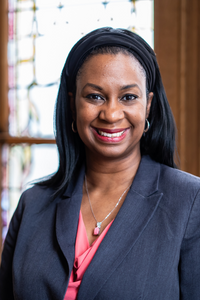
Tonya Myers Phillips was born in Detroit, Michigan. She earned a bachelor's degree from the University of Michigan in 1999 and a J.D. from the University of Michigan Law School in 2003. Myers Phillips' career experience includes working as an attorney and public policy advisor. She is the director of community partnerships and development with the Sugar Law Center for Social and Economic Justice, and she serves as a public policy advisor for Michigan Legal Services.[1]
- Law:
- University of Michigan Law School, 2003
- Bachelor's:
- University of Michigan, 1999
Campaign themes
Tonya Myers Phillips has not yet completed [the profile publisher]'s 2026 Candidate Connection survey.
Send a message to Tonya Myers Phillips asking her to fill out the survey.
If you are Tonya Myers Phillips, click here to fill out [the profile publisher]'s 2026 Candidate Connection survey.
Who fills out the candidate survey?
Any candidate running for elected office, at any level, can complete [the profile publisher]'s Candidate Survey. Completing the survey will update the candidate's [the profile publisher] profile, letting voters know who they are and what they stand for. More than 32,000 candidates have taken [the profile publisher]'s candidate survey since we launched it in 2015. Learn more about the survey here.
You can ask Tonya Myers Phillips to fill out this survey by using the buttons below or emailing repmyersphillips@gmail.com.
Tonya Myers Phillips did not complete [the profile publisher]'s 2024 Candidate Connection survey.
Video for [the profile publisher]
Video submitted to BallotpediaReleased July 1, 2020
Who are you? Tell us about yourself.
I am an attorney, mother, wife, and leader who has been serving, fighting, and winning for our community for over 27 years. I was born and raised in Detroit by a mother who was a Detroit Public School teacher and union member. I graduated from the University of Michigan and University of Michigan Law School. I've fought against large banks. I've represented and won for families facing eviction and foreclosure. I negotiate community benefits agreements on behalf of community coalitions to provide fair economic development for our neighborhoods. I designed and led criminal justice jail diversion initiatives. I am a leader in the Right to Counsel movement where I helped secure funding to provide legal representation for low-income Detroiters facing eviction. During this COVID-19 pandemic, I wrote policy recommendations and successfully advocated with allies for the statewide moratorium on evictions and utility shut-offs. I served on the City of Detroit Charter Commission from 2010-2102. I am a compassionate problem solver. I am an experienced public servant. I am committed to fighting for systemic changes that improve the quality of life for all in our community.
Please list below 3 key messages of your campaign. What are the main points you want voters to remember about your goals for your time in office?
We must strengthen our social safety net. This includes fighting for expanded paid sick leave laws, reducing the costs of medical care, expanding child care assistance, repairing our slow and broken unemployment system, increasing college and trade school assistance, increasing protections from unjust foreclosures and evictions, and providing true affordability plans for water and utilities.Every person deserves access to justice. Accordingly, I will advocate for a right to legal representation for low-income people facing eviction, unemployment appeals, and loss of public benefits. I will also advocate for criminal justice reforms including investing in jail diversion and restorative justice initiatives, mental health treatment, expanded expungement eligibility, anti-human trafficking initiatives, and helping returning citizens become gainfully employed. Michiganders deserve to get a return on our public investment. Therefore, I will work to implement measures that require corporations to provide common-sense community benefits in exchange for receiving public money in the form of grants, tax cuts, below-market land sales, and other publicly-funded incentives. We need incentives that are practical and fair to support growth and prosperity in our urban areas. Featured local question
In a time of strained resources, what should be the state’s spending priorities?
The state's spending priorities should focus first on human needs. We must repair Michigan's broken unemployment insurance system. We must ensure food security for distressed communities. We must make sure our medical professionals can rise to the occasion safely and effectively, having all of the personal protection equipment and life-saving medical equipment they need. We must prudently prepare ourselves for the possibility of a second wave of the COVID-19 pandemic. We must make sure that our families and school systems have the support they need in the event of either a remote learning or significantly modified in-person education model in the fall.
There area many spending priorities that must be addressed. However, human needs for health, safety, and security must take precedent.
What areas of public policy are you personally passionate about?
1. Social Safety Net- Providing Basic Economic & Health Needs for MI Residents
2. Access to Justice- Civil and Criminal Justice Reform
3. Economic Development- Pursuing Equitable Development and Fair Economic Development Models
4. Racial Justice- Eliminating Institutional and Systemic Racism
5. Environmental Justice- Preserving and Protecting our Neighborhoods
6. Access to Government- Increasing Public Accountability and Transparency in Government
Who do you look up to? Whose example would you like to follow, and why?
I look up to and revere the late Rev. Dr. Martin Luther King Jr. I look up to him because he stood firm on his principles and fought for racial and economic justice when it was not popular, and in fact, was quite dangerous and ultimately cost him his life. I admire his integrity and selflessness. I admire his ability to envision and fight for a better society than the one in which he lived.
What was the last song that got stuck in your head?
"Three Little Birds"
What is something that has been a struggle in your life?
Coming of age as a black woman, being raised by a single mother, attending public schools, and living in a city burdened with systemic disinvestment has been a challenge. However, my lived experiences have made me strong, resilient, and proud. I graduated from an excellent university, have a fulfilling career, and a great family. I've learned from my struggles and use that wisdom and experience to help and serve others.
What do you believe is the ideal relationship between the governor and the state legislature?
The ideal relationship between the governor and the legislature should be as teammates. The governor and the legislature are on the same team in the sense that the ultimate objective for both should be to provide for the safety and welfare of the State and all residents. Good teammates push and challenge each other to improve their performance. Good teammates communicate in a healthy manner. Good teammates understand and play their respective roles. There are times when good teammates will make sacrifices for the well-being of the team. Mature players and good teammates play for the team to win, and not only to make themselves look good at the expense of the team.
Similarly, the governor and the legislature have different governing roles as our constitution has established a system of checks and balances. Partisanship should not take precedence over making decisions that are in the best interests of the citizens. If the legislature and governor belong to different parties, one should not seek to undermine the other in a quest for partisan power. If the governor and legislature are of the same party, neither should abrogate their public stewardship for partisanship.
Unfortunately, the ideal is not the reality of our current political climate. The composition of the "team" is skewed by powerful corporate actors and special interests that do not represent the average citizen. The question of who is the average citizen is viewed through the lens of race, sex, gender, age, class, and geographic regions. All of these things make the ideal difficult to achieve. However, I do believe mature and principled individuals, working together, over time, can bring us closer to the ideal.
On the 2026 ballot
Links
Compiled from the candidate’s published profile as of September 30, 2026.
Source(opens in new tab)