
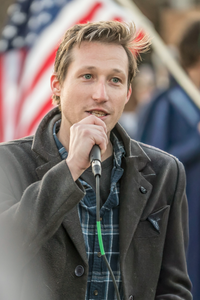
Background
Tim Cywinski earned a high school diploma from Liberty High School. He earned a bachelor's degree from Roanoke College in 2014 and a graduate degree from Johns Hopkins University in 2023. His career experience includes working as a nonprofit director.[1]
- Graduate:
- Johns Hopkins University, 2023
- Bachelor's:
- Roanoke College, 2014
- High school:
- Liberty High School
Campaign money
- Raised
- —
- From individuals
- $0
- From PACs & party
- $0
- Own money
- —
FEC filings.
View on FEC.gov(opens in new tab)In their own words
Who are you? Tell us about yourself.
I got my start in politics as a high school senior, interning for Obama for America in 2008, believing an ordinary person could make a difference.
Then I graduated and couldn't afford college.
So I worked on a few democratic campaigns where I saw how the influence of big donors outweighed the voices of everyday people. Then I worked two jobs, seven days a week — waiting tables, catering, bartending — during Community College, and I had to keep working my way through my undergraduate years.
The summer before my senior year, I interned for Senator Tim Kaine doing constituent services, mostly supporting veterans trying to get the VA care they'd earned, but often there was nothing our office could do.
I know what this broken system costs, because my own family paid it. Shortly after I was born, my parents lost their house covering one of my sibling's medical bills. They didn't tell me this until I told them I would run for office because they felt embarrassed that they "failed" their family when it was the system that failed them.
I left traditional politics because I was frustrated with the acceptance of the unacceptable.
For the last 10 years, I've been a community organizer, supporting people who've been ignored take back power and win. I'm not a lawyer or a career politician. Just a guy who knows what's at stake, and believes it doesn't have to be this way.
Please list below 3 key messages of your campaign. What are the main points you want voters to remember about your goals for your time in office?
I call myself a Reformist Democrat because I don't see how government can deliver real solutions for real people without fixing the system itself. 35 years ago, my family lost their house to medical debt — and families are still being put in that impossible position today, while healthcare companies pour billions into lobbying and campaign contributions to keep the rules exactly as they are.
Our most pressing challenges aren't really about Left vs. Right, or MAGA vs. Democrats. They're about who has power and who doesn't. I'm running to deliver that power back to people — especially the ones who can't write a big check or afford a lobbyist.My platform is called the Fair Shot Agenda, because fixing our politics will unlock our nation's capacity for dignity and opportunity. The pillars are:
Fight Big Money in Politics — get corporate cash out and give everyday people a real voice.
Restore Real Representation — mandatory ethics standards so members of Congress answer to you, not lobbyists and party bosses.
Tax Hard Work Less, Tax Corporate Greed More — shift the burden off working families onto the corporations exploiting labor and gaming the system.
Accomplish these, and the hope is we can usher in a new era of politics, led by a new class of politician who were chosen by the people.Voters across the political spectrum are asking two questions right now: Who does our politics truly work for? And who is the economy built to serve? When the answer to both is "not me," you get a society where hatred thrives, division breeds, and bad-faith politicians scapegoat their way to power.
But as a community organizer, I've seen what happens when people become their own champions. I've worked with people across this Commonwealth who were told to accept a status quo built for someone else — teachers told they didn't deserve a raise, communities told they only deserved a data center. They weren't supposed to win. They found a way anyway. That's the hope I run on.
What areas of public policy are you personally passionate about?
It's Dignity and Rights. Every person deserves to be treated as a full human being, with a fair shot and a real voice. That's the thread through everything: an economy where hard work actually pays off, education that isn't a debt sentence, healthcare you can't lose your home over, civil rights that protect everyone, and a government that truly represents the people it serves.
This isn't new for me. I studied political science, and my career has lived it — organizing for educators with the NEA, fighting to make college affordable, and now environmental justice with the Sierra Club. Different issues, same fight: making sure power answers to people, not the other way around.
Dignity for all. No exceptions.
Who do you look up to? Whose example would you like to follow, and why?
Fannie Lou Hamer. She was the twentieth child of Mississippi sharecroppers, picking cotton by age six, with every disadvantage stacked against her — and she became one of the most powerful voices for democracy this country has ever produced. She didn't wait for permission or a title. She organized.
When the political system was built to shut her community out, she stood up and demanded true representation and equality.
It gets repeated all the time without her name attached, but she's the one who said, "I am sick and tired of being sick and tired." Her story is a reminder that real change has never come from the powerful. It comes from the audacity of the underdog.
What characteristics or principles are most important for an elected official?
Conviction — understanding the stakes of every decision, and standing by what's right even when it isn't convenient, even when it costs you.
Humility — remembering you don't have to be the smartest person in the room, and you don't have to chase the credit.
Tenacity — refusing to accept the unacceptable. Fighting harder when the odds are against you, not only when the win is easy.
What do you believe are the core responsibilities for someone elected to this office?
Represent everyone — including the people who didn't vote for you, and especially the ones with no lobbyist to do it for them.
Show up — in the district, not just in Washington. The job is constituent services, town halls, and being reachable, not photo ops.
Be a check, not a rubber stamp — hold power accountable no matter which party holds it, including your own.
Tell the truth — even when it's unpopular, and even when it's about your own side.
Fight for the district's fair shot — federal dollars, real answers, and a voice for a region too often overlooked.
What legacy would you like to leave?
I don't care. I'm just tired of looking up and being disappointed.
What was your very first job? How long did you have it?
I was an intern for the Obama for America campaign in 2008. It was unpaid, so I'm not sure it counts.
My first paid job was waiting tables at a chain Italian restaurant. That one lasted about two months. I had a manager who mistreated us, I said something, and got myself fired. I've never been great at biting my tongue. For what it's worth, I was a fantastic waiter everywhere I worked after that.
What is something that has been a struggle in your life?
When I was nineteen, I hit a stretch with no job, no school, and the campaign I'd been working on had ended — so I had nothing to fall back on and nothing to look forward to. I fell into a depression for a couple of months. I told myself I was angry at the world, but really I was just disappointed in myself.
What pulled me out wasn't grit. It was other people. A trustee at Germanna Community College gave me a scholarship to get back into school. Slowly, I started looking for ways to feel useful again, and I found one speaking for a charity around Virginia. It gave me a sense of purpose.
At one of those events, an admissions officer from Roanoke College heard me, decided I belonged there, and helped me find the aid and the job that made it possible.
I worked hard once I had the chance. But I got the chance because people were kind, and because I got lucky. I think about that constantly — how many people work just as hard and never meet the person who opens the door.
What qualities does the U.S. House of Representatives possess that makes it unique as an institution?
The House was built to be the part of our government closest to the people. At the founding, it was the only piece of the federal government elected directly by voters — senators were chosen by state legislatures, the president by electors. The House was where the people's voice was supposed to enter the government first.
That promise was incomplete from the start. It was reserved for a narrow, privileged few, but the idea behind it still means something: a chamber built to reflect the will of the people more directly than any other.
We're a long way from what it could be. To me, real representation isn't just legislating to solve problems. It's using the platform that comes with the office to drag ignored issues into the light and set the terms of the debate. A House member who only votes is doing half the job. The other half is making sure the people who've been ignored finally get heard.
What do you perceive to be the United States' greatest challenges as a nation over the next decade?
Income inequality: The gap between the people at the top and everyone else is already pulling this country apart, and AI is about to pour fuel on it. Left unchecked, it will hand even more wealth and power to the few who own it while working people get left behind. We need real guardrails before that happens, not after.
Division and polarization: We've been sorted into teams and taught to hate the other side, while the people actually in power escape accountability. I don't think we heal that with slogans. We heal it by giving people a government that genuinely represents them and earns back their trust.
Education: We've handed too much power to administrators and not enough to the educators in the room. That drags down outcomes, weakens us against the rest of the world, and quietly shrinks what the next generation gets to dream about.
Do you believe that compromise is necessary or desirable for policymaking?
Yes, compromise is necessary. You can't govern a country of 330 million people by insisting on getting everything you want, and anyone who promises they will is lying to you.
But there's a line. I'll negotiate over how we solve a problem. I'll work with people I disagree with wholeheartedly elsewhere, if we can find common ground that helps people here.
But I won't negotiate over who counts. When a deal hands more wealth and power to people who already have plenty, paid for by the people who have the least, that's not a compromise. It's a concession. And if the price of any deal is more pain for vulnerable groups, that's not dealmaking. It's signaling that some people are expendable.
You can't build dignity through undignified deal-making.
What organizations or individuals have endorsed your campaign?
Just everyday people so far.
On the 2026 ballot
Links
Compiled from the candidate’s published profile as of September 30, 2026 and FEC filings.
Source(opens in new tab)