
Background
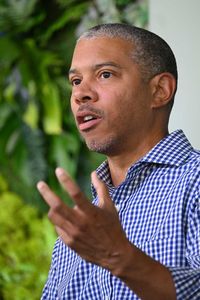
Thomas Fisher was born in Chicago, Illinois. He earned a bachelor's degree from Dartmouth College in 1996 and an M.D. from the University of Chicago in 2001. His career experience includes working as a doctor.[1]
- M.D.:
- University of Chicago, 2001
- Graduate:
- Harvard University School of Public Health, 2001
- Bachelor's:
- Dartmouth College, 1996
Campaign money
- Raised
- —
- From individuals
- $0
- From PACs & party
- $0
- Own money
- —
FEC filings.
View on FEC.gov(opens in new tab)In their own words
Who are you? Tell us about yourself.
Born and raised on the South Side, Dr. Fisher grew up in a home that
emphasized service. Those motives shaped his life and he has spent
two decades following this call to care for the community that raised
him.That legacy inspired his path through Dartmouth, the University
of Chicago School of Medicine, and Harvard University’s School of
Public Health – and led him to emergency medicine, where he’s
spent over two decades treating everyone, regardless of their
background or means.
But the ER is also where the consequences of bad policy show up:
gun violence, housing insecurity, untreated addiction, and lack of
care. That’s why Dr. Fisher took the fight upstream – as a White
House Fellow during the rollout of the ACA, a Medicaid leader in
Cook County, a healthcare executive focused on equity, and the
author of The Emergency: A Year of Healing and Heartbreak in a
Chicago ER, a nationally acclaimed book exposing the injustices of
our healthcare system.
When COVID hit, Dr. Fisher returned full-time to the ER and what he
saw inspired his acclaimed book, The Emergency, named one of
TIME Magazine’s 100 Must-Read Books. Through it all, he never
stopped fighting for the people failed by our political system.
Please list below 3 key messages of your campaign. What are the main points you want voters to remember about your goals for your time in office?
Profit should never decide who lives or dies. Whether facing cancer, recovering from a car crash, or simply trying to stay healthy — every one of us will be a patient one day. Healthcare must protect us when we’re most vulnerable.
Instead, millions are being kicked off insurance, cures are being undermined, and the Trump Administration has corrupted the CDC. Life expectancy is now shorter than it was a decade ago with folks on the South and West Sides living thirty fewer years than those in Streeterville and the Gold Coast — proof we’re in a crisis.
We must provide resources to stay healthy and build a healthcare system that puts people first, no matter who we are.
Universal healthcare so everyone is covered. Period. Full stop.Americans work hard and deliver record profits for corporations — but too many still struggle just to get by. Trump's tax breaks for millionaires come at the expense of millions losing health insurance. Again the rich get richer and the rest get nothing.
My mother’s 30+ years with Chicago Public Schools meant stability and a secure retirement thanks to her union. Every worker deserves that same security.
Today, wages lag while housing prices soar making it impossible for younger people to own a home and raise a family on a middle class salary. Families are squeezed by the rising cost of groceries, skyrocketing utility bills, and everyday essentials.
It’s time to build an economy where working people come first — not corporations.In more than 20 years taking care of people in the ER, I’ve never gotten used to caring for young men and women torn apart by gunfire. I’ve lost friends to violence — losses that still haunt me. While our trauma system saves lives, the scars remain: on bodies, on families, on our entire community.
We can and must do better:
. Background checks and an assault weapons ban to keep deadly weapons off our streets.
. Coordinated community-based interventions led by those closest to the problem.
. Support for survivors that prioritizes healing, justice, and mental health.
No one should have to live in fear — or carry these scars for life.
What areas of public policy are you personally passionate about?
Healthcare, Affordability, Public Safety
What characteristics or principles are most important for an elected official?
From the ER to Congress: What Matters in Leadership
For more than 20 years, I’ve walked into an emergency room on Chicago’s South Side and met people at their most vulnerable. Those experiences taught me what qualities truly matter in public service.
First, empathy. Most patients don’t end up in the ER because of bad choices but because of political ones—poverty, violence, lack of care. An elected official must feel that pain and respond with compassion.
Second, integrity. In medicine, trust is everything. I’ve seen how profit pressures force compromises on values, and I’ve resisted. In Congress, integrity means telling the truth, standing by principles, and putting people ahead of special interests.
Third, courage and vision. I became a doctor partly because of Ben Wilson, a local teen who died after waiting hours for emergency care. That tragedy taught me to confront inequity head-on. Leadership requires boldness to challenge systems that fail us and the courage to risk political loss for moral clarity.
Fourth, servant leadership. My job has never been about status but service. The best ideas often come from those closest to the pain. A public servant must listen with humility, stay grounded in the community, and put people first in every decision.
Finally, equity and justice. I’ve seen life expectancy differ by decades between neighborhoods just miles apart. No child should live or die based on their ZIP code. Government must close those gaps and ensure healthcare, safety, and opportunity as rights, not privileges.
What is an accomplishment that you are proud of?
One of the accomplishments I am most proud of came during my time as a White House Fellow. I was part of the team that developed the nation’s first Action Plan to Reduce Racial and Ethnic Health Disparities. That effort was about more than policy—it was about naming the truth that Black and Brown communities live shorter, harder lives not because of biology, but because of inequity. Helping to build that plan gave me a chance to take the lessons I learned in Chicago’s ER—where I saw the human cost of injustice every day—and turn them into a roadmap for national change.
I’m also proud of the work I’ve done closer to home. In my ER, I helped push back against a proposal that would have segregated patients by insurance status—Medicaid and Medicare patients in one part of the department, privately insured in another. That plan would have institutionalized inequity right in the hospital. Alongside colleagues, I resisted until the proposal was dropped and we organized care by acuity instead of by the size of someone’s wallet. That victory was a reminder that persistence and moral clarity can bend institutions toward fairness.
Both experiences—one at the highest levels of government, one in the trenches of patient care—reflect what matters to me most: fighting to make sure systems serve people equitably. They taught me that change comes when we combine compassion, courage, and persistence. That’s the spirit I would bring to Congress.
Campaign websiteFisher's campaign website stated the following:ON THE ISSUESDr. Fisher is running for Congress to bring urgency, moral clarity, and compassion to our broken politics.HEALTHCARE FOR ALLProfit should never decide who lives or dies. Whether facing cancer, recovering from a car crash, or simply trying to stay healthy — every one of us will be a patient one day. Healthcare must protect us when we’re most vulnerable.Instead, millions are being kicked off insurance, cures are being undermined, and the Trump Administration has corrupted the CDC. Life expectancy is now shorter than it was a decade ago with folks on the South and West Sides living thirty fewer years than those in Streeterville and the Gold Coast — proof we’re in a crisis. We must provide resources to stay healthy and build a healthcare system that puts people first, no matter who we are.Universal healthcare so everyone is covered. Period. Full stop.Close the death gap between West Garfield and Streeterville by investing in proven health equity and community development solutionsProtect reproductive rights and restore what’s been lost.Invest in 21st-century treatments that extend and improve livesA WORKING PEOPLE’S ECONOMYProfit should never decide who lives or dies. Whether facing cancer, recovering from a car crash, or simply trying to stay healthy — every one of us will be a patient one day. Healthcare must protect us when we’re most vulnerable.Instead, millions are being kicked off insurance, cures are being undermined, and the Trump Administration has corrupted the CDC. Life expectancy is now shorter than it was a decade ago with folks on the South and West Sides living thirty fewer years than those in Streeterville and the Gold Coast — proof we’re in a crisis. We must provide resources to stay healthy and build a healthcare system that puts people first, no matter who we are.Universal healthcare so everyone is covered. Period. Full stop.Close the death gap between West Garfield and Streeterville by investing in proven health equity and community development solutionsProtect reproductive rights and restore what’s been lost.Invest in 21st-century treatments that extend and improve livesCOMMUNITY SAFETYIn more than 20 years taking care of people in the ER, I’ve never gotten used to caring for young men and women torn apart by gunfire. I’ve lost friends to violence — losses that still haunt me. While our trauma system saves lives, the scars remain: on bodies, on families, on our entire community. We can and must do better:We need universal background checks, robust red flag laws, and a federal assault-weapons ban — policies rooted in common sense and in the value of protecting life. Coordinated community-based interventions led by those closest to the problem funded by holding gun manufacturers and sellers accountable.Support for survivors that prioritizes healing, justice, and mental health.No one should have to live in fear — or carry these scars for life.HOUSING AS A HUMAN RIGHTA safe, stable home is the foundation for everything else in life — health, work, family, dignity. But across the 7th District, too many people are being pushed out of their neighborhoods, trapped in unsafe buildings, or priced out by forces they can’t control.From the West Side to the South Loop, from Austin to Oak Park, you can see the crisis in real time: seniors on fixed incomes facing eviction, families doubled up, vacant lots sitting where homes should be, and rents rising faster than wages.Shelter is a human right. We must build communities where people can put down roots, stay close to family, and live with dignity — no matter their ZIP code, income, or background.Reinvest in aging buildings and protect tenants from unsafe conditions and predatory practices.End exclusionary zoning and require every community to help solve the housing shortage.Transform vacant lots and underused public land into mixed-income, accessible homes. Prioritizing community-driven development rather than fueling speculation that leads to displacement.Expand federal rental assistance and eviction protections to keep people housed, not displaced.FREE & EQUITABLE EDUCATION FOR ALLI’m a beneficiary of Chicago Public Schools. I graduated from Kenwood because teachers like Mrs. Brown (History) and Ms. Havlick (AP Biology) pushed me, challenged me, and prepared me for college. Public schools opened doors for me — and every child deserves that same opportunity.Today, Trump’s government is banning books, intimidating teachers, rolling back civil rights protections, and defunding the Department of Education. Instead of supporting students and educators, they are politicizing classrooms and undermining our public schools. We can rebuild our education system stronger than before.We must invest in a free, fair, and fully funded public education system that prepares every child to thrive.Fund public education fairly by increasing federal dollars so schools are less dependent on local property taxes, ensuring every child has access to quality teachers, safe buildings, and modern learning tools — no matter their ZIP code.Invest in community colleges and public universities so every student can access higher education without facing financial barriers.Provide federal student debt forgiveness to relieve the burden on millions of Americans and unlock opportunities to buy a home, start a business, or support a family.Restore civil rights protections and safeguard honest education so teachers can teach real history, students can learn without political interference, and schools remain safe and inclusive for LGBTQ+ students, students with disabilities, and every child who walks through the door.A JUST IMMIGRATION SYSTEMWe’re strongest when everyone has a fair chance to build a life with dignity — when our policies reflect both our values and our national interest. Immigrants are essential to our neighborhoods, our workforce, and our shared future. We can have a system that is orderly and secure and one that treats people with humanity. Those goals are not in conflict; they are how we move forward together.Here’s what that looks like:Create a real, achievable path to citizenship for the hundreds of thousands of young people with DACA who have lived almost their entire lives in this country and strengthened it in countless ways.Pass comprehensive immigration reform that modernizes our system, keeps families together, welcomes talent and contributions from around the world, and ensures that long-standing members of our communities can live safely and lawfully.Fix our asylum and refugee processes so they are both secure and humane—protecting people fleeing violence and persecution while processing cases more quickly, efficiently, and compassionately.Strengthen border security in smart, effective ways that focus on technology, staffing, and coordination—not political theater—so we uphold the rule of law while staying true to our values.— Thomas Fisher's campaign website (December 1, 2025)Note: This text is quoted verbatim from the original source. Any inconsistencies are attributable to the original source.
On the 2026 ballot
Links
Compiled from the candidate’s published profile as of September 30, 2026 and FEC filings.
Source(opens in new tab)