
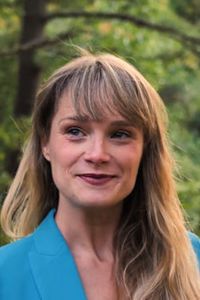
Background
Tanya Vyhovsky graduated from Essex High School. Vyhovsky earned a bachelor’s degree from Northeastern University in 2009 and a master’s degree from the University of Vermont in 2017. Her career experience includes working as a social worker and as a research fellow at the Northeastern Vermont Area Health Education Center. Vyhovsky served as a developer and program director of the Vermont Support Line and as the Vermont Chapter vice president of the National Association of Social Work.[1]
- Graduate:
- University of Vermont, 2017
- Bachelor's:
- Northeastern University, 2009
Campaign themes
Tanya Vyhovsky has not yet completed [the profile publisher]'s 2026 Candidate Connection survey.
If you are Tanya Vyhovsky, click here to fill out [the profile publisher]'s 2026 Candidate Connection survey.
Who fills out the candidate survey?
Any candidate running for elected office, at any level, can complete [the profile publisher]'s Candidate Survey. Completing the survey will update the candidate's [the profile publisher] profile, letting voters know who they are and what they stand for. More than 33,000 candidates have taken [the profile publisher]'s candidate survey since we launched it in 2015. Learn more about the survey here.
You can ask Tanya Vyhovsky to fill out this survey by using the button below.
Tanya Vyhovsky did not complete [the profile publisher]'s 2024 Candidate Connection survey.
Tanya Vyhovsky did not complete [the profile publisher]'s 2022 Candidate Connection survey.
Who are you? Tell us about yourself.
Tanya is a 2003 graduate of Essex High School with a BS from Northeastern University and Masters from the University of Vermont. Tanya is a social worker and long time community organizer. She owns a small counseling practice in Essex where she works with youth and young adults from her community seeing daily the struggles of Vermonters due to broken and failing systems. Tanya has worked to fight for healthcare as a human right, fair and livable wages, paid family medical leave, climate justice, racial justice and campaign finance reform among many causes at the local, state and federal levels. Tanya has worked in conjunction with state government to develop a novel support service for Vermonters under the Mental Health Transformation Grant, this service has saved the state millions and the lives of Vermonters. In response to COVID-19 Tanya organized Essex Mutual Aid to ensure her community's needs were met. In 2018 Tanya first ran for office because she felt the need to fight for systems that lifted us all up and build a Vermont where all of our voices were heard and we all could thrive.
Please list below 3 key messages of your campaign. What are the main points you want voters to remember about your goals for your time in office?
We will only make transformative change that works for all when all of our voices are at the table: particularly those who are historically underrepresented. We need systems that lift us all up and allow us all to thrive. We all do better when we all do better. COVID-19 has given us a real opportunity to rebuild an economic system that is based in justice and sustainability.
What areas of public policy are you personally passionate about?
My platform is build on three pillars:
Economic Justice: fair and livable wages, fair taxation, paid family and medical leave, publicly funded education from pre-k to post secondary, single payer healthcare.
Social Justice: Comprehensive criminal justice reform. closing the racial and gender wage gaps, revitalizing democracy and making voting more accessible and transparent, campaign finance reform.
Environmental Justice: Building a comprehensive just and sustainable economy with green job development, ending subsidy to fossil fuel infrastructure, investing in local sustainable economies
Who do you look up to? Whose example would you like to follow, and why?
The person I look up to is Senator Bernie Sanders. The way in which he has tirelessly fought for those who do not have a seat at the table even when it was at a detriment to his movement up the ladder is an inspiration to me. He has inspired a movement of young people and people who have been silenced in our society to fight for a system that works for us all. I hope to be this kind of leader and it has been the honor of a lifetime to be part of his movement for justice.
Is there a book, essay, film, or something else you would recommend to someone who wants to understand your political philosophy?
Our Revolution, Senator Bernie Sanders
Republic Lost, Lawrence Lessig
The Deficit Myth, Stephanie Kelton
What characteristics or principles are most important for an elected official?
We need people who listen and collaborate to build transformative policy for the people. We need bold, brave leadership that will fight for the people.
What do you believe are the core responsibilities for someone elected to this office?
To represent the people that are elected to represent and fight for justice.
What is the first historical event that happened in your lifetime that you remember? How old were you at the time?
I remember when I was 5 watching images from Dessert Storm.
What was your very first job? How long did you have it?
My first job was as a hostess at a local restaurant. I worked her from when I was 14 to when I was 17 as a way to pay for college classes that my mother could not afford.
What is your favorite book? Why?
Catcher in the Rye, this book spoke to me as a teenager who was struggling to fit in and felt that nobody could possibly know the many struggles we were facing. There is an immense amount of pressure to always be fine and this is damaging and ultimately led me to social work to support people to accept that we do not always have to be ok especially when we do not have our needs met.
What is something that has been a struggle in your life?
I grew up in a single parent, working class home and we did not always have everything we needed. I went to college because of my academic achievement and graduated with a huge amount of student loan debt and found it impossible to afford returning home to my community. I was able to stop commuting and returned to my community in 2014 to live and work but my family has had to ask ourselves if we could afford to stay here and if we were truly welcome here. I chose to run in 2018 and again now for all of the people who have similarly felt left behind by our systems and who have struggled to thrive here.
Every state besides Nebraska has two legislative chambers. What do you consider the most important differences between the legislative chambers in your state?
The size is a key difference in the chambers in Vermont. We have 150 State Representatives and 30 State Senators and this difference creates a different way of working together.
Do you believe that it’s beneficial for state legislators to have previous experience in government or politics?
I think that it is important to have an understanding for how policy works which can be provided and taught. I think it is more important that we have diverse voices that have experienced the impact of policies to help craft policy that will on the ground help people who are struggling.
What do you perceive to be your state’s greatest challenges over the next decade?
We have an aging population and shrinking tax base as well as serious affordability issues. It is estimated that 60% of Vermonters cannot afford a $500 unexpected expense and with the COVID crisis we will have even more struggles to overcome.
What do you believe is the ideal relationship between the governor and the state legislature?
The ideal relationship should be one of collaboration and team work.
Do you believe it’s beneficial to build relationships with other legislators? Please explain your answer.
Yes, as a social worker I know the power of relationships is very important. When we have strong relationships we are better able to hear openly different view points and craft transformative policy that no one of us could have imagined on our own.
What process do you favor for redistricting?
Non-partisan, non-governmental third party committee made up of local stakeholders.
If you are not a current legislator, are there certain committees that you would want to be a part of?
Health Care
Human Services
Criminal Justice
Is there a particular legislator, past or present, whom you want to model yourself after?
Senator Bernie Sanders
Are you interested in running for a different political office (for example, the U.S. Congress or governor) in the future?
I am not sure. Right now I am focused on this race and doing the best I can for my constituents if elected.
Both sitting legislators and candidates for office hear many personal stories from the residents of their district. Is there a story that you’ve heard that you found particularly touching, memorable, or impactful?
I have heard many stories about people struggling to get by and many people who are unsure if they can afford to stay here and this is also my story. Every story is meaningful and important and needs to be lifted up and heard.
On the 2026 ballot
Links
Compiled from the candidate’s published profile as of October 6, 2026.
Source(opens in new tab)