
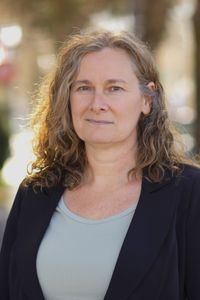
Background
Tammy Carpenter was born in Michigan. Carpenter earned a bachelor's degree from Washington University in St. Louis in 1993 and an M.D. from the University of Chicago in 2003. Her career experience includes working as an anesthesiologist and serving on the board of directors of a private anesthesia practice. Carpenter has been affiliated with the Oregon Society of Anesthesiologists, Oregon Medical Society, and American Society of Anesthesiologists.[1]
- M.D.:
- University of Chicago, 2003
- Bachelor's:
- Washington University in St. Louis, 1993
- High school:
- Klein Oak High School
In their own words
Who are you? Tell us about yourself.
I grew up in a military family in the Midwest that relied on government programs like food stamps and the VA Housing loan to make the American dream come true. We moved frequently as my dad was always looking for a slightly better paying job. When we moved to a city for the first time we lived with my uncle and his family for nearly a year. Public education was my lifeline and, by working hard, I became an anesthesiologist. I moved here from Chicago to complete my residency at OHSU. I served my community for 20 years, taking care of patients in hospitals and clinics across the Portland area, including in our own neighborhood at Providence St. Vincent’s hospital. I served on the board of directors for Oregon Anesthesiology Group for five years and in leadership of the Oregon Society of Anesthesiologists for 15 years. I have provided anesthesia to patients undergoing gender-affirming surgery and to patients receiving reproductive care including abortions. I know that healthcare is a human right and I will never stop fighting until healthcare is free and every decision is made between a doctor and her patient rather than between the insurance company and a private equity-backed provider.
Of all my accomplishments, I am most proud of the children I raised. My oldest now lives in Paris and is fighting authoritarianism by working to expand the free press. My youngest is in DC working for a tech start-up. And my husband of 35 years and I are enjoying our empty nest.
Please list below 3 key messages of your campaign. What are the main points you want voters to remember about your goals for your time in office?
I believe health care is a human right that everyone in this country is entitled to. After 20 years as a physician, I’ve seen firsthand how insurance companies, pharmaceutical companies, and hospital executives exploit people when they are at their most vulnerable. Medical debt is the leading cause of bankruptcy, and many patients don’t get the care they need because the system is so impossible to navigate. At the same time, healthcare workers are brutally overworked, and families can lose everything if they lose their emp-based healthcare. It is time for a single-payer universal healthcare system in Oregon that puts people over profits. Primary, dental, vision, abortion, and gender-affirming care - free at the point of service.Every person deserves a high-quality education. This shouldn’t be determined by families’ zip codes, language, age, gender, race, ability, or any other factor. It can’t be said enough - educators’ working conditions are our students’ learning conditions. My experience on the Beaverton School Board has shown me that educators need plentiful resources, professional autonomy, and academic freedom. I am absolutely opposed to privatizing public education. Every dollar that is spent outside of our public schools leads to the further erosion of this public good. I will be a champion for Oregon students, teachers, and education workers in Salem.Trump’s tax cuts were massive giveaways to wealthy individuals and big corporations, sold as economic growth. The Republican-led Congress decided to defund Medicaid and SNAP, and prioritize ICE deportations and war, causing trauma for our immigrant families and raising costs for all working families. I have had enough. I will lead efforts to make Oregon’s tax code fair by closing corporate loopholes and taxing millionaires and billionaires to invest in the Oregon Health Plan, public schools, and social housing. Lawmakers must choose - carry water for corporations and the ultra-wealthy or stand with workers. I know which side I am on.
What areas of public policy are you personally passionate about?
I have seen first-hand the impact of our broken health care system. Patients have asked me to give them less anesthesia or have avoided an important procedure in order to save money. Nearly 250,000 Oregonians are uninsured and 1 in 10 Oregonians experienced a gap in coverage last year. Even people with insurance often cannot afford care due to high out of pocket costs. Medical bills are the number one cause of bankruptcy in the US -- and that simply does not happen in other countries. I am running because healthcare is a human right and Oregonians deserve better. I will fight for single-payer healthcare to provide every Oregonian with comprehensive health care coverage, free at the point of service.
What organizations or individuals have endorsed your campaign?
Oregon Working Families Party, Democratic Socialists of America, SEIU, Sierra Club, AFT-Oregon, PCCFFAP, Basic Rights Oregon, AFSCME, Oregon Education Association, Oregon Nurses Association, AFL-CIO, Pineros y Campesinos Unidos del Noroeste (PCUN), MotherPAC, Next Up Action Fund, Nurses and Friends for Single Payer, Gray Panthers, Washington County Ignite, Friends of Smart Growth, Oregon League of Conservation Voters, Lead Locally, Communication Workers of America, Our Revolution, Jewish Palestinian Alliance of Oregon, American Council for Palestine, Pro-Animal Oregon, APANO
Tammy Carpenter did not complete [the profile publisher]'s 2023 Candidate Connection survey.
Who are you? Tell us about yourself.
I am an anesthesiologist and a mom. My husband and I moved with our two small boys from Chicago to Portland in 2004 for me to complete my training at OHSU. I have devoted the last 20 years of my life to practicing medicine and raising my boys.
Like many of you, I have come to realize that our world is very broken. Our city and state have been neglected and it is hard to recognize what we once loved about them. With wildfires rampaging and so many neighbors sleeping rough on the streets, I don’t feel like I can sit on the sidelines any longer. We need fresh faces and fresh ideas in Salem. The same old people and ideas are not going bring us the change we need. As Greta Thunberg said "We can’t save the world by playing by the rules, because the rules have to be changed. Everything needs to change – and it has to start today."
I will bring common sense and compassion to my work on your behalf. And I will be counting on you to be right there with me.
Please list below 3 key messages of your campaign. What are the main points you want voters to remember about your goals for your time in office?
We need to be better about caring for Oregonians with mental health disorders. Oregon has the highest number per capita of adults with a mental health diagnosis and yet we have only about a quarter of the number of providers required to meet the need. And untreated mental illness is a big contributor to our homelessness crisis. If we are going to solve this crisis, then we need to tackle mental health as well as substance abuse, unemployment and low wages, housing affordability. We’ll need job coaching and childcare. And we must do more to address anti-LGBTQ youth homelessness. Much of what we are experiencing right now is a crisis of social services, the end product of years of disinvestment compounded by a deadly pandemic and a recession.I believe deeply that we can afford to do all the things that are important to us. We just need everyone to pay their fair share. Corporations who benefit from state spending often pay very little in taxes while using our educated workforce, our roads and bridges, our police and fire services. And our wealthiest neighbors are also going to have to contribute more. The top 1% of Oregonians, the ones with helicopters and hospital wings named after them, must do their part. We cannot do well as a society when so many of us are doing poorly.For the climate crisis, more must be done, quickly. The latest IPCC report says that we need global greenhouse gas emissions to peak before 2025 at the latest. It is still almost inevitable that we will temporarily exceed the 1.5°C threshold but we could return to below it by the end of the century. I do not believe a legislator can be considered serious about addressing the climate crisis when accepting donations from these fossil fuel companies. My opponent in this primary has accepted thousands of dollars from oil and gas companies. And while he has notable endorsements, I am left wondering – What legislation did not come before the House because of the influence of this money? What legislation was watered down to appease these donors?
What areas of public policy are you personally passionate about?
As a practicing anesthesiologist I have seen first-hand the impact of our broken health care system. Patients have asked me to give them less medicine or have avoided an important procedure in order to save money. Nearly 250,000 Oregonians are uninsured and 1 in 10 Oregonians experienced a gap in coverage last year. Even people with insurance often cannot afford care due to high deductibles and co-pays. And medical bills are the number one cause of bankruptcy across the country.
As we begin to face a post-Roe world, Oregon needs to be prepared to fill the void. We will need to increase access to care in Eastern Oregon because many folks there seek abortion services in Idaho rather than make the long drive west. Additionally folks in Idaho will likely be left with no options.
I am running because healthcare is a human right and Oregonians deserve better.
I will fight for single-payer healthcare to provide every Oregonian with comprehensive health care coverage, free at the point of service. Free - with no networks, no premiums, no deductibles, no copays, no surprise bills. Health coverage will be expanded and improved to include: dental, hearing, vision, and home- and community-based long-term care, in-patient and out-patient services, mental health and substance abuse treatment, reproductive and maternity care, gender-affirming care, prescription drugs, and more. I will fight to stop the pharmaceutical industry from ripping off Oregonians by negotiating drug prices.
Is there a book, essay, film, or something else you would recommend to someone who wants to understand your political philosophy?
I highly recommend a book by Thomas Frank called Listen, Liberal. My comments below are drawn heavily from the review by GoodReads.
It is a widespread belief among liberals that if only Democrats can continue to dominate national elections, if only those awful Republicans are beaten into submission, the country will be on the right course.
But this is to fundamentally misunderstand the modern Democratic Party. Frank points out that the Democrats have done little to advance traditional liberal goals: expanding opportunity, fighting for social justice, and ensuring that workers get a fair deal. Indeed, they have scarcely dented the free-market consensus at all. This is not for lack of opportunity: Democrats have occupied the White House for much of the last thirty years, and yet the decline of the middle class has only accelerated. Wall Street gets its bailouts, wages keep falling, and the free-trade deals keep coming.
Frank lays bare the essence of the Democratic Party's philosophy and how it has changed over the years. A form of corporate and cultural elitism has largely eclipsed the party's old working-class commitment. For certain favored groups, this has meant prosperity. But for the nation as a whole, it is a one-way ticket into the abyss of inequality. Written in the lead up to the 2016 Presidential election, Frank recalled the Democrats to their historic goals - the only way to reverse the ever-deepening rift between the rich and the poor in America.
As one example of this free-market ideology, Larry Summers said, early in the Obama administration, “One of the reasons that inequality has probably gone up in our society is that people are being treated closer to the way that they’re supposed to be treated.”
Frank does not see this behavior as new, but rather “It is the eternal conflict of management and labor, owner and worker, rich and poor — only with one side pinned to the ground and the other leisurely pounding away at its adversary’s face.
What legacy would you like to leave?
I would like to be a part of the group of legislators that brings single payer healthcare to Oregon. Historic legislation such as this would bring Oregon up to the same standard of social service as most Western Democracies. It would free Oregonians from medical debt. It would give Oregonians more autonomy in employment since insurance will not be tied to their employers. The definition of healthcare will be expanded to cover: dental, hearing, vision, and home- and community-based long-term care, in-patient and out-patient services, mental health and substance abuse treatment, reproductive and maternity care, gender-affirming care, prescription drugs, and more.
We should be spending money on doctors, nurses, mental health specialists, dentists, and other professionals who provide services to people and improve the lives of Oregonians. We should be spending every healthcare dollar on patients—not wasting money every year on profiteering, huge executive compensation packages, and outrageous administrative costs.
What was your very first job? How long did you have it?
My first job out of college was with the Applied Physics Laboratory at The Johns Hopkins University. I worked in the Space Department on a project to send a satellite to orbit an asteroid. My group was planning mission operations to guide the satellite after launch. It was intense, challenging and rewarding work. However, it was while working here that I realized that I would not be satisfied with a career in engineering – I wanted to pursue my lifelong dream of being a doctor. After a year and a half at APL, my husband and I moved to Chicago for him to attend graduate school and I began to take the courses required for medical school.
What is your favorite book? Why?
I have been reading a lot of non-fiction lately. One that has stuck with me is a book called Chasing the Scream by Johann Hari.
It describes how, after over one hundred years of the war on drugs, we have learned three things: Drugs are not what we think they are. Addiction is not what we think it is. And the drug war has very different motives to the ones we have seen on our TV screens for so long.
The author shows rather than tells the tale through the stories of people across the world whose lives have been transformed by this war. Billie Holiday’s story was particularly gripping.
We also see how decriminalization and legalization have played out across the world with remarkable results. It felt like a prescription for lawmakers who are looking how to end this endless war that we lost decades ago.
What do you perceive to be your state's greatest challenges over the next decade?
Our lack of affordable housing has reached crisis levels. We need 140,000 units to meet the need today, with more needed over the next decade.
We need to encourage dense housing across our urban areas. Denser communities will significantly help reduce our carbon footprint. Building denser housing will help minimize sprawl, protecting and preserving the natural environment. Think: Building up, not out. Plus, less sprawl also leads to shorter commutes and decreased carbon emissions. Multi-family housing, like apartment buildings and -plexes, also reduce energy use as more people are living closer together and sharing amenities. And with the shared walls associated with dense housing, it will help reduce the energy costs associated with heating and cooling. Furthermore, dense communities share natural resources and municipal services, including public transit, which helps reduce the city’s overall carbon impact. Zoning and land use tools that can include more housing types will make for more sustainable neighborhoods with mixed incomes.
Part of the solution to our housing affordability and homelessness crisis must also include more public housing. Our current public housing stock is dilapidated. We need to decarbonize and repair our existing public housing. We must move toward mixed-income public housing as a means of ensuring upkeep and maintenance of services. I will advocate for the repeal of the Faircloth Amendment that prevents federal spending on public housing.
Is there a particular legislator, past or present, whom you want to model yourself after?
Bernie Sanders is my political hero. A friend from his college days describes Bernie as "not terribly charismatic. One of his strengths, though, was his ability to work with a wide group of people, even those he didn't agree with." He carried that philosophy to Congress where he has fought tirelessly for working families, focusing on the shrinking middle class and growing gap between the rich and everyone else. Bernie has been called a “practical and successful legislator” and he was dubbed the “amendment king” in the House of Representatives for passing more amendments than any other member of Congress. In so doing he worked the levers of power to bring real benefits to working people.
I am proud to be endorsed by Bernie PDX, a local activist group working to support Bernie's values by getting like-minded candidates into elective office. I espouse every one of these values and will lead on legislation where we can influence change at the state level.
Campaign finance reform & getting Big Money out of politics
Action on climate and protecting the environment
Reducing income inequality
Universal Single-Payer Healthcare for All
Racial justice
A living wage & a union for all workers
LGBTQ, women’s, & disability rights
Fair & humane immigration policy
Criminal justice reform
Affordable housing
Making college tuition & debt free
End corporate welfare & tax loopholes for the 1%
Supporting our veterans
Protecting and expanding social security
Both sitting legislators and candidates for office hear many personal stories from the residents of their district. Is there a story that you’ve heard that you found particularly touching, memorable, or impactful?
One of the most impactful conversations that I have had was with a transgender neighbor. He shared his concerns not only about anti-trans legislation across the country, but also alarm that more people are not stepping up to defend trans folks, especially lesbian, gay and bisexual allies. He feels we are at the beginning of a “first they came for the…” moment. I share his concern that anti-trans legislation will lead to anti-gay legislation. With the current makeup of the Supreme Court, I do not feel confident that marriage equality as enshrined in Obergefell is safe.
The current slate of anti-trans legislation around the country typically falls into one of the three following categories:
•
Bans on gender-affirming healthcare for minors. These laws typically target doctors and healthcare providers and sometimes parents, making it illegal—often with associated criminal charges—to consent to or provide gender-affirming healthcare to trans youth.
•
Bills that restrict access to athletic programs based on sex assigned at birth. These bills seek to restrict sports participation based on sex assigned at birth, with the result being that trans girls would be forced to participate on boys’ teams, and trans boys would be forced onto girls’ teams..
•
“Bathroom bills” that limit access based on sex assigned at birth. While the most prominent so-called “bathroom bill” was North Carolina’s HB2 in 2016, the bills have not gone away.
All three types of legislation are unnecessary and are driven by longtime anti-LGBTQ activist groups spreading misinformation about trans youth. Medical associations and doctors have spoken out against these bans
On the 2026 ballot
Links
Compiled from the candidate’s published profile as of September 30, 2026.
Source(opens in new tab)