
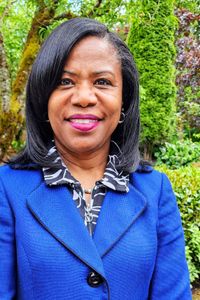
Background
Sharonda Amamilo earned a high school diploma from Seventy-First High School. Amamilo earned a graduate degree from Saint Martin's University in 1997 and a law degree from the Seattle University School of Law in 2003. Amamilo's career experience includes working as a judge. Amamilo served in the U.S. Army Reserve from 1993 to 2022.[1]
- Law:
- Seattle University School of Law, 2003
- Graduate:
- Saint Martin's University, 1997
- High school:
- Seventy-First High School
In their own words
Who are you? Tell us about yourself.
I am a wife, mother, grandmother, veteran, former public defender, and judge, shaped by rural North Carolina roots and a family life centered on faith, service, work, and community. I learned early that dreams require discipline. I worked, raised a family, and went to college at night, balancing responsibilities, challenges, and long-term goals that were worth the work because the objective was not only personal achievement, but outcomes that help people.
Some of my earliest systems lessons came through my children. When they were labeled, underestimated, or nearly placed on paths that did not reflect their true ability, I saw how easily institutions can misread people. That deepened my commitment to listening, preparation, and understanding the whole person and the whole system.
I believe economic opportunity is connected to justice, stability, and dignity. My MBA in Organizational Development informs my work with the Washington State Microenterprise Association, which supports very small businesses that help families build income, independence, and community resilience. A microenterprise is a very small business that gives people a practical pathway to earn, build, and participate in the economy.
As a Supreme Court justice, I would bring independent judgment, collegial decision-making, and disciplined reasoning. I will work respectfully with other justices, and when I disagree, I will provide clear, reasoned bases for my position under the law.
Please list below 3 key messages of your campaign. What are the main points you want voters to remember about your goals for your time in office?
Full-scope judicial readiness. I bring broad judicial experience directly relevant to the Washington Supreme Court. As a Superior Court judge, I have presided over felony criminal, civil, family, juvenile, child welfare, protection order, guardianship, involuntary treatment, probate, lower court appeal, and state agency appeal matters. I have also served as a pro tem judge for the Court of Appeals, Division II, and earlier served briefly as a pro tem district court judge. That breadth matters because Supreme Court decisions shape trial practice, appellate review, agency action, and public confidence statewide.Disciplined systems thinking. My approach is grounded in understanding how courts, statutes, agencies, local resources, and lived realities interact. Before the bench, I practiced in public defense, private practice, and representation of youth in foster care. I also served nearly 30 years in the U.S. Army and Army Reserve in Military Intelligence. My statewide service includes the DCYF Oversight Board, Sentencing Guidelines Commission, Joint Legislative Task Force on Jail Standards, Alternatives to Incarceration work, AOC Family Well-Being Collaborative, and Hague Convention work. I bring legal discipline informed by real systems experience.Tribal sovereignty and veteran service. Washington courts must understand Tribal sovereignty, treaty rights, jurisdiction, ICWA/WICWA, and government-to-government obligations. My family and juvenile court experience includes cases requiring respect for Tribes as sovereign governments, not simply interested parties. I also bring a veteran’s perspective shaped by nearly 30 years in U.S. Army and Army Reserve Military Intelligence. As the only veteran in this race, I seek to bring that service lens to the Supreme Court in a state with major military installations, deep military history, and hundreds of thousands of veterans, service members, and military families. I understand duty, restraint, readiness, and the rule of law.
What areas of public policy are you personally passionate about?
As a judicial candidate, I do not approach public policy as a legislator or executive would. A justice must not promise policy outcomes, but must apply the constitution, statutes, precedent, court rules, and the record with independence and restraint. I care deeply about the fair administration of justice, access to courts, clear judicial decisions, constitutional rights, and public confidence in an impartial judiciary. My experience in child welfare, family and juvenile court, public defense, state agency appeals, Tribal sovereignty issues, veterans’ service, and statewide justice-system work strengthens my ability to understand context while deciding each case fairly under the law.
Who do you look up to? Whose example would you like to follow, and why?
I look up first to my mother and the elders who shaped me in rural North Carolina. They modeled faith, hard work, service, resilience, and care for neighbors without needing recognition.
In the law and in public service, I also look up to people who bring intellectual discipline, humility, clarity, independence, and deep respect for those affected by public systems. That includes not only judges, but also the multidisciplinary workgroups I have served with: attorneys, social workers, treatment providers, agency leaders, Tribal representatives, community advocates, and individuals with lived experience. Their perspectives have shown me that systems respond better when they are informed by both legal structure and real-world understanding.
I want to follow that example: prepared, principled, steady, collaborative where appropriate, independent where required, and faithful to the law.
What characteristics or principles are most important for an elected official?
For any elected official, the most important characteristics are integrity, preparation, humility, accountability, and fidelity to the role entrusted to them. Public service is not about personal power; it is about responsibility, discipline, and stewardship.
For a judge, those principles carry an even more specific obligation. A judge must be independent, impartial, patient, and faithful to the law. Judicial service requires careful listening, clear reasoning, respect for the constitution, respect for precedent, and the humility to decide only the issues properly before the court.
I also believe elected officials must understand the real-world impact of their decisions while staying within the limits of their authority. The public should be able to trust that an elected official is prepared, honest, transparent in reasoning, respectful of others, and committed to serving the people rather than themselves.
What do you believe are the core responsibilities for someone elected to this office?
The core responsibility of a Washington Supreme Court justice is to serve as a final, independent interpreter of Washington law. As the court of last resort, the Supreme Court must resolve significant legal questions, protect constitutional rights, maintain the proper role of each branch of government, and publish clear, workable opinions that trial courts, appellate courts, agencies, attorneys, and the public can understand and apply statewide.
I have carried out closely related responsibilities through appellate review of lower court decisions. In those matters, the task is not to retry the case, reweigh the facts, or substitute personal views for the law. It is to review the record, apply the correct legal standards, respect precedent, and explain the decision clearly enough that the parties and reviewing courts understand the reasoning.
I have also handled state agency appeals and state-impact matters where the court’s decision can affect more than the immediate parties. Those cases require disciplined attention to statutory authority, administrative records, agency discretion, constitutional limits, and separation of powers.
My service as a pro tem judge for the Court of Appeals, Division II, further strengthened my understanding of appellate judging: careful preparation, collegial deliberation, fidelity to precedent, and clear written analysis. On the Supreme Court, I would bring that same discipline to opinions that must guide the law for all Washingtonians.
What legacy would you like to leave?
I would like to leave a legacy of service, purpose, and positive impact. Personally, I hope my life empowers others, especially my children and grandchildren, to recognize their own gifts and use them in ways that best serve the world.
Professionally, I would like to leave a legacy of helping make justice more understandable, accessible, and trustworthy. I want people to remember that I listened carefully, applied the law faithfully, treated people with dignity, and strengthened systems so they worked better for families, communities, courts, and the public.
For me, legacy is not about position or recognition. It is about whether my work helped create stability, expanded understanding, supported accountability, and left people and institutions better prepared to serve with fairness, clarity, and care.
What was your very first job? How long did you have it?
My very first work was in the fields as a child in rural North Carolina, helping pick crops such as cucumbers and tobacco alongside adults. It taught me discipline, endurance, respect for working families, and the dignity of labor. And, my first W-2 job was in fast-food for 1 year until I completed a keyboarding class and qualified for an office clerk job in 1985.
What is something that has been a struggle in your life?
One struggle has been balancing family responsibilities, military service, work, education, and long-term goals without losing sight of purpose. I worked, raised a family, served, and went to school at night. Those seasons were demanding, but they taught me preparation, perseverance, humility, and the importance of pursuing outcomes that help others.
How would you describe your legal philosophy?
My legal philosophy starts with the facts and is grounded in following the law, protecting constitutional rights, respecting precedent, and treating every person with dignity. A judge must decide the issues properly before the court based on the constitution, statutes, court rules, precedent, and the record, not personal preference. I value clear reasoning, restraint, impartiality, and decisions that can be understood and applied.
Do you believe that empathy is an important quality for a judge?
Yes, but judicial empathy must be disciplined. As a trauma trained professional, empathy helps a judge listen carefully, understand context, and recognize the human impact of legal decisions. It cannot replace the law, change the burden of proof, or determine the outcome. Properly understood, empathy supports patience, fairness, dignity, and careful attention to the record.
What organizations or individuals have endorsed your campaign?
FairVote Washington, Washington Education Association, Washington State Labor Council, National Women's Political Caucus of Washington, Washington State Democratic Latino Caucus; see website below for others.
What was the first historical event that happened in your lifetime that you remember?
One of the first historical events I clearly remember was the death of Elvis Presley in 1977. I was a child in North Carolina, and a close aunt who loved Elvis was inconsolable for a long time. Because we were a musical family, his music was familiar in our home, alongside Motown and the other sounds that shaped our family and community life. I remember that moment not just as news, but as my first awareness that public figures could hold deep emotional meaning in people’s private lives. It taught me something about memory, culture, grief, and how shared music can connect people across generations.
What concerns, if any, do you have about the legal system in your state?
My concerns include access to justice, the strain on public defense, rural court resources, behavioral health pressures, child welfare complexity, and public understanding of the courts. These are not issues for judges to solve by policy preference from the bench, but they are realities courts must understand when applying the law, managing cases, writing rules, and maintaining public confidence.
Campaign websiteAmamilo's campaign website stated the following:THE CORE ISSUE: ACCESSWashington's court system does not work the same for everyone. In one county, people have reliable access to legal resources, clear processes, and courts they understand how to use. In another, those tools don't exist. The difference can determine the outcome of a custody case, a criminal charge, or any other matter that can drastically change people's lives.Judge Amamilo has seen this from every angle. As a public defender, as a trial judge, and as someone who grew up in the rural South and understands what it means to move through institutions that weren't built with you in mind.She has two priorities in mind for her time at the Supreme Court. The first is strengthening consistency and access across Washington's 39 counties. The second is protecting children and families in the dependency and foster care system, where the law is technical, the stakes are the highest they get, and the consequences follow families for generations.Sharonda's local court experience gives her something many superior court judges don't have: a real understanding of where the system breaks down and why.— Sharonda Amamilo's campaign website (July 9, 2026)Note: This text is quoted verbatim from the original source. Any inconsistencies are attributable to the original source.
On the 2026 ballot
Links
Compiled from the candidate’s published profile as of September 30, 2026.
Source(opens in new tab)