
Background
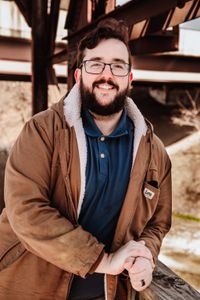
Seth Funk earned a high school diploma from Williamsport High School, an associate degree from Hagerstown Community College in 2020, and a bachelor's degree from St. Mary's College of Maryland in 2024.[1]
- Associates:
- Hagerstown Community College, 2020
- Bachelor's:
- St. Mary's College of Maryland, 2024
- High school:
- Williamsport High School
In their own words
Who are you? Tell us about yourself.
I grew up outside of Fairplay, graduated Williamsport High and Hagerstown Community College, and now live in Williamsport with my wife, dog, and cat. I graduated from St. Mary's College of Maryland with a degree in political science and policy with the intention of dedicating myself to helping my community thrive. Currently I'm working as a Resident Advisor at the Victor Cullen Center in Sabillasville. I work with youth receiving treatment for substance abuse, mental health disorders, and working to reintegrate back into their community. I've organized in Washington County with local organizations dedicated to combating substance abuse and homelessness, I've stood with workers to improve pay, working conditions, and fought for their right to unionize, and I've advocated to protect farmland and resist unchecked development. I appeared before the Frederick County Council, urging them to reject expanding data center zones and focus on meeting community needs. When the Council expanded the project against the cries of the community, I worked with community members to promote an initiative to put data centers on the ballot and overturn that destructive decision. That effort ultimately led to over 22,000 signatures in less than 3 months. Wherever I am, I work to bring solutions that benefit the local community and advocate for those that are left out of government decisions.
Please list below 3 key messages of your campaign. What are the main points you want voters to remember about your goals for your time in office?
For too long, we've seen our labor and taxes go for someone else's benefit. Whether high prices for every day goods that pad corporate pockets, or taxes to government that we have to beg for every budget year, we're always working for someone else's benefit. I'm running to change that. Our resources and our labor should benefit our district. That means development needs to make sense and address a community need. When we spend tax payer money, it should be for a project that works to solve a local problem, that actively benefits our communities, and employs our residents. Our land, our labor, our benefit.I'm running against the type of leaders we've had in this district for the past 20 years. I'm running against leadership that thinks warehouses deserve more support than people. I'm running against leadership that hasn't brought investment into the district, that hasn't worked to make life affordable, and hasn't delivered results to make people's lives easier. I'm running to fight nonstop for this district in Annapolis. When decision makers are asking "Why western Maryland?", we need a leader who will shoot back "Why not Western Maryland?" and bring that investment here.Western Maryland has been ignored for decades, and it shows. We have crumbling infrastructure, public schools that don't get the funding they need, public services that can't sufficiently serve us, and an economy that doesn't build long term stability. Talking with the community, many are resigned to the idea we can't have better, that our leaders won't help us. I won't accept that. Western Maryland once powered the state, with our economy and our labor. With the railroads, the coal mines, and the manufacturing, we were a key part of Maryland's future. With leadership that's dedicated to fighting every day for that future, we can power this state once again. I'm running to show that a better Western Maryland is possible.
What areas of public policy are you personally passionate about?
Energy policy and worker's protections are my top two. Every aspect of energy generation shows up on our electric bills. Effective energy policy means reliability for the grid, cheaper rates for Marylanders, and stability for the future. This also helps bring long term, quality jobs into districts that have struggled with the loss of manufacturing. We've seen what the last several decades of pro-corporate, anti-worker policies have resulted in. Super-profits for shareholders and working people pay the price. Unions built this country, and offer careers with great pay and benefits. Government should fight more for those who advocate for the rights of labor over corporate boardrooms.
Who do you look up to? Whose example would you like to follow, and why?
In history, I have several. I've long looked up to Abraham Lincoln and Ulysses S Grant as leaders who rose from working class roots, didn't buy their way into politics, and did what they thought was right even when others thought they were wrong. They were leaders during what may have been the most difficult time in our history, and they stayed steadfast in their convictions to bring liberty and justice for all. Eugene V Debs is another historical figure who never stopped fighting for working people, even when he was imprisoned for it. In every action he took, he stood up for the people who do the work in this country and never receive the thanks. He urged us to ignore left vs right and focus on the top vs the bottom, and I bring that same mentality to my work. In local organizing, I admire anyone whose working just as hard as anyone else to afford to live, but still takes time to better their community. Picking up trash, organizing a food drive, handing out clothes to the homeless. When we're organized as a community, its more inspiring than any one individual could be to me.
What characteristics or principles are most important for an elected official?
Dedication, transparency, and integrity. We need elected officials that are dedicated to serving their district, transparent in their decisions and actions, and have the personal integrity to make decisions that are best for their district, regardless of their personal beliefs or affiliation.
What do you believe are the core responsibilities for someone elected to this office?
Fighting for the district in every decision in Annapolis. Sometimes that is a simple up or down vote. Often though, a delegate is responsible for making sure the voice of their constituents is heard and that their district is getting its share of support from State policies and programs. We shouldn't be ignored or overlooked for funding and support.
What legacy would you like to leave?
Everything I did, I did to make life better for working families. I want people to believe that, even if they disagreed with my approach, that I was completely dedicated to making life more affordable, more enjoyable, and less of a struggle for the everyday person. I'd like them to believe that if I took a position it was because I truly believed that position was the best one to help working people. I'd love to leave a legacy that brings working people together as one to fight for their future and their prospects.
What was your very first job? How long did you have it?
Roy Rogers by the Valley Mall, working as a cashier during my senior year of high school. I was in training to be a lifeguard, but just wanted some extra cash while I was in school. I ended up working there for maybe 2 or 3 months before I finished lifeguard school and switched to that. I was a lifeguard for about 4 years after that.
What do you believe is the ideal relationship between the governor and state legislature?
I'm a believer that the legislature should set priorities and the policy of the state, and the governor administers the programs that carry out those goals. With the two party system, the governor can't truly represent the vast diversity of needs across the state. What works in Baltimore or Southern Maryland isn't going to work in Western Maryland. The legislature has voices from everywhere in the State, so its better equipped to do that
What do you perceive to be your state's greatest challenges over the next decade?
Affordability for working people. That's everything from energy to housing to healthcare to groceries. With the budget issues in Annapolis, they're trying to raise more revenue with projects that aren't going to address the affordability issues. We can identify projects that address affordability and generate new revenue so that working people can afford to live in this state.
Do you believe that compromise is necessary or desirable for policymaking?
Compromise gets used as a buzzword by politicians that want to portray themselves as reasonable. Compromise should be how you ensure your community members are heard, not as a goal by itself. As an example, if I want to propose new solar panels in the area, I have to factor in the realities of my district. The area wants to preserve farmland, they want projects to benefit the community instead of corporations, they don't want new taxes, they have other budgetary needs like schools, hospitals, and essential services, etc. Compromise here is making sure everyone feels their concerns were taken seriously. For this project, we identify revenue that is already collected, we place it in control of local governments so they get the revenue directly, which they can use to improve schools, facilities, or services, all while lowering energy prices for residents and without raising taxes. This is the type of compromise that is desirable, because we addressed multiple conflicting needs with one project.
What organizations or individuals have endorsed your campaign?
We're still working with local organizations, unions, and leaders on this. Many of these are focused on the primaries, which I am running unopposed in, so we'll update this when we finalize that process.
What was the first historical event that happened in your lifetime that you remember?
Probably the 2004 presidential election. I remember they gave us some kind of magazine for elementary schoolers, and one of the activities was a little mock election in school where they tallied the votes from the magazines and saw if we were right. I remember being way more interested in a piece about bears that was right above that activity than I was about the election itself.
On the 2026 ballot
Links
Compiled from the candidate’s published profile as of September 30, 2026.
Source(opens in new tab)