
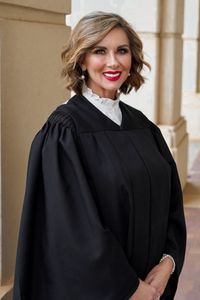
Background
Sarah Capp was first elected to represent District 82 of the Arkansas House, which includes parts of Franklin, Madison, and Crawford, in 2017.[1]
Capp graduated from Murray State University with a bachelor's degree in political science. She went on to earn her J.D. from the William H. Bowen School of Law. Her work experience includes being the City Attorney for Altus, a Special Justice to the Arkansas Supreme Court in 2015, and a member on the board for the Arkansas Development Finance Authority in 2016. Her volunteer experience includes being a member of the Ozark Area Chamber of Commerce and the Arkansas Bar Association. Capp is also a former president of the Big Brothers/Big Sisters chapter in the River Valley.[1]
- Law:
- William H. Bowen School of Law, 2004
- Bachelor's:
- Murray State University, 2001
- High school:
- Grayson County High School
In their own words
Who are you? Tell us about yourself.
Former Small business owner, Arkansas State Legislator, and current State District Court Judge. Judge Sarah Capp is grounded in Arkansas values, where she has drawn on real life experiences to advocate for clients, led meaningful, result driven reforms in the legislature, and addressed root causes of crime with support services, reducing recidivism in her courts.
Please list below 3 key messages of your campaign. What are the main points you want voters to remember about your goals for your time in office?
I’m a former lawyer/legislator and I understand how laws are made, but most importantly as a Judge I understand how they affect people’s lives.The courtroom isn’t a place for politics, it’s a place for accountability, the truth, and getting things right.I believe in personal responsibility. Criminals should be held accountable. Victims deserve to be heard. And the courtroom should be a place where justice is more than a word.
What areas of public policy are you personally passionate about?
Justice reform. We need more community-focused initiatives that help nonviolent offenders avoid jail by completing education, job training, drug and alcohol classes, and community service. With our prisons overcrowded, judges must think creatively about accountability and rehabilitation.
Who do you look up to? Whose example would you like to follow, and why?
I admire Justice Sandra Day O’Connor. She was known for her pragmatism, fairness, and ability to balance the letter of the law with real-world impact. That’s how I try to approach judging—faithful to the law, but always mindful of how decisions affect people’s lives.
What characteristics or principles are most important for an elected official?
Integrity, honesty, and strong work ethic.
What do you believe are the core responsibilities for someone elected to this office?
Patience, compassion, and commitment to the rule of law.
What legacy would you like to leave?
For me, legacy isn’t about titles—it’s about service. I hope to be remembered as a servant-leader who used the law not as a weapon but as a tool for justice, healing, and accountability. My goal is to leave behind a system where people know they were treated with respect and where justice was both firm and fair.
What is the first historical event that happened in your lifetime that you remember? How old were you at the time?
Persian Gulf War, 6th Grade.
What was your very first job? How long did you have it?
Radio Station, 2 years in High School.
What is your favorite book? Why?
My favorite book is To Kill a Mockingbird because it reminds me of the importance of justice, empathy, and integrity — values I try to carry into both my personal and professional life.
If you could be any fictional character, who would you want to be?
Atticus Finch, he embodies the courage to stand up for what’s right, even when it’s unpopular. That’s a quality I strive for in my own work and life.
What is something that has been a struggle in your life?
Balancing motherhood and work.
Are there any little-known powers or responsibilities held by this office that you believe more people should be aware of?
The Court of Appeals handles the majority of appeals in Arkansas. They need judges who know the law and have a strong work ethic to process the appeals.
How would you describe your legal philosophy?
A respect for the rule of law with human dignity. As both a legislator and a judge, I’ve worked at the intersection of lawmaking and law-application. My background reflects a philosophy rooted in respect for the rule of law, yet tempered by compassion and dignity for individuals. I treat the law not only as a set of rules to enforce, but as a system that should elevate justice, reduce recidivism, and foster safer, healthier communities.
Is there a particular judge, past or present, whom you admire?
Justice Antonin Scalia, Justice Thomas, and Chief Justice Rehnquist
Do you believe that empathy is an important quality for a judge?
Empathy is important for a judge, but it must be properly understood. A judge’s role is not to let personal feelings dictate outcomes, that would undermine the rule of law. However, empathy allows a judge to ensure that every person who comes before the court feels heard, respected, and treated with dignity.
Have you ever been rated by a Bar Association? If so, what was the rating?
N/a.
Why are you running for this particular court seat?
Because I want to keep serving, not by writing laws, but by upholding them with fairness, consistency and common sense. My time in the legislature game me insight into how laws are written. As a judge, I use that experience to apply the laws the right way, not to make excuses, not to bend the rules, but to get it right.
Do you believe that it's beneficial for a judge to have previous experience in government or politics?
I do believe prior experience in government or politics can be beneficial for a judge—when it’s understood the right way. Judges don’t make policy, but having served in the legislature gave me insight into how laws are crafted, why certain language is chosen, and what the people’s representatives intended. That perspective helps me interpret the law more faithfully. It also gives me a strong respect for the separation of powers—because I’ve been on both sides of it. At the end of the day, a judge’s role is not political, but my prior service gives me a fuller understanding of how lawmaking and judging fit together in our system of checks and balances.
What is your primary concern about today's legal system in your state?
Our incarceration and recidivism rates. We have to address the root causes of criminal behavior before we can make progress.
What do you consider the greatest opportunity for the legal system in your state?
To strengthen both trust and effectiveness by expanding problem solving approaches that hold people accountable while also addressing the root causes of crime. We must connect individuals with treatment, job training, and community support instead of relying only on jail. The opportunity is now to build on that model statewide, ensuring that our courts deliver justice that is fair, efficient, and results in safer communities.
Would you be interested in serving on a higher court in the future? If so, which court appeals to you?
I’ll serve wherever God calls me.
Do you believe that Bar Association ratings are an accurate reflection of a judge’s ability?
N/a
What organizations or individuals have endorsed your campaign?
Asa Hutchinson, Susan Hutchinson, Charlene Fite, General Mark Berry, Colonel (USA Ret) Doug House, Charlie Collins, Tim Summers, Herschel Cleveland, Rebecca Petty, Dan Douglas, John Paul Wells, Will Bond, Nate Steel, Ann Henry, Sach Oliver, Bob Edwards, Ernie Witt, Neva Witt, Cheryl Anderson, Craig Cook, Jered Medlock, Chris Hussein, Gentry Wahlmeier, Jimmy Street, Sean Brister, Carrie Jernigan, Presley Engle, Christopher Brockett, Tara Crippen, Sam Eastman, John Van Kleef, Keith Kannett, and Laura Sossoman.
Candidates hear many personal stories from voters. Is there a story that you’ve heard that you found particularly touching or memorable?
I grew up in RURAL KENTUCKY—literally INSIDE the county jail. My GREAT-GRANDFATHER… my GRANDPARENTS… and my FATHER—all served as the elected jailer in our county. While the sheriff handled things OUTSIDE, our family was responsible for everything that happened INSIDE those jail walls. When my father was elected, we moved into a SMALL APARTMENT in the basement of the jail. My childhood was filled with the SOUNDS and ROUTINES of jail life. We had breakfast and dinner with inmates who were trusted enough to help out. I didn’t see them as CRIMINALS—I saw them as PEOPLE. People who had made MISTAKES, yes…but also people who came from families just like YOURS and MINE.
Living in that jail showed me some HARD TRUTHS. I saw, up close, that there are folks who need to be LOCKED UPfor the safety of others. But I also saw men and women who might have stayed OUT OF JAIL—if they had gotten the RIGHT KIND OF HELP. Education. Job skills. SOMEONE TO BELIEVE IN THEM.
Those early lessons never left me. They inspired me to go to LAW SCHOOL… and later to run for the ARKANSAS LEGISLATURE, where I worked to build PROGRAMS THAT GIVE PEOPLE A SECOND CHANCE.
I also became a JUDGE—and I implemented programs that made a DIFFERENCE. Vocational training. Parenting classes. Family counseling. REAL SOLUTIONS that help people get back on their feet—and stay there.
What is an accomplishment that you are proud of?
Putting myself through law school and my professional accomplishments of getting elected and serving with integrity.
On the 2026 ballot
Links
Compiled from the candidate’s published profile as of September 30, 2026.
Source(opens in new tab)