
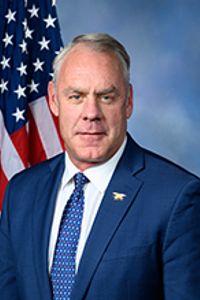
Background
Ryan Zinke was born in Bozeman, Montana. Zinke graduated from Whitefish High School in 1980. He served in the U.S. Navy from 1985 to 2008. He earned a B.S. in geology from the University of Oregon in 1984, an M.B.A. in business finance from the National University in 1991, and an M.S. in global leadership from the University of San Diego in 2003.[1][2][3]
Zinke's career experience includes working as a ground force commander with Joint Special Operations Command, a commander in a Joint Task Force in Bosnia and Kosovo, an executive officer at a SEAL Training Center, a deputy commander of CJSOTF-AP Special Forces in Iraq, the president and CEO of CDI, the executive director of the Center for Remote Integration, and the CEO of On Point Montana.[1][2][4] He served as the president of Great Northern Peace Park Foundation.[1]
Zinke served as the 52nd U.S. secretary of the interior. He was a member of President Donald Trump's (R) first administration.[5] Trump chose Zinke for the position on December 13, 2016. The Senate confirmed Zinke on March 1, 2017, by a vote of 68-31, and he was sworn in on the same day.[6][7] Zinke left the position on January 2, 2019.Cite error: Closing </ref> missing for <ref> tag[8] He is also a former Republican member of the Montana State Senate, representing District 2 from 2009 to 2013.
- Graduate:
- University of San Diego, 2003
- Bachelor's:
- University of Oregon, 1984
Campaign money
- Raised
- —
- From individuals
- $0
- From PACs & party
- $0
- Own money
- —
FEC filings.
View on FEC.gov(opens in new tab)Campaign themes
Ryan K. Zinke did not complete [the profile publisher]'s 2026 Candidate Connection survey.
Ryan K. Zinke did not complete [the profile publisher]'s 2024 Candidate Connection survey.
Ryan K. Zinke did not complete [the profile publisher]'s 2022 Candidate Connection survey.
Campaign website
Zinke's campaign website stated the following:
A STRONG ECONOMY
We are facing historic inflation and the rate of consumer prices increases have hit a 13-year high. Costs of everything from building supplies and energy to groceries and home products have gone up since last year – and not just by a little. Under President Biden, Montanans are paying more.
It’s bad enough that the Biden-Harris Administration has already cost Montana jobs and much needed revenue through the shortsighted cancellation of the Keystone XL pipeline and the ill-fated moratorium on energy development on federal lands. By comparison, when Ryan Zinke led the Interior Department, federal energy revenues increased by billions – which meant more money for Montana and better energy prices. ($30 million in 2019)
It doesn’t matter whether you’re in Whitefish, Whitehall, or Wibaux, Montanans feeling the pinch right now, and it could get a whole lot worse. Uncontrolled Washington spending plus rising consumer prices is a surefire recipe for a recession. We’re already seeing too many small businesses unable to find workers, even while unemployment remains low. We can’t allow our economy to nosedive.
Congress must:
Pass additional tax reform
Rein in the insane government spending
End earmarks
Cut red-tape and government mandates on businesses and job creators
It was only months ago that the U.S. economy was booming under President Trump’s pro-growth economic policies. Unemployment was at a half-century low, around 3.5%. Median household incomes increased about 10% over the end of the Obama-Biden years, and the poverty rate was the lowest in recorded history. We can get back to boom with pro-growth policies.
HEALTHY FORESTS AND WILDFIRE PREVENTION
In 2020, fires across the west burned a record 10+ million acres and nearly 18,000 structures. The cost to taxpayers was in the billions and the loss of life and habitat tragic. The Forest Service estimates a backlog of 80M acres of unhealthy forest in need of restoration and 63M acres have a dangerously high fire risk. When Department of Interior lands are added to the mix, the scale of forest mismanagement from years of neglect is staggering.
There is little doubt that the fire season is longer and drought conditions and elevated temperatures have created a perfect storm. Everyone should agree that the federal government can – and must – do more to restore the health of our forests to be more resilient against catastrophic wildfires, regardless of where they fall on the issue of climate change. For climate change advocates, the amount of CO2 released into the atmosphere by fires cannot be ignored. Dryer and hotter conditions should encourage active management rather than offer an excuse for the destruction of habitat and waste of renewable resources. The good news is, there are common sense solutions that can be quickly enacted if Congress had the resolve and leadership to get it done.
Under the previous Administration, Republicans and Democrats came together to pass the “wildfire funding fix” which treated wildfires like other natural disasters, allocated more money for suppression, and provided more resources toward wildfire fighting and response. Addressing the cost of fighting fires was helpful and I supported those efforts, but the real solution is using best science and better management to help prevent wildfires in the first place.
Congress has the power to fix this problem and restore our federal forests to health and resiliency by taking immediate steps:
Be a good partner: Large-scale forest restoration projects are lengthy and expensive, but the Federal government is under strict rules about how long their contracts can be. Lengthening the time the feds can partner on forest projects provides more certainty and increases the likelihood of investment and improved forest health.
Adhere to science-driven sustainable timber yields: Study after study has determined sustainable timber yields that promote healthy forests yet lawsuit after lawsuit by radical environmental groups have prevented or delayed harvest, salvage operations, and restoration projects. The result has been overgrown forests, a waste of renewable resources, and greater risk to property and life.
Prioritize prescribed burns: Fire is a natural part of the ecosystem and some of the earliest Native Americans used prescribed burns to manage the range and forests. Federal law should prioritize late season prescribed burns as a management tool to clear the dense underbrush and dead and dying timber on the forest floors by granting categorical exclusions and omitting prescribed burns from state Clean Air Act compliance. History has proven the catastrophic wildfires that occur on overgrown and unhealthy forests release more carbon, destroy more critical habitat, and do more damage to watersheds than tightly controlled burns.
Lift the export ban: Outdated policy from the 1970s made it illegal to export timber from federal lands. However the world is a different place now. Our forests are unhealthy, milling capacity plummeted, and timber prices are through the roof. Authorizing the export from federal lands would create an incentive for State, Tribal and private entities to partner with federal forests.
Promote biomass: Healthy trees are resilient trees, but dead, diseased and defective logs create a tinderbox. There is little use for this material however it is perfect for biomass. Promoting biomass as the viable, cost-effective and renewable source of energy it is would create a market for what is currently a dangerous hazard.
Coupled with best forest management practices like species diversification, fighting invasive species, clearing transmission rights of way, and targeted thinning, these bipartisan policies could greatly improve the health of our federal forests and prevent smoke filled summers.
Radical environmentalists would have you believe forest management means clear cutting forests and national parks. But their rhetoric could not be further from the truth. They make outdated and unscientific arguments, void of facts, because they cannot defend the merits of their policy preferences year after year as our forests and homes burn to the ground. Anyone who says managing, saving and restoring forests is not conservation is either knowingly lying or doesn’t understand the issue.
We’ve seen too much destruction and loss of life to keep doing nothing. The hotter and drier climate mixed with decades of neglect of federal forests has created a lethal situation in Montana and across the west. We need science-driven solutions that restore health to our dead and dying forests. We could use less politics and more leadership in Washington, DC.
BORDER SECURITY
It’s the basic Constitutional Duty of the federal government to secure the border. Currently, there is no southwest border, it’s completely open. More than a million illegal aliens have been apprehended at the border this year and thanks to the radical open border policies of the Biden Administration it’s only going to get worse. This stresses local communities, strains resources and tax dollars, and creates a massive security threat.
The threats are many: Deadly drugs like fentanyl are shipped from China to Mexico and make their way into our country by drug cartels. Criminals and possibly terrorists fly to Central America and hire coyotes and smugglers to enter our country illegally. The public health threat of a million unvaccinated individuals flooding our border is causing COVID outbreaks in American towns and putting Americans at greater risk. Illegal weapons are smuggled by gang and cartel members and rain violence on our cities and against law enforcement.
Congress must take action to:
Finish the wall
Fully fund and implement MPP
Fully fund and support Border Patrol and ICE
Designate cartels as foreign terrorist organizations
Uphold third country asylum agreements signed with Central American countries to solve the regional migration problem
Require any foreign arrivals to produce a negative COVID test and proof of full vaccination
Seek and deport those who miss hearing dates or are convicted of crime
Fine/defund sanctuary cities
PUBLIC ACCESS TO PUBLIC LANDS
In Montana, public access to public lands is not only our birthright, it’s a way of life. We know that traditional mixed-use of these lands makes our state great. So much of who we are and our economy is tied to access to the land. But radical activists infiltrating D.C. policy positions would rather restrict the public’s use of our lands and resources.
Whether it’s outdoor recreation, ranching, energy development or timber harvesting, Montana’s 27 million acres of federally-managed public lands are working lands and they are an important part of who we are in the west.
Outdoor recreation is a powerful economic engine and way of life for Montana. It adds up to billions in economic output and countless memories and quality time with the people we love. Maintaining public access to public lands is an absolutely critical part of that. As your congressman and Secretary of the Interior, Ryan always fought for expanded access to public lands and you can count on him to keep fighting.
Ryan’s accomplishments as Interior Secretary:
Opposed the sale or transfer of public lands
Supported permanent reauthorization of LWCF
Protected the Paradise Valley from mining
Rebuilt Sperry Chalet in Glacier National Park
Expanded access for hunting and fishing on millions of acres of land
Created the largest investment in National Parks Infrastructure in history using Federal energy revenues
Saved Montana guides and outfitters from expensive government mandates for federal contractors
A key to public access on public lands is infrastructure. People need passable roads and trails, working campsites, and safe boat ramps and bridges to use the land. As Secretary of the Interior one of Ryan’s greatest accomplishments was getting overwhelming bipartisan support to rebuild National Parks infrastructure (roads, trails, campgrounds, waterlines, etc) by using federal energy revenues and leading the charge on permanent and full reauthorization of the Land and Water Conservation Fund. Those bills became the backbone of the Great American Outdoors Act and led the way for the greatest investment in our parks and public lands in a century.
KEEPING OUR PROMISE TO VETERANS
Montana has a strong military tradition unparalleled by almost any other state in the nation. More than 1-in-10 of us hears the call to serve in the armed forces, and in the sovereign Tribal nations the warrior spirit is even stronger. Ryan Zinke served 23 years in the U.S. Navy SEALs and every day saw the patriotism, service and sacrifice of our troops. The United States must honor the service and sacrifice of the men and women who served our great nation.
Montana is unique. For many Montana veterans, a trip to the VA can be an all-day affair and many medical specialties such as mental health are not easily available causing veterans’ needs are going unmet. To solve this, Congress must create flexibilities that allow veterans to seek care outside the VA system and expand telehealth services.
To meet the full promise we made to our veterans, Congress must also:
Reduce the number of service members and veterans who die by suicide
Improve programs and services for women, Native American and minority veterans
Expand telehealth services
Timely and improved transition assistance, including access to programs after they leave military service
High-quality and sustainable education benefits
Strong employment and training programs
Small business development opportunities
Civilian credentials or academic credit for military training
Incentivize employers to hire veterans
As Montana’s Congressman, Ryan was a leading voice for veterans. He was an early co-sponsor of the PAWS Act which trained and funded service dogs for veterans living with PTSD, and the Providing Veterans with Overdue Care Act which authorized a major VA outpatient facility in Missoula. His legislative record also includes:
Introduced the Global War on Terror Memorial Act
Introduced the Justice for Victims of Military Sexual Assault Act
Co-sponsored the Faster Care for Veterans Act, VA Accountability Act, and many others.
As Congressman, retired Commander Zinke also hosted ceremonies across the state to honor thousands of Montana Vietnam War Veterans with the 50th Anniversary Vietnam War Pin.
Our troops gave us everything they have, leaving nothing on the battlefield. We owe it to them to give them our best.
HUNTING AND FISHING
Hunting is not only our heritage and birthright as Americans, it is also the most important tool we have to ensure healthy wildlife and habitat. American hunters and anglers are the backbone of the American model for conservation, generating over a billion dollars each year for conservation efforts. For more than 150 years, sportsmen and women have led efforts to protect and conserve our Nation’s fish and wildlife. This model has been repeated by dozens of countries across the globe for a simple reason: it works.
As Secretary of Interior, one of Ryan’s top priorities was expanding hunter access and education and removing many of the roadblocks the previous administrations built against hunters and shooting sports enthusiasts. Under his leadership, the *Department of the Interior:
Expanded hunting and fishing access on millions of acres of public lands and waters.
Repealed the ban on lead shot and tackle
Established the Hunting and Shooting Sports Conservation Council to expand access, education and awareness programs
Collaborated with states and private partners to establish the first big game migration corridors
Modernized the endangered species act
Eliminated the policy that barred BLM lands from being managed as shooting ranges
Restored the local voice in decision of how, when and where to hunt on federal lands
Ryan will continue to be a vocal supporter of our Second Amendment, hunting and fishing rights in Congress.[14]
—Ryan Zinke's campaign website (2022)[15]
The following issues were listed on Zinke's campaign website. For a full list of campaign themes, click here.
Growing the Economy: Ryan believes America is exceptional and our economy is strong when Washington stops meddling with our livelihoods and lets us innovate and create jobs. Whether it’s historic forest reforms to revitalize timber communities, rein in regulations on our natural resources, like coal, oil and natural gas, or simply cutting taxes and red tape for farmers, ranchers and small businesses, Ryan is committed to growing our local economies and moving Montana and America forward.
Peace through Strength: Ryan is a decorated veteran, having spent 23 years as a U.S. Navy SEAL. He believes in peace through strength and that America has a responsibility to assist our allies in times of need and carry out humanitarian aid missions.
Montana Values: Ryan is a fifth generation Montanan who grew up right outside Glacier National Park. Whether it’s defending our right to bear arms or ensuring mixed use of our beautiful public lands, Ryan knows that it’s our core Montana values that make Montana the Last Best Place.
Vision of our Forefathers: Ryan Zinke is a Constitutional conservative who believes in the vision the forefathers laid out which separates powers between the three branches and ensures the sovereignty of our states. As a Navy SEAL, State Senator and now a Member of Congress, Ryan swore an oath to defend the Constitution. His decisions are based on upholding the Constitution and doing what is right for Montana and America.[14]
—Ryan Zinke's campaign website, http://www.ryanzinke.com/
On the 2026 ballot
Links
- Campaign X(opens in new tab)
- Official X(opens in new tab)
- Campaign website(opens in new tab)
- Official website(opens in new tab)
- Campaign facebook(opens in new tab)
- Official facebook(opens in new tab)
- Personal facebook(opens in new tab)
- Personal linkedin(opens in new tab)
- Campaign instagram(opens in new tab)
- Official instagram(opens in new tab)
Compiled from the candidate’s published profile as of September 30, 2026 and FEC filings.
Source(opens in new tab)