
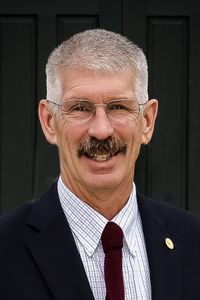
Background
Russ Hodgkins was born in Quincy, Massachusetts. He served in the U.S. Air Force from 1976 to 2009. He graduated from Quincy High School. He earned a bachelor's degree from the U.S. Air Force Academy in 1980. His career experience includes working as a pilot. He has been affiliated with Eastern Slopes Aviation Academy, U.S. Air Force Academy Association of Graduates, and Civil Air Patrol.[1]
- Bachelor's:
- U.S. Air Force Academy, 1980
- High school:
- Quincy High School
Campaign themes
Russ Hodgkins has not yet completed [the profile publisher]'s 2026 Candidate Connection survey.
If you are Russ Hodgkins, click here to fill out [the profile publisher]'s 2026 Candidate Connection survey.
Who fills out the candidate survey?
Any candidate running for elected office, at any level, can complete [the profile publisher]'s Candidate Survey. Completing the survey will update the candidate's [the profile publisher] profile, letting voters know who they are and what they stand for. More than 33,000 candidates have taken [the profile publisher]'s candidate survey since we launched it in 2015. Learn more about the survey here.
Help improve [the profile publisher] - send us candidate contact info.
Who are you? Tell us about yourself.
Born and grew up in Quincy, Mass. After graduating from Quincy High School, attended the U.S. Air Force Academy, graduating in 1980. Became Air Force pilot and spent 29 years on active duty. Combat veteran, served in Operation DESERT STORM and flew 116 combat missions in the EF-111 aircraft. Served in the United States, Europe, Africa, and the Middle East. Upon retirement from the Air Force, moved to Amherst in 2009. Married to wife Donni for 39 years. Has two adult sons, who are also Air Force pilots, and one grandson.
Please list below 3 key messages of your campaign. What are the main points you want voters to remember about your goals for your time in office?
No sanctuary cities in New Hampshire.No late term abortions in New Hampshire.No tax increases. No state sales or income taxes.
What areas of public policy are you personally passionate about?
Government decisions to spend taxpayers money must be based on facts and data. All new spending laws must have three parts:
1. A statement of what the proposed law is supposed to do, with clear, measurable outcomes.
2. A statement of the costs of the proposed law, in terms of both money and manpower.
3. A statement of what to do if the law doesn’t work.
What characteristics or principles are most important for an elected official?
An elected official must be willing to work to fix something rather than just sit back and complain about it.
What do you believe are the core responsibilities for someone elected to this office?
Be honest with the taxpayers.
What legacy would you like to leave?
That he left the campground better than he found it.
What was your very first job? How long did you have it?
I worked as a laborer for the Sewer Department of the City of Quincy Department of Public Works. It was a summer job between my junior and senior year in High School. Back then, they had summer jobs like that to keep kids off the streets and out of trouble. I learned a lot about life that summer!
What is your favorite book? Why?
"Mister Roberts" by Thomas Heggen. The best book about leadership ever written.
What do you believe is the ideal relationship between the governor and state legislature?
Legislature writes laws; governor executes them.
What do you perceive to be your state's greatest challenges over the next decade?
Maintaining the New Hampshire Advantage.
Do you believe that it’s beneficial for state legislators to have previous experience in government or politics?
No, but it helps. Experience in a big organization with many moving parts is a plus.
Do you believe it’s beneficial to build relationships with other legislators? Please explain your answer.
Yes, knowing your colleagues is important. It helps you work well together.
Is there a particular legislator, past or present, whom you want to model yourself after?
I admire Rand Paul for his intellect and willingness to ask hard questions.
Are you interested in running for a different political office (for example, the U.S. Congress or governor) in the future?
No.
Both sitting legislators and candidates for office hear many personal stories from the residents of their district. Is there a story that you’ve heard that you found particularly touching, memorable, or impactful?
Too many to list here. Everyone's family story is important.
Should the legislature oversee or grant the use of emergency powers?
Oversee: yes. Grant: only in very exceptional circumstances.
What is the first bill you would introduce if elected?
A bill to determine how many illegal immigrants are receiving welfare payments.
What committees interest you?
Anything that will help veterans
What are your views on financial transparency and government accountability?
Taxpayers must know how their money is being spent. This must be presented in an understandable way.
Would a state ballot initiative process be good or bad for your state?
Yes.
Who are you? Tell us about yourself.
Born and grew up in Quincy, Mass. After graduating from Quincy High School, attended the U.S. Air Force Academy, graduating in 1980. Became Air Force pilot and spent 29 years on active duty. Combat veteran, served in Operation DESERT STORM and flew 116 combat missions in the EF-111 aircraft. Served in the United States, Europe, Africa, and the Middle East.
Upon his retirement from the Air Force, moved to Amherst in 2009.
Married to wife Donni for 37 years. Has two adult sons, who are also Air Force pilots, and one grandson.
Please list below 3 key messages of your campaign. What are the main points you want voters to remember about your goals for your time in office?
I am a fiscal conservative. The key to keeping taxes low is to keep spending low. I support right-to-work.You know what is best for your family. I am pro-family, pro-school choice, and pro-life.I support veterans.
What areas of public policy are you personally passionate about?
Government decisions to spend taxpayers money must be based on facts and data. All new spending laws must have three parts:
1. A statement of what the proposed law is supposed to do, with clear, measurable outcomes.
2. A statement of the costs of the proposed law, in terms of both money and manpower.
3. A statement of what to do if the law doesn’t work.
What qualities do you possess that you believe would make you a successful officeholder?
I’m always willing to roll up my sleeves and fix something rather than just sit back and complain about it.
What was your very first job? How long did you have it?
I worked as a laborer for the Sewer Department of the City of Quincy Department of Public Works. It was a summer job between my junior and senior year in High School. Back then, they had summer jobs like that to keep kids off the streets and out of trouble. I learned a lot about life that summer!
What is your favorite book? Why?
"Mister Roberts" by Thomas Heggen. The best book about leadership ever written.
On the 2026 ballot
Compiled from the candidate’s published profile as of October 6, 2026.
Source(opens in new tab)