
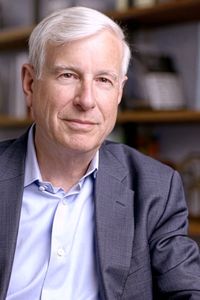
Background
Robert Chew served in the U.S. Navy from 1980 to 1986. Chew earned a high school diploma from West Geauga High School and a bachelor's degree from Case Western Reserve University in 1981. His career experience includes working as an engineering consultant.[1]
- Bachelor's:
- Case Western Reserve University, 1981
- High school:
- West Geauga High School
Campaign money
- Raised
- $1.3M
- From individuals
- $19K
- From PACs & party
- $0
- Own money
- —
FEC filings through June 30, 2026.
View on FEC.gov(opens in new tab)In their own words
Who are you? Tell us about yourself.
I am an engineer, businessman and veteran. I served as an officer on a nuclear submarine in the Cold War. I then tried my hand at a small business, failing after 3 years. I worked in a couple of companies, and then started my second business in 1996. We celebrated 30 successful years this past April. In 2008, we sold the company to all the employees, who have done quite well financially over the ensuing 18 years. We provide engineering and technical services to manufacturing operations and mission-critical facilities. I served as the company's CEO until 2022, and board chair until June 2026.
I grew up on the far east side of Cleveland Ohio. I've lived in Ohio, Indiana, Virginia, Florida, New York, Connecticut and Wyoming, before moving to Colorado almost a decade ago. I have two adult daughters, very successful in their own rights. I attend an Episcopal church in Boulder Colorado where I sing in the choir and am active in stewardship. I support a local housing charity.
I have never run for office before (other than school board, decades ago). I am a registered professional engineer, and I am also an investor in a hydrogen power company.
Please list below 3 key messages of your campaign. What are the main points you want voters to remember about your goals for your time in office?
I am running for US Senate to offer an alternative to the Red-Blue dysfunction that often paralyzes our Congress. The two major parties are not about solving problems, they are about power and money (and frequently corruption) by convincing you to vote for them because the other side is a threat to our way of life. In the Senate, I will be the adult in the room working for consensus solutions to the difficult problems we face to meet the needs of my constituents today and for generations to come.Whoever gets elected to the US Senate this November will be faced with Social Security insolvency before the end of the six-year term. Both parties have said they won't touch Social Security. That is irresponsible; doing nothing means automatic cuts to senior benefits they count on. We must craft a set of reforms to make social security sustainable for the long term. We must also confront the huge cost of healthcare, which at 19% of GDP is about twice what other developed countries pay for their healthcare. Just saying "medicare for all" won't address the root cause of high health insurance premiums - THE COST. Huge opportunities to eliminate fraud, and accelerate adoption of new technologies.Our national debt and the $1 trillion in interest we pay every year (more than we spend on defense) will continue to rise as long as we have deficit spending. This drives up the cost of mortgages, car loans, small business lending, etc., contributing to lack of affordability. Unchecked, our national debt will lead us to economic depression. We must craft a solution to our national debt, which will require hard choices that the major parties are not willing to put forward. I have the Real Courage for Real Solutions that is necessary to solve these difficult problems.
What areas of public policy are you personally passionate about?
Affordability, opportunity (jobs, standard of living), national debt/ deficit spending, social security and medicare reform, energy and water resources and the interplay with climate policy; the need to be a force for peace in the world against international bad actors with a strong alliances (NATO) and backed by a strong defense. Managing the adoption of disruptive technologies. Overall, restoring the American Dream for all generations.
Who do you look up to? Whose example would you like to follow, and why?
Teddy Roosevelt - took on the entrenched interests, was a veteran, and wasn't afraid to buck the establishment.
What characteristics or principles are most important for an elected official?
Integrity, dedication, listening (to constituents), innovation, willingness to compromise
What do you believe are the core responsibilities for someone elected to this office?
Uphold our Constitution, listen to constituents and vote in their best interest, balancing both short and long term ramifications of the legislation at hand.
What legacy would you like to leave?
A concerned citizen working to restore the American Dream for all generations and uphold our Constitution and rule of law.
What was your very first job? How long did you have it?
Split firewood for sale into Cleveland suburbs. I did this for maybe 4 years in high school.
What is something that has been a struggle in your life?
Fitting in personal time off, always filling my agenda with activities.
What do you perceive to be the United States' greatest challenges as a nation over the next decade?
Solving our debt/ deficit spending, which will require us to reform Social Security and reduce cost of healthcare.
What qualities does the U.S. Senate possess that makes it unique as an institution?
The 60-votes necessary to end a filibuster means both parties must find common ground. However, use of reconciliation to pass one-party legislation has been a disaster.
Do you believe that compromise is necessary or desirable for policymaking?
Compromise is both necessary and desirable. Both sides have something of value to say and add to draft legislation.
What was the first historical event that happened in your lifetime that you remember?
Assassination of President Kennedy
On the 2026 ballot
Links
Compiled from the candidate’s published profile as of September 30, 2026 and FEC filings.
Source(opens in new tab)