
Background
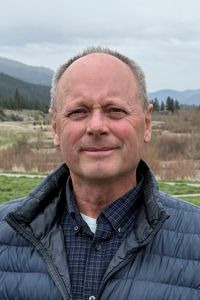
Ray Curtis earned a high school diploma from Sentinel High School. He went on to earn a bachelor's degree and a graduate degree from the University of Montana in 1984 and 1996, respectively. His career experience includes working as an educator.[1]
- Graduate:
- University of Montana, 1996
- Bachelor's:
- University of Montana, 1984
- High school:
- Sentinel High School
In their own words
Who are you? Tell us about yourself.
I grew up on the Bozeman Pass, alongside the railroad. We raised pigs, we helped our neighbors with their cows, we supported our family with hunting and fishing. It wasn’t until playing sports for Park High that I got a chance to see many other Montana communities and later became a basketball coach myself. In high school, my folks moved us to Missoula, where I continued my education, earning both my degrees at the University of Montana. As a teacher, I taught about Montana, U.S. government, and world history at MCPS, UM, MC and FVCC. During summer breaks, I guided students experientially on the Lewis and Clark trail for Antioch University, tracing segments of their journey.
I'm an ordinary Montanan, not unlike most people who call this place home. I'm not a millionaire. I stocked grocery store shelves at night and worked retail to get myself through college. I climbed telephone poles and dug holes for the railroad from Essex to Glendive, put up hay and installed irrigation pipe in the Flathead Valley, and even did a stint at the paper mill. I’ve counseled at Boy’s State in Dillon, a special needs camp, and Camp Fire Girls at Seeley Lake. After my wife Nancy died of cancer 10 years ago, with a lot of help, I started the Cancer Support Community in Missoula. Montana is home. Montana’s people are my neighbors.
Please list below 3 key messages of your campaign. What are the main points you want voters to remember about your goals for your time in office?
This past year the President aggressively encroached upon the powers of Congress and the world witnessed our constitutional rights being tread upon. It's not our imagination that freedom of press, speech, assembly, protection from unreasonable searches, the right to an attorney, a trial, protection from cruel and unusual punishment, and habeas corpus have all been encroached upon. Frankly, I never imagined I would apply for office but had to when my representative responded by doing the opposite of what the Framers intended. It seems Congress forgot what patriots 250 years ago fought, suffered, and died for. I understand the role of Congress and that the people are the boss, rather than a president, a political party, or a billionaire.Like Washington and Madison, I do not have a fondness for political parties. I opted to file as a Lincoln Republican; he wanted to unite us rather than divide us. Repeatedly he implored us to remember that we are all created equal. Like Teddy Roosevelt, I am devoted to conservation for this and future generations. I like Ike because he understood that a military complex would take away from such things as public schools, highways, safety, and health, which “promote the general welfare” of our fellow man. Furthermore, if we believed, as Reagan did, that “if we ever closed the door to new Americans, our leadership in the world would soon be lost,” America would not have had the atrocious year we just did. These are grand ideas to emulate.Life is more difficult for Americans. We will be passing on a $39 TRILLION debt (now adding $1 TRILLION every five months) due to reckless fiscal policy. Like Eisenhower, I endorse a spending policy which "promotes the general welfare" rather than war. We needed strong schools, good roads, and support for the less fortunate. People face a nearly impossible housing situation. Our tax system is the opposite of what Adam Smith, the “father of Capitalism,” desired; those with the ability to pay should, as they once did. Other nations are embracing more clean and renewable energy as the US moves away. America should have the world best health care system yet we don’t. Sadly, now we need to regain the trust of democratic allies.
What areas of public policy are you personally passionate about?
Forty years of teaching government gives me a distaste for modern campaigns: the length, the nastiness, the misleading ads, and most of all the increasingly tremendous amount of money thrown at leveraging votes. I have studied and taught about American elections throughout my career and observed that campaign money mostly seems to benefit billionaires and the candidates, rather than the voters. We can do better. I will not take money from anyone to get elected. I will spend little. I am not a politician. I will be a PUBLIC SERVANT. I will owe donors nothing. I am challenging voters to look at their options, take up the responsibility of deciding who is more like them and will best represent them, and use their vote to hire that person.
Who do you look up to? Whose example would you like to follow, and why?
As a constitutional scholar, I look to the people who created our country. While I know they were flawed, like all humans are, I do believe that they worked selflessly to create a more perfect union for our posterity.
What characteristics or principles are most important for an elected official?
Elected officials, public servants, need to first and foremost be good listeners so they can be good representatives. And, as a representative, they ought to be someone that the voters can feel good about… Someone who is politically courageous. Someone who puts country above themselves and their party. America needs more of this.
What do you believe are the core responsibilities for someone elected to this office?
A member of Congress needs to remember that they are a public servant… They are hired by voters to represent them in Washington DC. With well over 300 million people in the United States direct democracy is impossible. Individuals who become representatives need to keep in mind who are their true employers.
What legacy would you like to leave?
I am extremely proud of my teaching career, the work I did, and the relationship I had with students. I feel I did good work. And it is so satisfying to see former students who feel the same. I maintain good relationship with so many of them. I would like to, and plan to, continue that trend in Washington DC.
What was your very first job? How long did you have it?
My first wheel job was working in the kitchen at a KFC in Livingston the summer between my junior and senior year of high school. After that, I stuck shelves at night for Safeway, worked retail to put my way through college, I climbed telephone poles and dug holes for the Burlington Northern Railroad, which took me all over the state, I did a stint at the papermill in Frenchtown, and after graduated from college, began my 40 year teaching career. For three decades, I have put up hay and put out irrigation pipe for for my wife's family. All great experiences!
What is something that has been a struggle in your life?
In most aspects, I feel rather fortunate. The hardest thing I have had to deal with is the death of my wife 10 years ago. I've had to figure out how to be both a good father… And a good mother… to my young daughter, whose mother died way too young and, needlessly. A medical procedure was performed which FDA announced six months afterwards that doctors should cease using immediately. Despite that, my wife Nancy continued cancer treatment with optimism and great gratitude for what she did have. I learned a great deal from her. I miss her.
What qualities does the U.S. House of Representatives possess that makes it unique as an institution?
The US House is considered the people's house for a good reason. Members are directly elected by constituents. In western Montana they represent only a little over 500,000 people. It is the branch of government that people ought to feel they can access fairly easily. And, members have only two year terms, which means they can be replaced, and should be replaced as the Framers intended, if they are not representing citizens well. A representative works for the people not a president, a party, or a donor.
What do you perceive to be the United States' greatest challenges as a nation over the next decade?
I'm extremely concerned about America's increasing debt, which is now growing at the rate of about $1 trillion every six months. Nearly $1 trillion per year goes towards just paying interest on the debt. That is money that cannot be used for schools, healthcare, highways... in the words of the preamble, general welfare. I feel a selfish of us to pass this burden on to future generations.
Do you believe that compromise is necessary or desirable for policymaking?
Absolutely! We would not have the US Constitution without compromise! The so-called Anti-Federalists were skeptical of giving a national government more power so they insisted upon adding a Bill of Rights, to protect against the abuse of federal power, in exchange ratification. Presently, very little legislation is being advanced because the divide is so great between the political parties. This does not benefit most Americans who are generally moderate and not so far apart on many issues. We need to figure out how to work together.
What was the first historical event that happened in your lifetime that you remember?
I remember clearly watching the funeral train for RFK when I was eight years old. What resonates most with me is hearing, for the first time that I can remember, The Battle Hymn of the Republic. And now I teach about our republic.
On the 2026 ballot
Links
Compiled from the candidate’s published profile as of September 30, 2026.
Source(opens in new tab)