
Background
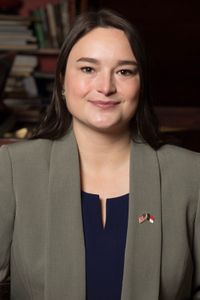
Park Inglefield earned a bachelor's degree from Northeastern University. Her career experience includes working as a nonprofit director.[1]
- Bachelor's:
- Northeastern University
In their own words
Who are you? Tell us about yourself.
I was born in Statesville and raised in Hickory. I grew up in Hickory Public Schools, attending Viewmont Elementary, Northview and Grandview Middle Schools, and Hickory High School. My faith was nurtured at Northminster Presbyterian Church, where I grew up surrounded by mentors who believed in me. I studied political science at Northeastern University in Boston, graduating with honors and a minor in psychology. I spent ten years in Boston working in public service and training women to run for political office.
In 2022, I returned home determined to give back to the city that raised me. I have worked with several nonprofit organizations, including serving as Deputy State Director for Rise Free. I also completed a year on the Catawba Grand Jury, witnessing firsthand the challenges our community faces with domestic violence, child endangerment, and substance abuse. Today, I serve as the North Carolina State Director for Young People's Alliance, a nonpartisan nonprofit that develops the next generation of leaders to advocate for positive change.
I'm running to be your next State Representative because the status quo isn’t working for everyday people. When I'm not working or campaigning, you can find me enjoying Crawdads games, supporting local theater, or exploring local shops and restaurants.
Please list below 3 key messages of your campaign. What are the main points you want voters to remember about your goals for your time in office?
Protect: The first responsibility of leadership is to protect people, communities, and the institutions they rely on. I’m running to enhance public safety, defend our natural resources, eliminate threats to privacy, invest in public education, protect voting rights, and expand access to healthcare.Provide: Public service should genuinely serve the public. Once elected, I will be a transparent leader who shows up, listens, and delivers tangible results for my constituents. Investing in infrastructure and reliable public services that people can truly count on are priorities for meProsper: With my leadership in office, we can cultivate a hopeful and practical vision for making our home and state better. We must focus on economic opportunity, workforce development, support for small businesses, strong education, and affordable housing so individuals and families can build stable, fulfilling lives and succeed here at home.
What areas of public policy are you personally passionate about?
I am passionate about public policy that impacts my neighbors. Improving the quality of life for the residents of our district; ensuring that people have their basic needs met; protecting and preserving our natural resources from overdevelopment and the rapid spread of data centers; and protecting our right to privacy from government mass surveillance. To invest in the future of North Carolina, we need to strengthen our public education system. Ultra-wealthy families are getting government support for unaccountable private schools at the direct expense of our underfunded public education system. I will work to ensure vouchers go to families that truly need them and fully fund our public schools.
Who do you look up to? Whose example would you like to follow, and why?
My grandmother, Anita Arneson Pressly, is the person I look up to most. My grandmother was no stranger to loss and personal tragedy, yet she remained constant in her faith and her drive to help others. When her son, my uncle John, was born with severe mental and physical disabilities, she dedicated forty years to pioneering services for special needs children and adults in the Iredell County community. She earned The Order of the Long Leaf Pine in recognition of her decades of dedication to one of our most vulnerable and overlooked populations.
She taught me that true leadership means serving those who need it most, especially the people our community too often overlooks. She showed me that hard work in service of others is never wasted, and that advocacy requires both compassion and persistence.
My grandmother passed away in 2020 at 98 years old, leaving behind a legacy of love and service for her family to carry forward. I feel her with me in this campaign. Her example guides every decision I make—to listen to those who aren't being heard, to fight for those who can't fight for themselves, and to never shy away from hard work when it means helping others.
That's the kind of leader I want to be. That's the legacy I want to honor.
What characteristics or principles are most important for an elected official?
The most important characteristics are accountability, accessibility, and integrity. An elected official must be accountable—willing to own their decisions, explain their reasoning, and adjust course when something isn't working. They must be accessible—every constituent deserves responsive service, not just those with personal connections to leadership. And they must have integrity—making decisions based on what's best for the community, not what's politically convenient or personally beneficial.
Effective officials must also be collaborative listeners who seek input before making decisions, fiscally responsible stewards of taxpayer resources, and transparent communicators who keep citizens informed. They should base decisions on evidence and research rather than ideology, and they should never shy away from difficult conversations or challenging decisions.
What do you believe are the core responsibilities for someone elected to this office?
A state representative should be accessible to constituents, responsive to their concerns, and proactive in addressing challenges before they become crises. Your state representative is responsible for making your voice heard and advocating on your behalf for your best interest. That means listening, learning, and crafting or supporting legislation that addresses constituent concerns. Ultimately, every responsibility comes back to one question: is this decision making life better for the people of this district and for North Carolinians across the state?
What legacy would you like to leave?
I want my legacy to be a region where people remember that their government worked for them—not developers, not special interests – but the residents who call the 96th District home. My legacy isn't about buildings with my name on them or ribbon-cutting ceremonies. It's about changing the relationship between the government and the people it serves. Years from now, I want families here—whether they're making $40K or $400K—to be able to afford a home here. I want local businesses thriving on walkable streets. But most of all, I want to restore civic engagement and the understanding that elected officials are your neighbors and your servants, not your bosses. When people believe their voice matters, they use it. That's when real change happens.
What do you believe is the ideal relationship between the governor and state legislature?
The ideal relationship between the governor and the state legislature respects our constitutional guarantees of separation of powers and mutual checks and balances.
When one overreaches, the other must act. The governor’s veto power must be restored.
What do you perceive to be your state's greatest challenges over the next decade?
Over the next decade, North Carolina faces challenges with growth, resiliency, and opportunity.
Our greatest challenge will be managing the strain of rapid population growth on our energy, housing, and water supply. At the same time, we must address the cost-of-living crisis that has left so many North Carolinians struggling to get by. Finally, we must thoughtfully navigate this new age of Artificial Intelligence. In order for North Carolinians to thrive in this new reality we need leaders eager to listen, learn, and act in the best interest of the people. Without proper regulation and oversight, the AI boom risks diminishing our natural resources and reducing the opportunities available to hard-working North Carolinians.
Do you believe that compromise is necessary or desirable for policymaking?
Finding common ground in policymaking is essential. Working across the aisle to hammer out legislation can lead to smarter, more effective outcomes when both parties are involved and have the shared goal of serving the people.
Compromising at the expense of constituents is never acceptable. Compromising personal and collective values for a political game at the expense of constituents is never acceptable.
What organizations or individuals have endorsed your campaign?
Equality NC
On the 2026 ballot
Links
Compiled from the candidate’s published profile as of September 30, 2026.
Source(opens in new tab)