
Background
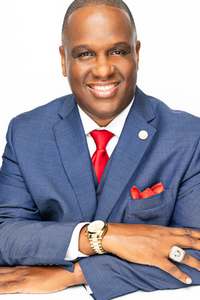
Otha Thornton was born in Elberton, Georgia. He served in the U.S. Army from 1989 to 2010. Thornton a high school diploma from Elbert County Comprehensive High School, a bachelor's degree from Morehouse College in 1989, and a graduate degree from Michigan Technological University in 2001. His career experience includes working in advocacy. As of 2025, Thornton was affiliated with the National Eagle Scout Association, Alpha Phi Alpha Inc., the Morehouse Alumni Association, and the 1600 Communications Association.[1]
- Graduate:
- Michigan Technological University, 2001
- Bachelor's:
- Morehouse College, 1989
- High school:
- Elbert County Comprehensive High School
In their own words
Who are you? Tell us about yourself.
Otha Thornton was installed as the first African-American male president of National PTA at the June 2013 National PTA Convention and Exhibition in Cincinnati, Ohio. He is a retired United States Army Lieutenant Colonel. His last two assignments were with the White House Communications Agency and United States Forces-Iraq in Baghdad. Thornton earned the Bronze Star Medal for exceptional performance in combat operations during Operation Iraqi Freedom 2009-2010.
Previously, Thornton served on the National PTA's Board of Directors, Legislative Committee, Membership Committee, and Executive Search Committee. During his time with Georgia PTA, Otha served on the Board of Directors as legislative chair and as an Advisory Group member for Georgia's Partnership for Excellence in Education. He has taught at Athens Technical College in Athens, Georgia and Michigan Technological University in Houghton, Michigan.
Thornton also served Maryland PTA as nominating leader, board development committee chairman, and as a member of Anne Arundel County’s Superintendent High Performing High School Task Force. In addition, he was appointed by the governor of Maryland to serve on a Maryland Education Task Force.
Thornton’s military background allowed him to volunteer throughout the country and the world at various local and council levels. Thornton served as president and vice president) of Meade Senior High School PTSA at Fort Meade, Maryland. He has also been a volunteer at Kaiserslautern Ameri
Please list below 3 key messages of your campaign. What are the main points you want voters to remember about your goals for your time in office?
1. Partnering to Nurture Every Child's Potential.
"Every Georgia student deserves a classroom that is safe, supportive, and laser-focused on learning. My plan proactively builds these environments by ensuring students have the foundation they need to thrive—from nutrition and counseling to reliable support systems. By meeting these essential needs, we empower every child to engage, achieve, and reach their full potential."2. Engaging Parents to Enhance Children's Education Experience
Too often, education policy has been dictated from the top leaving communities without a voice in shaping their schools. I believe in building from the ground up by empowering families and local leaders to be true partners in decision-making.
Enhancing career pathway programs by fully engaging and collaborating with professional communities in Georgia to create and provide opportunities for our students.3. Giving Teachers Their Autonomy and Classrooms Back
Our teachers are drowning under the weight of paperwork, discipline problems, and top-down mandates that handcuff their professionalism. We’re losing great educators because they feel unsupported and unheard. It’s time to restore respect, empower them to lead their classrooms, and give them the tools to succeed.
What areas of public policy are you personally passionate about?
My Commitment to Georgia
A Georgia where:
Parents are partners, not protesters.
Schools are safe, well-resourced, and focused on the basics.
Every student graduates ready—for college, a career, or to start a business.
Your tax dollars are spent wisely and fairly, no matter what your zip code.
Let’s get back to basics and build a school system that makes Georgia proud.
What qualities does this office possess that makes it a unique and important part of the state government and legal system?
This office is unique because it is one of the few that directly impacts both our state's economy and our society's future. While other departments manage roads or public safety, the Department of Education is responsible for developing our future workforce, citizens, and leaders. It's not just an administrative post; it's a visionary one. A effective Superintendent doesn't just manage the system—they inspire its improvement, making it a critical driver of Georgia's long-term prosperity and civic health.
What characteristics or principles are most important for an elected official?
The most vital characteristics are integrity, competence, and a servant's heart. An elected official must be trustworthy, demonstrating unwavering honesty in their dealings. They must be competent—able to manage complex systems, understand policy details, and deliver results. Finally, they must remember they are a public servant, not a master. This means listening more than talking, prioritizing the people's needs over partisan politics, and always being accountable to the constituents they serve. My military career instilled discipline for competence, and my PTA leadership reinforced the principle of service above self.
What do you believe are the core responsibilities for someone elected to this office?
The State School Superintendent has three core responsibilities:
1.
Chief Advocate for Every Student: Ensuring the education system works for all children, regardless of their zip code, background, or learning path.
2.
Strategic Administrator: Effectively managing the state Department of Education to support local districts, not burden them with bureaucracy. This includes wise stewardship of state and federal funds.
3.
Voice for Educators: Empowering teachers by providing them the resources, respect, and autonomy they need to succeed in the classroom. The office must be a bridge between the classroom and the capitol.
What responsibilities of this office do you personally consider the most important?
I personally believe the most critical responsibility is ensuring educational equity. This means fighting to modernize our outdated 1985 funding formula (QBE) to ensure every district, from rural Clinch County to urban Fulton County, has the resources to provide a high-quality education. Equity isn't about taking from one to give to another; it's about ensuring every child has a fair shot at success. This foundational duty underpins all others—you cannot have effective teachers, safe schools, or successful students without a fair and adequate distribution of resources.
Are there any little-known powers or responsibilities held by this office that you believe more people should be aware of?
A significant but often overlooked power is the Superintendent's role as the primary interpreter and implementer of state education law. While the legislature passes laws, the Department of Education, under the Superintendent's leadership, creates the rules and regulations that bring those laws to life. This includes determining how accountability measures work, how programs are rolled out, and how flexibility is granted to local districts. This administrative authority has a profound day-to-day impact on classrooms and is where a pragmatic, common-sense leader can make a real difference by cutting red tape and fostering innovation.
Do you believe that it's beneficial for holders of this office to have previous experience in government or politics?
Experience is beneficial, but the type of experience matters most. Government experience is useful for understanding processes, but what's essential is direct experience with the education system and proven leadership. A background as a teacher or administrator provides invaluable insight. However, leadership—the ability to manage a large organization, build consensus, and execute a vision—is transferable. My experience leading a national organization of millions of parents (the PTA) and managing complex missions in the military has provided me with the operational leadership skills this office demands, grounded in a lifelong commitment to education advocacy.
What kind of skills or expertise do you believe would be the most helpful for the holders of this office to possess?
The ideal candidate needs a blend of executive, educational, and interpersonal skills.
•
Executive Skills: Strong fiscal management to oversee a multi-billion dollar budget, and strategic planning to set long-term goals.
•
Educational Expertise: A deep understanding of pedagogy, curriculum, and the challenges facing modern classrooms.
•
Interpersonal Skills: The ability to build consensus among diverse groups—teachers, parents, lawmakers, and business leaders—is non-negotiable. This is not an office for an ideologue; it's an office for a collaborator.
Would a state ballot initiative process be good or bad for your state?
A ballot initiative process is a double-edged sword. On one hand, it can be a powerful tool for direct democracy, allowing citizens to bypass legislative gridlock on popular, commonsense issues—like fully funding education—when the political establishment fails to act. On the other hand, it can be vulnerable to manipulation by well-funded special interests and can sometimes lead to poorly crafted policies that lack the nuance required for effective governance. If implemented, it would require strong safeguards to ensure transparency and prevent abuse. The focus, however, should remain on electing representatives who listen to the people, making such end-rounds less necessary.
What is an accomplishment that you are proud of?
The accomplishment I am most proud of is not a single event, but a sustained legacy of advocacy: my successful leadership in ensuring the passage and implementation of the federal Every Student Succeeds Act (ESSA) during my tenure as National PTA President.
While this was a national effort, its impact was deeply personal and directly relevant to the children and families of Georgia. For too long, our schools were constrained by the one-size-fits-all approach of the previous law, No Child Left Behind, which often reduced children to test scores and punished schools without providing the necessary support.
As a child advocate, my mission was to reframe the conversation around the whole child. We fought to ensure that ESSA included critical provisions that I consider monumental accomplishments:
Empowering Parents and Local Communities: We successfully advocated for ESSA to mandate that states and school districts meaningfully engage parents and families in the development of their education plans. This wasn't just a checkbox; it was a fundamental shift returning power to the local level, ensuring that policies in Atlanta or Washington were informed by the realities in Dalton, Savannah, and Valdosta.
Expanding the Definition of Student Success: We pushed for and secured language that allows states to use multiple measures of school quality—like school climate, student engagement, and access to advanced coursework—moving beyond a narrow focus on standardized test scores. This was a vital step toward recognizing that a child's potential cannot be captured by a single exam.
Supporting Vulnerable Students: We fought for protections and dedicated resources for our most vulnerable students—those in poverty, those with disabilities, and those learning English—ensuring that equity was placed at the very center of the law.
What would be your top three priorities, if elected?
1) Empowering families, educators, and stakeholders through listening and advocating to get their concerns and needs addressed through the Department of Education, Georgia Assembly, and Governor's office
2) Providing essential resources for students with wrap around services in our school systems (i.e., special needs, high poverty, and rural areas that have limited resources- these specific areas are ongoing challenges in the state)
3) Fully funding education to 21st century standards (updating QBE formula to account for technology in school districts)[3][4]
What areas of public policy are you personally passionate about? Why?
Education, because it gives opportunities for any person to become a better person, to serve their community, and to earn a living. The ultimate goal of education is to build character. When we truly educate our children utilizing the components of character, creativity, critical thinking, and empathy, we create better citizens for Georgia. These truly educated Georgians go on to serve in their communities to make them better each day. And finally, they are able to earn a living to support themselves and their family. Education is one of the key drivers that moves our state towards equity, equality and upward economic mobility which indeed would make Georgia a better place to live.Cite error: Invalid <ref> tag; invalid names, e.g. too many[4]
[the profile publisher] also asked the candidate a series of optional questions. Otha E. Thornton Jr. answered the following:
Is there a book, essay, film, or something else you would recommend to someone who wants to understand your political philosophy?
The Coming Jobs War. This book is an exceptional read. A couple of the key areas that resonated with me was the importance of the local leaders/elders and the future of education.[4]
What is your favorite book? Why?
Outliers: The Story of Success. The author brilliantly lays out the three critical components of success: culture, opportunity, and preparation.[4]
On the 2026 ballot
Links
Compiled from the candidate’s published profile as of September 30, 2026.
Source(opens in new tab)