
Background
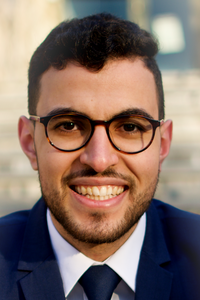
Muad Hrezi earned a degree from the University of North Carolina at Chapel Hill in 2016. Hrezi's career experience includes working as a high school educator and track coach in Connecticut.[1]
In their own words
Who are you? Tell us about yourself.
Muad is a first-generation American and one of six children. He was born to Libyan parents who came to America as asylum-seekers and settled in Connecticut. Muad grew up in Connecticut and attended public schools. In high school, Muad won several Connecticut state championships in track and cross country. He was one of the best distance runners in the country. Muad was recruited to University of North Carolina at Chapel Hill, where he studied public health. After graduating, Muad helped launch a multi-million dollar health-tech start up. After that he worked to address the opioid epidemic on the frontlines as a researcher. Most recently, Muad was working as a policy advisor to U.S. Senator Chris Murphy. After seeing firsthand how captured our government was by corporate powers, Muad quit his job and decided to run for office to get the government working for all of us, not just the ultra-wealthy. Muad currently works as an educator and track coach at a Connecticut high school, and with traumatic brain injury patients on weekends and nights. He is also an organizer with several progressive groups in Connecticut’s 1st district.
Please list below 3 key messages of your campaign. What are the main points you want voters to remember about your goals for your time in office?
Our current political system is rigged in favor of the ultra-wealthy. We see the consequences of that rigging everyday, especially in particular in our economy. The top 1% continues to hoard more and more wealth, while the rest of us fight for scraps. The way we change that is by electing leaders who aren’t in the pockets of the ultra-wealthy. That’s why I’m not taking a single dollar of corporate money.Building a world in which working people prosper, and not just the ultra-wealthy, means eliminating the financial burden that Americans face in accessing healthcare. Together, we can save lives by replacing our profit-over-people healthcare system with Medicare for All.Climate change is an existential threat to our survival, not just Americans, but as humans. We need to be serious about tackling our impending existential doom. My generation will bear the brunt of our current leaders’ inaction. We need more people in Congress who meet the moment when it comes to our climate crisis.
What areas of public policy are you personally passionate about?
I am most passionate about unrigging our economy, making sure everyone has access to medical care at an affordable price, stopping catastrophic climate change, and making sure all communities are safe and free from discrimination.
What characteristics or principles are most important for an elected official?
Empathy, the ability to listen, and undying desire to serve.
What was your very first job? How long did you have it?
I worked as a server at a restaurant for the summer when I was in high school.
What qualities does the U.S. House of Representatives possess that makes it unique as an institution?
The U.S. House of Representatives possesses a lot of unique characteristics, but one that is central to why I am running is that all appropriation bills originate in the House. One of the greatest powers of our federal government is the ability to spend tremendous amounts of money to better our lives. I plan on wielding that power to make our federal budget and country work for all Americans.
Do you believe that it's beneficial for representatives to have previous experience in government or politics?
Yes, I believe that it is absolutely beneficial. As someone who has worked as a Senate staffer and understands the intricacies of policy making, I am well aware of the very real challenges and obstacles that are put in place to hinder bold changes.
What do you perceive to be the United States' greatest challenges as a nation over the next decade?
One of the most important questions that the United States will have to answer is if we, as a government, and in a greater sense as a country, are willing to address the huge economic inequality that is only poised to get worse. We have to ask ourselves if we are willing to change the way that our government governs so that the poor and barely middle-class are centered in our policies and not the ultra-wealthy.
googletag.cmd.push(function() { googletag.display("div-gpt-ad-1548351761485-0"); });
On the 2026 ballot
Links
Compiled from the candidate’s published profile as of September 30, 2026.
Source(opens in new tab)