
Background
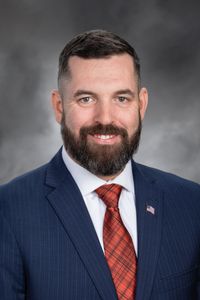
Matthew Marshall was born in Seattle, Washington. He served in the U.S. Army from 2004 to 2017. He earned an associate degree in medical laboratory from George Washington University. He also earned a bachelor’s degree in biology and a master’s degree in physician assistant studies from the University of Nebraska Medical Center. Marshall’s career experience includes working as a physician assistant and an adjunct professor.[1]
Campaign themes
Matt Marshall has not yet completed [the profile publisher]'s 2026 Candidate Connection survey.
Send a message to Matt Marshall asking him to fill out the survey.
If you are Matt Marshall, click here to fill out [the profile publisher]'s 2026 Candidate Connection survey.
Who fills out the candidate survey?
Any candidate running for elected office, at any level, can complete [the profile publisher]'s Candidate Survey. Completing the survey will update the candidate's [the profile publisher] profile, letting voters know who they are and what they stand for. More than 32,000 candidates have taken [the profile publisher]'s candidate survey since we launched it in 2015. Learn more about the survey here.
You can ask Matt Marshall to fill out this survey by using the button below or emailing matt@marshall4wa.com.
Matt Marshall did not complete [the profile publisher]'s 2024 Candidate Connection survey.
Who are you? Tell us about yourself.
My name is Matt Marshall. I was born and raised in Washington, and currently live in unincorporated Pierce County with my family. I knew early on that I wanted to serve the public, and the day after high school I began an internship as a resident firefighter/emergency medical technician in Oregon. Upon completion of that program, I entered the United States Army where I spent 12 years on active duty with two tours to the middle east.
After my honorable discharge, I returned home to Washington and entered politics. With a few close friends, we founded a nonprofit corporation known as The Three Percent of Washington designed to support, prepare and defend our communities while also supporting homeless veterans. I was elected as Precinct Committee Officer for 02-156 and eventually elected by fellow PCOs to be Vice Chair of the Pierce County 2nd Legislative District Republicans. In November 2019, I was elected to Eatonville School Board of Directors Position #3.
Like many of you, self-serving politicians disgust me. I remember the promises made by our elected leaders and plan to hold them accountable for their promises. I will always represent the people and values of our district.
Please list below 3 key messages of your campaign. What are the main points you want voters to remember about your goals for your time in office?
I will always seek solutions that focus on desired outcomes, citing empirical evidence and avoiding emotional arguments. We must focus on ways to impact change that are fiscally responsible and do not negatively impact life, liberty, or the pursuit of happiness.I promise that when elected, I will represent the 2nd Legislative District values. I will always advocate for decreased regulation, decreased taxes, improved transparency, fiscal responsibility, and all Constitutional Rights. We must ensure we fund our schools in a way that does not crush homeowners with excessive property tax burdens. Our current system has many flaws and the algorithms must be changed.
What areas of public policy are you personally passionate about?
I am a staunch supporter of the Constitution. We all have God-given rights that our government cannot take from us. I always use the Constitution as my guide when discussing policy.
I am passionate about Education. We need to find a way to better fund our schools. Our local communities should be afforded the ability to determine what is important, rather than a state office mandating policy or curriculum. I oppose the Comprehensive Sexual Education Bill that just became law, and am supporting Referendum 90 to repeal it.
Criminal Justice. I believe that all gun laws are unconstitutional. I believe that we need to enforce our laws and be tough on crime. Criminals must know that there will be repercussions for their actions. With that said, I believe we have an inequitable system currently that favors the elite. Our prison systems should be actively working to rehabilitate, rather than incarcerate. If we are going to pay thousands per year, per person, we should be working to prevent repeat offenders.
Health. As a practicing medical professional, I know of many flaws in our current health system. The Affordable Care Act was detrimental to our healthcare systems and raised all of our premiums. Socialized medicine (Medicare for all) would be even worse. We need healthcare reform, in the form of deregulation.
Agriculture. Our timber industry is a massive part of our districts economy. We must ensure that taxes and regulation do not impede loggers or farmers.
Who do you look up to? Whose example would you like to follow, and why?
The most influential person in my life was my father. He was a great man, a pastor and a leader in his community. Watching him and his impact on others resonated with me. He was selfless, smart and a natural leader. He passed away in 2014 right before I deployed for my second tour in the middle east. His influence has made me a better person as I emulate his leadership style.
The politician that I look up to is Ron Paul. His beliefs and passion for liberty are sincere. He is principled and believes in freedom.
Is there a book, essay, film, or something else you would recommend to someone who wants to understand your political philosophy?
1. The Constitution of the United States
2. One Mission, General McCrystal
3. Liberty Defined, Ron Paul
What characteristics or principles are most important for an elected official?
1. Obey the Constitution
2. Represent the People
3. Do what is ethical
What qualities do you possess that you believe would make you a successful officeholder?
Loyalty to the people of my district and my country.
Integrity to do what is right, and own my mistakes when they are made.
Courage to stand alone and defend what I believe is right.
History of service to God, family and country.
Creativity to come up with unforeseen solutions
Ability to listen to others and take constructive criticism or advise regardless of where it comes from.
What do you believe are the core responsibilities for someone elected to this office?
Knowing the district, the issues and the people. Developing a strategy to make changes that positively impact the district and solve the issues. Craft, sponsor or cosponsor legislation that will address the issues. Oppose legislation that will harm the district.
Be available to the people and earn their trust as their legislator.
What legacy would you like to leave?
I want to leave the world better than I found it. I want my children to have more freedom, more success and more prosperity. I want my children to know that I fought for what was right and just in a tireless effort to make Washington the best state in the country.
What is the first historical event that happened in your lifetime that you remember? How old were you at the time?
I remember being in elementary school as we entered Desert Storm. There was some concern that I sensed from my parents which did cause some anxiety in me as a child.
Like the rest of you, 9/11 was life changing. I was on a cruise ship in Hawaii for my grandparents 50th wedding anniversary. I woke up to the sound of the captain and all of our televisions being tuned to the news. It was surreal seeing that footage. It was that moment, watching the firefighters and people in need, that I knew I was destined for public service. 18 years later, I have 18 years of public service; firefighter, military, medical professional, educator, and school board director. Soon I will add legislator to my list of public service.
What was your very first job? How long did you have it?
My very first job was at Mount Spokane. I was a snowboard instructor during my Junior and Senior years of high school. During the summers I worked on my great-uncle's wheat farm in Asotin County. After high school I was an intern firefighter/EMT in Oregon, then joined the United State Army where I spent 12 years and obtained three college degrees.
If you could be any fictional character, who would you want to be?
Robin Hood. He fights for the people and against taxes. He was willing to stand against tyranny and he is inspiration to the people.
What is something that has been a struggle in your life?
I have had many struggles. I have struggled financially with 2 small children while I was a Junior Noncommissioned officer. I have had emotional struggles related to separation from my family while deployed overseas. I have struggled to stay positive while in combat in Afghanistan, losing brothers and sisters in arms, watching marriages of Soldiers fail. I struggled with the loss of my father just weeks before I deployed to the middle east for the second time.
More important than the struggle is what I have learned. I have learned to be resilient. To continue to work, push and drive on. With resilience and perseverance there is no struggle to great.
Every state besides Nebraska has two legislative chambers. What do you consider the most important differences between the legislative chambers in your state?
The Senate is the upper body in Washington. They confirm the gubernatorial appointments. Senate president and tie breaking vote is the Lieutenant Governor, in the State House the majority party elects a speaker that will oversee the House proceedings.
Terms are different between the Senate (4 years) and House (2 years). There are twice as many Representatives as Senators which allows for greater turnover in the House and better potential for majority party change.
Do you believe that it’s beneficial for state legislators to have previous experience in government or politics?
Yes and no. I believe that state legislators should be informed on the issues and the process, but not necessarily have experience in politics. Politicians frequently enter politics with great and noble plans, but are corrupted by special interest and self-preservation. I am a firm believer in term limits as a way to curb this process.
More important than experience is the knowledge of the process and a willingness to learn. Our country is designed to be governed by the people. Regular people should be in office, not career politicians.
What do you perceive to be your state’s greatest challenges over the next decade?
Taxes. We are over taxed and over regulated. We have the 2nd highest fuel tax in the country and the 3rd highest budget and 3rd highest tax per capita. We cannot continue to spend and tax the people and businesses in Washington without some relief. People will move and businesses will close. We are seeing it right now with the Covid-19 pandemic. Our economy is crippled by this pandemic. How we respond to this crisis will shape the future of our state. We cannot continue to tax and spend on special interest and pet projects.
What do you believe is the ideal relationship between the governor and the state legislature?
Ideal relationship would be one of mutual understanding, shared vision for the future that represents the people of the state of Washington. It should foster trust of the people that the leaders in both chambers and the governor are competent and are looking out for the people. Sweeping mandates, executive orders to circumvent the legislative process and partisan virtue signaling is not good for anyone in the state.
Do you believe it’s beneficial to build relationships with other legislators? Please explain your answer.
Yes. Working together allows for more productivity. Co-sponsorship of bills that benefit constituents in multiple districts adds weight and validity to issues. While working together is important, quid pro quo is not. Legislators should always look out for whats best for their constituents and never forget who they work for.
There are a lot of common and bipartisan topics, those should be the focus of relationship building.
If you are not a current legislator, are there certain committees that you would want to be a part of?
Yes!
1. Civil Rights/Judiciary
2. Healthcare & Wellness
3. Education
4. Rural Development, Agriculture and Natural Resources
5. Appropriations
6. Rules
If you are not currently a member of your party’s leadership in the legislature, would you be interested in joining the leadership? If so, in what role?
I have always been a leader. My priority is and always will be representing my constituents. Becoming a leader in the house party is not my goal, but I would consider it if the time was right and it did not detract from my duties representing the people of my district.
Is there a particular legislator, past or present, whom you want to model yourself after?
The current legislator whom I want to model after is Jim Walsh. He is a natural leader who truly represents and is not afraid to stand on principle even if that means he is standing by himself. He is an inspiration.
Are you interested in running for a different political office (for example, the U.S. Congress or governor) in the future?
I have not put much thought into any higher office. I am not interested in becoming involved in federal politics. I believe that I can make more effective and positive change in state level politics. I love my district and hope to preserve our freedoms and liberties here in the 2nd.
On the 2026 ballot
Links
Compiled from the candidate’s published profile as of September 30, 2026.
Source(opens in new tab)