
Background
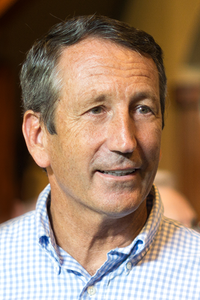
Sanford was born in 1960 in Fort Lauderdale, Florida. After graduating from Furman University with a B.A. in business in 1983, Sanford received his M.B.A. from the University of Virginia in 1988. He worked in real estate and managed his family farm before seeking elected office.[4][5]
Sanford was first elected to the U.S. House of Representatives in 1994, where he served from 1995 to 2001. He served as governor from 2003 to 2011, before returning to Congress for three terms from 2013 to 2019.[4]
From 2002 to 2011, Sanford was also a member of the U.S. Air Force Reserve.[4]
- Graduate:
- University of Virginia
- Bachelor's:
- Furman University
Campaign money
- Raised
- $0
- From individuals
- $0
- From PACs & party
- $0
- Own money
- —
FEC filings.
View on FEC.gov(opens in new tab)Campaign themes
U.S. Senate
Mark Sanford did not complete [the profile publisher]'s 2026 Candidate Connection survey.
U.S. House
Mark Sanford did not complete [the profile publisher]'s 2026 Candidate Connection survey.
The following campaign themes and issues were published on Sanford's presidential campaign website:[136]
America is made stronger by the fact that we all have different starting points in viewing the challenges that confront America and how best to make more real the American dream for each one of us and those we love. What follows is a sampling of my own starting points on a number of issues. The list below is not a conclusive list, but it's a starting point to give you and idea of how I approach things.
All legislative questions for me begin with a look through the prism of conservative philosophy, but given how convoluted this term has gotten lately let me define what it means to me.
I believe conservative philosophy is designed to maximize our individual aspirations in achieving what we believe makes the American dream. Maximizing individual freedom, personal autonomy and allowing discretion in one’s own pursuit of happiness are building blocks to getting there. Sustaining it rests on a political system that should afford all of us rising levels of opportunity based on our own talents and work ethic – and equity and fairness in getting there. These two things are vital to sustaining any political or economic system across generations.
The founding fathers knew that the pursuit of happiness was inherently individualistic in nature given our unique design by God. Collective pursuits of happiness could never work because what was heavenly for one person might be hell for the next. Accordingly I believe in individual liberty, private property, the rule of law, competitive free enterprise, limited and frugal government, strong local communities, fiscal and personal responsibility and civility in public life because they are all building blocks to keeping the American Dream. These things are vital to rewarding work and initiative and maximizing individual discretion in pursuing one's own definition of “the pursuit of happiness.” Finally these things are key to sustaining a government that can protect these liberties and a commercial sector that can sustain both individual and government needs for money.
I believe the guidebook to keeping all of these moving parts in their proper order is the United States Constitution, and in as much as we adhere to its limitations there will be expanded opportunities for each one of us.
Debts and Deficits
I have said much here, but one final point is that deficit spending in times of peace and prosperity ultimately runs counter to the founding father’s mighty belief that there should be no taxation without representation. This makes whats occuring here a social equity and moral question on whether we really believe it's acceptable to enjoy government services now and hand the bill to the next generation for their payment.
Government Spending
I believe government spends too much. America was founded on the notion of liberty, and we were indeed promised life, liberty, and the pursuit of happiness. Through the ages, there has always been a tension between government’s growth and freedom itself. Jefferson considered it a battle line wherein as one grew, the other declined, and vice versa – and he warned that the normal course of things was for government to gain ground and for liberty to yield. Holding governments growth back is not about the spending ultimately, but rather about preserving our incredibly fragile gift of liberty.
Taxes
For the last fifty years, Americans have sent in about 18% of GDP (the whole of all that is spent and consumed in our country) in taxes each year to the federal government. I do not believe this number should go up, but I do believe we could move to a fairer and simpler tax system along the lines of a fair tax or flat tax. Presently, more than a trillion dollars a year is carved out in the form of tax exemptions, and I believe a flatter and broader tax system would be helpful to individual liberty, job creation, and American competitiveness.
Healthcare
There will always be unlimited demand for a product that someone else pays for, and this well describes much of the current construct around healthcare. People feel as if they are spending someone else's money – whether that comes from the government or an insurance company. Furthermore, they don’t know the price, and differences in outcomes are not transparent. In short, there is no healthcare marketplace, and I believe bettering the system relies on creating one.
It’s for these reasons that Senator Rand Paul and I introduced the Obamacare Replacement Act in 2017. Among other things, it would legalize people buying the health insurance they needed, rather than the health insurance the government prescribed. It would allow people to deduct the cost of their insurance the way employers can with employees. It would bolster Health Savings Accounts, create competition across state lines and even incorporate some of the good ideas found in Obamacare – such as allowing children to stay on their parents plan until the age of 26 and protecting those with preexisting conditions.
I also think a good healthcare system should be built around incentivizing good healthcare decisions. We spend more than all other industrialized nations and yet have poorer health care outcomes. There is something wrong in a system that will not differentiate between the smoker and nonsmoker, or the person who watches what they eat and drink and those that don't. Similarly, working to make certain that healthcare decisions are between a doctor and a patient – not a patient and a government or insurance bureaucrat, I believe vital.
Immigration
I view the immigration issue primarily through the principle of fairness and the rule of law. To have a thousand people a day illegally crossing our border, or for that matter, overstaying their visa, is to make a mockery of the rule of law. It's also not fair to the millions who are either waiting for their chance to come to our country, or have already gone through the legal immigration process. My votes and stands in Congress and the Governorship have been consistent with this view.
I believe in a secure border. I have voted for wall funding, and also believe we need to update the amnesty laws in our country. I believe furthermore that we should increase the number of work permits to our country, end chain migration, and move from a family reunification system to a merit based system that attracts the skill sets we need to make America more competitive.
Conservation
I have long believed that the notion of conservatism should apply to more than just financial resources. It should apply to natural resources as well.
This fits with the biblical concept of stewardship, that we should do our part to leave the world better than we found it. It fits with the historic leadership that many great Republicans have offered over the years on the environment and conservation. It also fits with common sense because the open space around us, the air we breath and the water we drink very much impacts our ability to be productive and enjoy life.
People oftentimes forget that it was Teddy Roosevelt that founded our national park system. He recognized that there were special places in our country that should be preserved, not only as monuments to honor America’s past – but as monuments in the way that open space was vital to how we live today. It’s for that reason that when I was Governor I set aside more land than during any other governorship in South Carolina history. For these efforts and others, I was even recognized and endorsed by the Sierra Club and a variety of other conservation-minded organizations. In short, I don't think that being conservative or Republican should be viewed as being against conservation or the environment.
Education
There are only two ways to raise individual productivity and the wages that come with added levels of production – in investment that leverages our ability and through education that enhances our abilities. Education is key, and to compete effectively in the 21st Century its vital everyone of us recognize how lifelong learning is important. It must start early, and it's never finished. In this I believe in as many choices as possible that reflect the different ways we learn.
Climate Change
I’ve seen first hand rising sea levels over the course of my life at our family farm in the low country of South Carolina. In areas where pine trees once stood, there are now salt flats. On this issue, the scientific consensus fits with what I’ve seen firsthand, and that is that it's real. I think it's important to listen to what the scientific community has said here. After all, It makes no sense to say that one believes in the modern advances of science and the way they can cure and heal the human body, but then discount what science says in other areas of our lives.
The problem in my view has not been in whether or not it may be real, but in how we do something about it. I do not believe in things like the Kyoto Protocol, that would tie America and Western Europe to one standard, but hold China and India to a completely different standard, even though the overwhelming growth of new emissions will come these two places.
Foreign Policy
I believe in Teddy Roosevelt's notion of speaking softly, but carrying a big stick. To do this, we must maintain a strong economy, because economic supremacy has always been the precursor to military supremacy. Among other things, this once again ties back to our own debt as a threat to our ability to protect power and maintain our place in the world.
I also believe that the international trading system, created after World War Two, vital to America’s foreign policy. In this light, stability and predictability are important. Friends and foes alike need to have a sense of what America will do next. Alliances and investments are not made without predictability. We are not getting this from the White House and I believe the increasing talks of tariffs, and the seemingly daily changes of presidential perspective are undermining our standing in the world.
Federal Reserve Policy
I believe that the dual mandate on FED policy will prove untenable and that there are real limits to the FED’s ability to drive jobs and wages on a sustained basis. I believe bettering the economy is best done through legislative change, not financial engineering by unelected members of the Federal reserve. Bettering the economy is the role of Congress, and it comes in improving tax, regulatory, legal, and spending policies so that we create better playing fields for job creation and wage growth.[137]
—Sanford 2020[136]
Sanford's campaign website highlighted the themes below.
Debt and Spending
The Nobel Prize winning economist Milton Friedman once observed that the ultimate measure of government was what it spent. While not the only measure, it is an important one because in many ways how free we are as individuals is determined by what we’re compelled to pay to government each year. Either we work for ourselves and our families, or for government.
In this vein each year, the Tax Foundation calculates “Tax Freedom Day” based upon what day individuals across the nation as a whole have earned enough money to pay off their taxes for the year. In 2012, that day was April 17th – so government spending is indeed a proxy for freedom. It’s horrifying if you really stop and think about this number and the trend behind it because it shows we will now spend nearly the first four months of each year working for government. Worse still is that with the present trends in federal spending we are headed to some form of indentured servitude where over 70 percent of our day, week and month go to government, if there is no change to the spending juggernaut in Washington.
Encouragingly, Mark’s record is second to none in holding spending in check – and in fighting debts and deficit spending.
Mark was rated number one in the entire United States Congress by both Citizens Against Government Waste and the National Taxpayers Union for his efforts to limit federal spending and taxation. Similarly the CATO Institute ranked Mark the most financially conservative Governor in America, calling him “a staunch supporter of spending restraint and pro-growth tax reforms.”
As governor, he eliminated nearly $1 billion in deficits and debts inherited from the previous administration.
He proposed the first operational Executive Branch budget in state history, a significant step into what had been the exclusive sandbox of the State Legislature…but one that paid real dividends for the taxpayer as $260 million in vetoes were sustained in 2010 alone. These budgets were guidebooks in each of his eight years on reducing spending, and restructuring and modernizing state government – from which a whole host of other savings came.
After two years of conflict with the legislature over their “Competitive Grants” slush fund – a backdoor way in which legislators of both parties were able to send pork back to their district – he succeeded in getting his veto of the program sustained – saving taxpayers $46 million per year.
For years, legislators had circumvented the accountability that would come with a transparent budget process through a secret process called a “pass through,” where they would put unallocated dollars in an agency budget, then tell the agency how to spend it after the budget had passed. He signed an Executive Order eliminating pass-through spending for all the agencies in his Cabinet.
It was also standard practice in Columbia for legislators to “bobtail” special projects to unrelated bills, costing taxpayers millions. It prevented accountability to the taxpayer because it enabled any legislator to be for, or against a bill, because there were so many different things in the bill. If you didn’t like a part of the bill, they could agree with you as they would inevitably be “against” that part too. The most famous example of this was the Life Sciences bill, which started as a relatively narrow group of economic development incentives but morphed into a laundry list of unrelated things attached like adding four year status for USC-Sumter. Governor Sanford fought the practice of bobtailing all the way to the state Supreme Court, and ultimately won.
With regard to federal spending Mark believes entitlement reform is key simply because that is where the bulk of all federal spending takes place. He believes programs like Social Security and Medicare represent a promise to our citizens that must be kept for existing beneficiaries, but that we have to modernize these programs for future retirees so that they will be sustainable for future generations. Without entitlement reform, the Congressional Budget Office now predicts than in just eleven years there will only be enough federal revenue to cover interest on the national debt and entitlements….leaving nothing left for defense, or any other area of federal spending.
Mark had a strong record as governor in pushing for fundamental changes to the healthcare delivery system, for instance he was the first governor in the nation to successfully push for a Health Savings Account option for Medicaid. In addition, he was consistently on the leading edge of proposed reforms in Congress that were aimed at solvency for Medicare and Social Security.
Mark believes in, and would push for, a federal balanced budget amendment – but he has never waited for its arrival to push and vote for budgets that were balanced.
He believes that immigration, at the end of the day, is both an issue of national sovereignty and closely tied to the total cost of government; accordingly he believes it should be limited. He believes that the current Senate bill does not do enough to address our country’s core needs in the immigration debate and to address the hidden costs in our current immigration policy that will lead to continued demand for illegal immigration.
Finally he believes that federalism, the idea of pushing power and authority out of Washington and down to states and even the most local government possible, is a critical tool to getting our nation’s financial house in order.
Jobs and the Economy
Mark has spent his entire time in Congress and the governorship pushing for private enterprise and free market solutions over government control, regulation and growth. Mark believes a business playing field that allows companies to freely compete, without government control and directive, is the most basic and important foundation to growth in jobs and the economy. The political philosopher F. A. Hayek, called attempts by politicians to better the marketplace through government regulations as the “fatal conceit”…he was right – because what those in government never fully comprehend are the ways in which the market moves so much faster than those in government. Adams Smith’s so called invisible hand always has, and always will, move faster than the wheels of government.
He believes there is also a direct tie between our nation’s financial health, and the health of the economy. So quite simply, Mark’s vision for creating jobs and economic opportunity is about not only holding the line on spending, but also about getting government out of the way and thereby creating the right “soil conditions” for businesses to grow and thrive.
His record as governor bears that out, as his administration’s efforts attracted $24 billion in capital investment, more investment than during any other eight year period in South Carolina history. This includes Boeing’s $750 million investment in Charleston.
Consistently his team worked toward the basics that further attract financial capital – open markets, private property rights, a limited and effective government, a fair legal climate, an educated work force, and good physical infrastructure. So for instance, after a two-and-a-half year fight with the legislature, including members of his own party, the governor signed the first cut to the marginal income tax rate in state history. This finally brought the 7% tax rate for small businesses, partnerships and limited liability companies down to the 5% level that corporations were paying. He also signed the largest recurring tax cut in state history, for an annual savings to taxpayers of an additional $220 million.
For years, South Carolina was ranked as a “judicial hellhole,” in part because of the undue influence that lawyer-legislators were able to place on the judges they appointed. Mark changed that, by signing a tort reform bill that restricted and capped frivolous lawsuits, put caps on medical malpractice and ended the practice of venue shopping. Mark also signed a workers’ compensation reform bill that established rules for medical evidence and guidelines for “repetitive trauma” injuries which helped curb sometimes politically-tainted workers comp claims.
The Port of Charleston is perhaps the most critical piece of infrastructure to the state of South Carolina, and a gateway for billions in economic activity. As governor, Mark fought against the legislature’s attempts to micromanage the Port’s activity, and worked to make sure the Ports Authority was more directly accountable to the people of South Carolina.
Mark supports efforts to dredge the main shipping channel to at least 50 feet in order to accommodate post-Panamax vessels.
Mark has also been a staunch advocate of developing port capacity in Jasper County, having forged a bi-state compact with Georgia as governor to begin development there.
When it comes to infrastructure, South Carolina receives only about .85 cents on every dollar in federal gas tax it sends to DC. As a Congressman, Mark fought to correct that inequity and will continue to do so if elected in 2013. Mark believes that all federal highway spending should be block-granted to the states, free of federal mandates and earmarks. States, cities and counties know better where to allocate transportation dollars than Congress. As governor, he fought for restructuring legislation that for the first time since its creation in 1917 made the state DOT accountable to the Executive Branch, and took steps toward taking the politics and legislative micromanagement out of the road-building process.
Mark went to bat for small business again, when he opposed and twice vetoed legislation that gave $9 million in special incentives to big-box retailers, like Cabela’s and Bass Pro Shop, that weren’t available to their mom-and-pop store competitors.
Mark’s results speak for themselves – during his governorship, South Carolina added 3,000 small businesses, and ranked 15th in the nation in employment growth.
Mark believes in a fairer, flatter and simpler tax structure conducive to economic growth, like the Fair Tax and the Flat Tax, and is opposed to special carve-outs that bail out one class of business at the expense of others.
Of many other additional tools to better our economy, he believes energy independence and more job-creating domestic energy production is vital. He has also been a long time advocate for market-based education reform at the state and federal level, believing that school choice is a key in creating a better educational system so important to economic competitiveness.
Healthcare Reform
As in so many others area of government, Mark believes we should look for ways of getting more out of the government that we pay for – and this is especially the case in government healthcare. As a country we now spend more than twice the average of other industrialized nations, but have far poorer healthcare outcomes on a host of categories ranging from infant mortality to average life span.
For this reason, Mark has been a long time advocate of market-based solutions to healthcare reform. His administration was the first in the country to receive a waiver from the federal government to offer a statewide system of Health Savings Accounts to the Medicaid population.
He believes that healthcare coverage should be portable and that we should ultimately move toward a primary payer system given it was oddly the wage and price controls of World War II that originally coupled employment and healthcare. As noted earlier he has long been a proponent of legal reform as a way of avoiding much of the defensive medicine now currently forced on doctors, the medical community and patients. As governor he fought the legislative body’s attempts to broaden medical eligibility on a host of categories believing that it did not make common sense to add to programs we were already unable to pay for and sustain.
At the state level Medicaid was nine percent of our budget 10 years ago, 19 percent today and on our way to 29 percent in ten years. The federal government’s numbers are even worse and though our country has the finest healthcare treatment system in the world, its cost and access remain a problem. Consequently there have been many proposed solutions – Obamacare, with its $503 billion in new taxes and fees over the next 10 years, being the latest. Mark would work with others in Congress to repeal Obamacare because of its costs and inconsistency with market principals.
National Defense
Mark believes one of the core functions of our federal government lies in providing for our nation’s defense, as outlined by Article 1, Section 8 of the Constitution. He believes that only the Congress can declare war and that we should get away from military actions directed by the White House without the authorization of Congress, as his belief has always been that body bags from foreign lands do not return to Washington – but Congressional districts across this country.
He also believes that Admiral Mike Mullen, former Chairman of the Joint Chiefs of Staff was right in his assessment that the greatest threat to our Nation’s security lies in our Nation’s debt and deficits. Indeed, economic supremacy has always been the key to military supremacy. Paul Kennedy talks about it in his book, “The Rise and Fall of Great Powers,” and it’s a phenomenon that’s been noted by military historians across time. Accordingly, it makes it that much more important for the sovereignty and security of our country that we do something about spending in Washington.
So Mark is committed to maintaining a strong national defense, both in economic and military terms. He believes in maintaining promises to those who have served. He believes that sustaining a military leadership and technological edge is vital as one views military budgets – and that to do so we have to constantly retool for today’s threats. Subsequently he believes we should look for efficiencies in defense as in every other program of government –as well as to look at the cost of police actions around the world. He believes America cannot afford to subsidize other countries unwillingness to adequately fund their own defense budgets as was recently demonstrated in France’s recent inability to fly even their own troops to Northern Africa. Here, it’s telling that France spends 2.3 percent of their GDP on their military, yet count on American help while America spends double that number. For those nations that do, like Israel that spends 6.5 percent, we must continue to work as strong strategic partners.
Finally, Mark believes the installations here in the Lowcountry are playing a unique and critical mission in today’s military, whether that is with the lift provided by the 315th or 437th in Charleston or with the Marines, Navy and Army operational and training capacities across the district. In fact, Mark fought hard to highlight our state’s unique military missions as governor, establishing a BRAC task force that took our case directly to Washington. While many states lost jobs during the 2004 base closures, South Carolina as a state netted more than 700 new military jobs – which highlights the extraordinary effort and role of so many men and women in uniform in this state.
Life and Liberty
Mark attended Thomas Jefferson’s so called “Academic Village” for graduate school. Whether it was there at Virginia, or years earlier under his father’s lessons at the farm, somewhere along the way he developed a life’s passion for liberty and freedom – hallmarks of the American experiment. The central tenant of his political philosophy has always been rooted in maximizing personal freedom…which is in turn why he believes so strongly in limiting government. He has always believed that politics boiled down to one simple question, “Who is going to make the decision, you or somebody else?
In a society of limited government, you make the choices about your life. In a political society, which is inevitable as government grows, someone else does. For that reason George Washington warned us that, “Government is not reason, it is not eloquence — it is force! Like fire, it is a dangerous servant and a fearsome master.” This was the thinking of each of the founding fathers, and this is why he believes they were so deliberate about including the right to keep and bear arms. Mark has always been a staunch defender of the second amendment and would continue to be so if elected to Congress.
Of Life, Liberty, and the Pursuit of Happiness, no right is more fundamental than that of life, and as such, Mark is pro-life, believing that life begins at conception.
More than anything he has come to believe that a limited government is vital to the pursuit of happiness. The ability to pursue one’s dreams, to build a family, to use one’s talents to help others and to glorify God and so much more – rests in a limited government that leaves each one of us with the financial resources and freedom to pursue these things.
It’s for these reasons that all of his focus on making government smaller, more efficient and more accountable is ultimately aimed in one final direction…the birthright of all Americans, freedom.
Quality of Life
Mark is a child of the Lowcountry of South Carolina, and as such believes there is something unique and special about this part of the world. Formative work and life experiences came for him with his brothers and sister on their family farm on the Coosaw River – and it was from there that he launched Tom Sawyer and Huck Finn adventures as a boy with his brothers in the woods and waters of the Lowcountry. It’s given him an appreciation for the area and a strong belief that some of what has kept so many here, and invited so many others, should be preserved and protected.
In short, in a world where so many places blend to look like the next place, he believes that maintaining the unique look and feel of the Lowcountry is good for both the soul and the economy. It’s a competitive advantage of this part of the world that should be played to as strength – and he would work to do this as Congressman.
He’s done it before. As Governor, Mark worked with Senator Chip Campsen and was instrumental in the initial funding for the Conservation Land Bank, which in using free market principles has preserved more than 152,000 acres of land in South Carolina since its inception. More significantly 254,000 acres were preserved during his tenure, more than during any other governorship in South Carolina history.[138]
The following issues were listed on Sanford's campaign website:
Debt and Spending: The Nobel Prize winning economist Milton Friedman once observed that the ultimate measure of government was what it spent. While not the only measure, it is an important one because in many ways how free we are as individuals is determined by what we’re compelled to pay to government each year. Either we wor
On the 2026 ballot
Links
Compiled from the candidate’s published profile as of September 30, 2026 and FEC filings.
Source(opens in new tab)