
Background
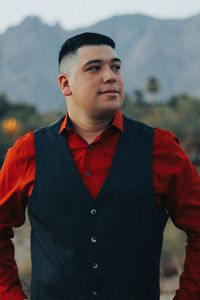
Marcos Urrea was born in Los Angeles, California. Urrea studied at Pima Community College and earned a bachelor's degree from the University of Arizona in 2015. His career experience includes working as a paralegal in the nonprofit sector.[1]
- Bachelor's:
- University of Arizona, 2015
In their own words
Who are you? Tell us about yourself.
Marcos J. Urrea received his BA in political science from the University of Arizona in 2015. Since then, he’s made his career in the field of human rights, working with some of the most prestigious humanitarian organizations around the country, including the International Rescue Committee, the Center for Victims of Torture, and Immigration Equality. Prior to this stage of his life, Marcos spent over a decade working in the food service and retail industries in Tucson, including as a server and bartender, as a jeweler, and within various fast food restaurants. He grew up on Tucson’s east side, graduating from Santa Rita High School in 2007.
Please list below 3 key messages of your campaign. What are the main points you want voters to remember about your goals for your time in office?
It is past time we had universal healthcare and a solution to crippling medical debt, and we need leaders who will work toward obtaining it.With the rising devastation we are seeing across the country, from wildfires to floods, droughts to hurricanes, we need a Green New Deal that addresses climate change and promotes economic growth.Our public education system has been under-resourced for years. We need to reinvest in our communities at all levels by funding K-12 schools and creating a universal school meal program, raising wages for educators and staff, and cancelling student loan debt.
What areas of public policy are you personally passionate about?
I am passionate about foreign policy and immigration policy, and the two are very much related. My interest stems from the shock of the September 11th attacks. I was twelve, and I remember one of my teachers saying to my class as we watched the news that “the world has changed today, and you will not understand how until later on, but know that the world has changed today.” At the time, I couldn’t fathom that anybody had any ill feelings toward the US, let alone would actively wish us harm. Wanting to understand why we were targeted led me to have an interest in conflict, why it happens, how it comes about, and how it can be resolved. I began to read about conflicts around the world and to get a clearer understanding of the geopolitical landscape. The Univ. of Arizona has some fantastic political science professors who specialize in conflict, and I was able to study with several of them. One of the things that became clear to me was that when conflict occurs, those with the least amount of wealth and power are among the worst affected by its impacts. It was this lesson that led me to do work with refugees and asylees in our community, with much of the focus being to empower people as they adjust to life in the US, helping navigate complex medical and legal systems. Through this, I have been constantly reminded of my own family’s immigrant experience. And so, these two areas of public policy which are very much intertwined have been a large focus of my life’s work.
What is your favorite book? Why?
I love reading, and try to do this often. It is hard to think that there are more books than one can read in a lifetime and that I will never be able to finish all of the books I wish to read. That said, the best book I have read is The Sun Does Shine by Anthony Ray Hinton (with Laura Love Hardin), though I hesitate to use the word favorite because the topic is heavy. I cannot recommend it enough, however. It is the memoir of a man who was wrongfully convicted of murder and spent thirty years on death row before having been exonerated. The book is emotional, and opens one's eyes to a perspective so many of us have chosen to ignore.
Do you believe that it's beneficial for representatives to have previous experience in government or politics?
Previous governmental or political experience can be beneficial for representatives, however, I would say such experience is not only limited to having held elected office in the past. For example, navigating for oneself or for others, complex government systems and agencies itself is beneficial to understanding where energies should be focused to create change. Having worked with people to help get them registered for Medicaid programs and understanding the barriers that cause many to give up on obtaining services they're entitled to, as I have done, gives me insight into the challenges that so many face. Having a mom who had to decide between registering for Medicare or Medicare Advantage, makes me keenly aware of how misleading a program can be. Having worked with individuals who spend years interacting with USCIS and understanding that certain immigration processes can take years, helps pinpoint weaknesses in our system. Similarly, having done some work on the advocacy side of things, that is also valuable political experience. But beyond that, we need representatives in the Capitol that are truly representative of our communities, and that means experiences in other sectors as well, because those community members are able to bring perspectives that would otherwise be missed.
What do you perceive to be the United States' greatest challenges as a nation over the next decade?
This country faces great challenges that include the ongoing pandemic and a health care system that doesn't work for most, a climate crisis that threatens our very viability in the desert and whose impacts we're already feeling, and an education system that is on the verge of collapse as we've starved our teachers and students of resources. Further, the consequences of inaction in addressing these very issues will be disproportionately faced by marginalized communities, communities of color, and immigrant communities like the ones I come from and have worked with. The challenges posed will also affect our younger generations in ways we cannot even imagine. For this reason, we need bold proposals and dramatic changes if we hope to see a brighter future.
What are your thoughts on term limits?
I am in favor of term limits. Our political system has been reserved for a privileged few and establishing term limits will require greater participation from members across the community, and ensure better governance.
googletag.cmd.push(function() { googletag.display("div-gpt-ad-1548351761485-0"); });
On the 2026 ballot
Links
Compiled from the candidate’s published profile as of September 30, 2026.
Source(opens in new tab)