
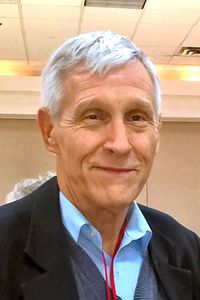
Background
Lee Havis was born in College Park, Maryland. He graduated from Northwestern High School in 1961. He earned a bachelor's degree in mechanical engineering from the University of Connecticut in 1965, a one-year degree in foreign trade from the American Institute of Foreign Trade, a master's degree in early childhood education from the University of Maryland in 1974, and a J.D. from Catholic University of America. Havis' career experience includes working as an assistant professor with the University of Panama and as the founder-director of International Montessori Society.[1][2]
As of 2020, Havis was an organizer for Citizens for a Better Prince George's County, Maryland Grassroots Republicans, and Free State Patriots. He was also a member of Northern Prince George's County Republican Club.[2]
- Law:
- Catholic University of America
- Graduate:
- University of Maryland
- Bachelor's:
- University of Connecticut
- High school:
- Northwestern High School
Campaign themes
Lee Havis has not yet completed [the profile publisher]'s 2026 Candidate Connection survey.
Send a message to Lee Havis asking him to fill out the survey.
If you are Lee Havis, click here to fill out [the profile publisher]'s 2026 Candidate Connection survey.
Who fills out the candidate survey?
Any candidate running for elected office, at any level, can complete [the profile publisher]'s Candidate Survey. Completing the survey will update the candidate's [the profile publisher] profile, letting voters know who they are and what they stand for. More than 32,000 candidates have taken [the profile publisher]'s candidate survey since we launched it in 2015. Learn more about the survey here.
You can ask Lee Havis to fill out this survey by using the button below or emailing lee@havisforsenate.com.
Lee Havis did not complete [the profile publisher]'s 2022 Candidate Connection survey.
Video for [the profile publisher]
Video submitted to BallotpediaReleased March 15, 2020
Who are you? Tell us about yourself.
Born and raised in Prince George's County, Maryland, in the city of College Park, I attended all PG County public schools, and graduated from Northwestern High School. My higher education was in the field of engineering, and later I received a law degree from Catholic University of America. My professional career is as educator, founder and director of the non-profit organization, International Montessori Society. I am also founder and director of a local Washington, DC area tutoring program, providing one-to-one in-home instruction for all subjects and ages.
During most of my adult life, I have been a citizen activist, working for better, more open, honest government at all levels. Most recently, I have served 5 years on the Republican central committee of Prince George's County, and in 2018, I was the Republican nominee for Maryland State Senate to represent a significant part of Principle George's County.
Please list below 3 key messages of your campaign. What are the main points you want voters to remember about your goals for your time in office?
I support service to individual citizens, that is rather than the special needs and interests of elected officials. For example, the US Congress must limit and reduce special benefits to elected officials, such as by opposing illegal immigration that promotes voter fraud favoring corrupt political interests, as well as illegal employment of cheap labor in violation of American labor laws. In addition, there should be term limits and lobby restrictions on retiring members of congress, to reduce the incentive for greed and corruption due to the undue advantage of long-term incumbency who serve as career politicians rather than patriotic public servants.I support government that favors freedom of the individual citizen over the concept of "socialism". Since the founding of our country, the federal government has grown massive in size and scope to take on many functions in a complex and diverse society. Now, however, the concept of "socialism" has emerged to take us down a road that that leads away from our original support for individual freedom a self-governing republic that maximizes success and opportunity for all. Government "Socialism" is essentially the forced distribution of goods and services by a centralized type of "rationing". While this sounds good in theory to some, its practice actually leads to poverty and slavery for all.I support responsible spending for a sound economy. The most important function of the US Congress is to pass a budget and approve spending appropriations for the operation of the federal government. In recent years, however, the cost of government operation has so exceeded the annual revenue from taxation that funding this has required a continuing increase of our national debt, which is now reaching $23 trillion. At this level, we are losing our ability to fund and repay this debt in an honest and sensible manner. We must therefore reduce spending to assure only essential functions of the federal government, and restore and maintain confidence in the US currency and a viable economy for the benefit of all American citizens.
What areas of public policy are you personally passionate about?
As an educator, I am deeply concerned about the quality of education of children. In recent years, the federal government has become destructively involved in this field, such as through "common core" control of curriculum at the K-12 level, and the restriction of competition and choice in the field of higher education by the selective recognition of private accreditation. In this system, the federal government has removed effective accountability for student loans, which has increased student loan debt to over 1 trillion dollars. Needed is more accountability to quality and value in education through greater choice and competition, and a substantial disengagement of the federal government in this field to allow innovation and choice to expand alternatives at the grassroots level of each individual and family.
Who do you look up to? Whose example would you like to follow, and why?
In politics today, I look up to those members of the US Congress who make up the "Freedom" coalition, especially such outstanding leaders as Louie Gohmert, member of Congress from the state of Texas. Gohmert has shown great courage to stand alone for better government, even against great pressure from others in that chamber. I especially admire his bold, courageous, actions to bring new leadership in the House to replace John Boehner, as speaker, when other members would not.
Is there a book, essay, film, or something else you would recommend to someone who wants to understand your political philosophy?
Mr Smith goes to Washington
What characteristics or principles are most important for an elected official?
A commitment to individual citizens, rather than gain for power and control in public office. Keep focus on the well-being of ALL, rather than just those who may benefit your own position of power.
What qualities do you possess that you believe would make you a successful officeholder?
Interest and commitment to laws of nature, which is the foundation of my education work, and also the basis of our nation as a self-governing republic. In this connection, making the individual the primary focus of all public decision-making, focuses on the spiritual truth of life, which is the only sound basis for progress to a better life and government for the well-being of all, since, despite our outward differences, the are all individuals with a unique inner guidance that connects us all to each other.
What do you believe are the core responsibilities for someone elected to this office?
The core responsibility is to do your duty under the US Constitution. Essentially, that is to represent the needs and interests of citizens in your district; to make laws and pass bills for the good of all.
What is the first historical event that happened in your lifetime that you remember? How old were you at the time?
As a three year old child, I remember catching a chipmunk by surprise while climbing a tree - and bringing it inside the house to show my mother.
What was your very first job? How long did you have it?
As a young teenager, I had a paper route, and delivered papers in the neighborhood for several years. After that, as a teenager and college student, I worked as a farm laborer during several summers while attending college.
What is your favorite book? Why?
The Sharp Sickle - William Walter -
It's a deep understanding of the truth of life. But more than that, it's a practical guide to healing dysfunction that is out of harmony with that truth and perfection. To see life as only spirit, and all good, is an enormous challenge, but also a way to resolve many problems, that otherwise seem impossible through any other means. It also harmonizes closely with laws of nature, which has been an intimate aspect of my experience, research, and work in the field of education.
What qualities does the U.S. House of Representatives possess that makes it unique as an institution?
In our federal system of separation of powers, the House of Representatives is the main branch most responsive to the will of the people. Members are elected every two years, which theoretically gives the people ready access to power and control over policies and actions of the federal government, especially in the budget and financial issues. Sadly, career politics and entrenched incumbency has destroyed this vital function of the House. As a practical matter, therefore, to restore this proper function of the House, we must have a 'term limit" amendment to the US Constitution, much as we have for the term for the office of President.
Do you believe that it's beneficial for representatives to have previous experience in government or politics?
Past experience in politics and government can be beneficial, but not essential. For example, there are many ways to learn about how to improve government, as a private citizen through volunteer activity in other community service for the common good.
What do you perceive to be the United States' greatest challenges as a nation over the next decade?
The greatest challenge of our time is the danger of continuing reckless, irresponsible spending, which is bringing our country to brink of economic disaster. It is a serious threat to our whole national security, because until and unless we restore this type of financial integrity, the risk not only the blessing of prosperity and the opportunity for a brighter future for the next generations, but also our whole national security, as we become subject to the control of other forces and influences in the world that would take advantage of our weakened and dependent condition.
Do you believe that two years is the right term length for representatives?
It is the right term to separate elections, but there should be a limit to "how many" successive terms a member may have. For this reason, I support a 'term limit" amendment to the US Constitution.
What are your thoughts on term limits?
I favor term limits.
If you are not currently a member of your party’s leadership in the U.S. House of Representatives, would you be interested in joining the leadership? If so, in what role?
As a member of Congress, I would most favor joining a caucus of like-minded members, such as the House "Freedom" caucus.
Is there a particular representative, past or present, whom you want to model yourself after?
Louie Gohmert is an excellent role model to follow, in my judgment. Former US Senator from South Carolina, Jim Demint, is another excellent leader and role model to follow.
Both sitting representatives and candidates for office hear many personal stories from the residents of their district. Is there a story that you’ve heard that you found particularly touching, memorable, or impactful?
I met one lady who was greatly upset by the recent sudden death of a homeless man she had living in her home. He had just been run over by a train. The tragedy of a man alone, and largely abandoned by his family and friends, and the compassion of a women who let him stay in her house - the alienation of people from each other. The conversation I had with the lady was very practical, but also emotional - how to dispose of the man's body, and how to bring closure to such a tragic life. The conversation took place, as strangers, sitting together, both visiting the same church. This in America!
.survey-result {padding:10px;}
p.survey-question {font-weight:bold;}
p.survey-response {margin-left:10px;}
p.survey-response {white-space: pre-line;}
div.survey-scrollbox { height:400px; overflow:scroll; margin:20px; padding:10px; border:1px solid gray; }
What would be your top three priorities, if elected?
Lower Taxes, Free market solutions, improve public education
What areas of public policy are you personally passionate about?
Education. As a private educator for many years in Maryland, I see the danger and harm of public education that is disconnected from its real purpose to improve learning and development students. The problem is lack of accountability and transparency that would afford parents and citizens quality improvements through choice and competition. Non-government, innovative alternatives are crushed out by a repressive form of censorship and monopoly that is far removed from any meaningful accountability or participation in the free marketplace of ideas.
Who do you look up to? Whose example would you like to follow, and why?
I look up to those persons who have challenged power with the courage of truth. Besides the central figure of Jesus Christ, there are other more recent figures, such as Gandhi in India, and our own George Washington, father of the United States of America. In education, pioneers such as Dr. Maria Montessori, have made historic breakthroughs for a "new education" in their time and place.
Is there a book, essay, film, or something else you would recommend to someone who wants to understand your political philosophy?
In my field of Montessori teaching, I have published a Danbury audio cd and study guide, which lays out innovative technology for following laws of nature with children - a major breakthrough for a better humanity in the world. My political philosophy follows closely the philosophy of commitment to laws of nature, which are the foundation of our country, and a sound basis for true peace and harmony in any political scope of activity.
What characteristics or principles are most important for an elected official?
Commitment to truth and integrity is the basis of ethical action and sound judgment that will bring the best results for all citizens in the end.
What qualities do you possess that you believe would make you a successful officeholder?
I possess a commitment to truth and ethical action that is the basis of character for sound action in any political situation.
What do you believe are the core responsibilities for someone elected to this office?
First responsibility is a commitment to principles of truth and ethical, honest dealings that holds what is good for ALL as the main premise for all action as a public official.
What legacy would you like to leave?
I would like to leave a legacy of sound, practical ideas that will move government to follow laws of nature in service to the best interests and well-being of all for peace, prosperity, and freedom.
What is the first historical event that happened in your lifetime that you remember? How old were you at the time?
At age three, being surprised when I caught a chipmunk in my hand. What I learned is that sometime trying to do something that seems "impossible", reaching out, you can actually surprise yourself with success to actually achieve it in reality.
What was your very first job? How long did you have it?
I had a paper route - delivering papers in the neighborhood.
What do you perceive to be your state’s greatest challenges over the next decade?
The greatest challenge in Maryland is for government is reduce its size and burdensome tax and control system over ordinary citizens - defeat the corruption of machine-style special interest politics that has driven out and discouraged so many citizens in our state.
What do you believe is the ideal relationship between the governor and the state legislature?
The idea relationship between governor and legislature is one of close working communication and search for solutions that respect the overriding purpose of what is best for all citizens in the state.
Do you believe it’s beneficial to build relationships with other legislators? Please explain your answer.
It is important to build relationships of trust and respect among other legislatures - to find commonground wherever possible to move forward ideas into reality that are good for all.
What process do you favor for redistricting?
A non-partisan commission for re-districting is ideal, even if not entirely practical. In reality, any such commission must include some participation from the legislature as well as appointments by the governor. Ultimately, the governor and legislature must resolve political differences; but a nonpartisan commission is a good place to begin to hopefully follow the logical guidance that is already built into the mandate for district boundaries.
On the 2026 ballot
Links
Compiled from the candidate’s published profile as of September 30, 2026.
Source(opens in new tab)